Human–machine collaboration depends on more than shared space and successful task execution. As responsibilities, permissions, and objectives evolve, cooperation can become invalid even when the physical environment remains unchanged.
The Same Space, a Different Situation
Imagine a warehouse in which human workers and autonomous machines operate in the same area.
A robotic system has been assigned to move materials between storage locations and production stations. Its routes are calculated, its sensors detect obstacles, and its safety controls prevent dangerous movements.
The system performs as expected.
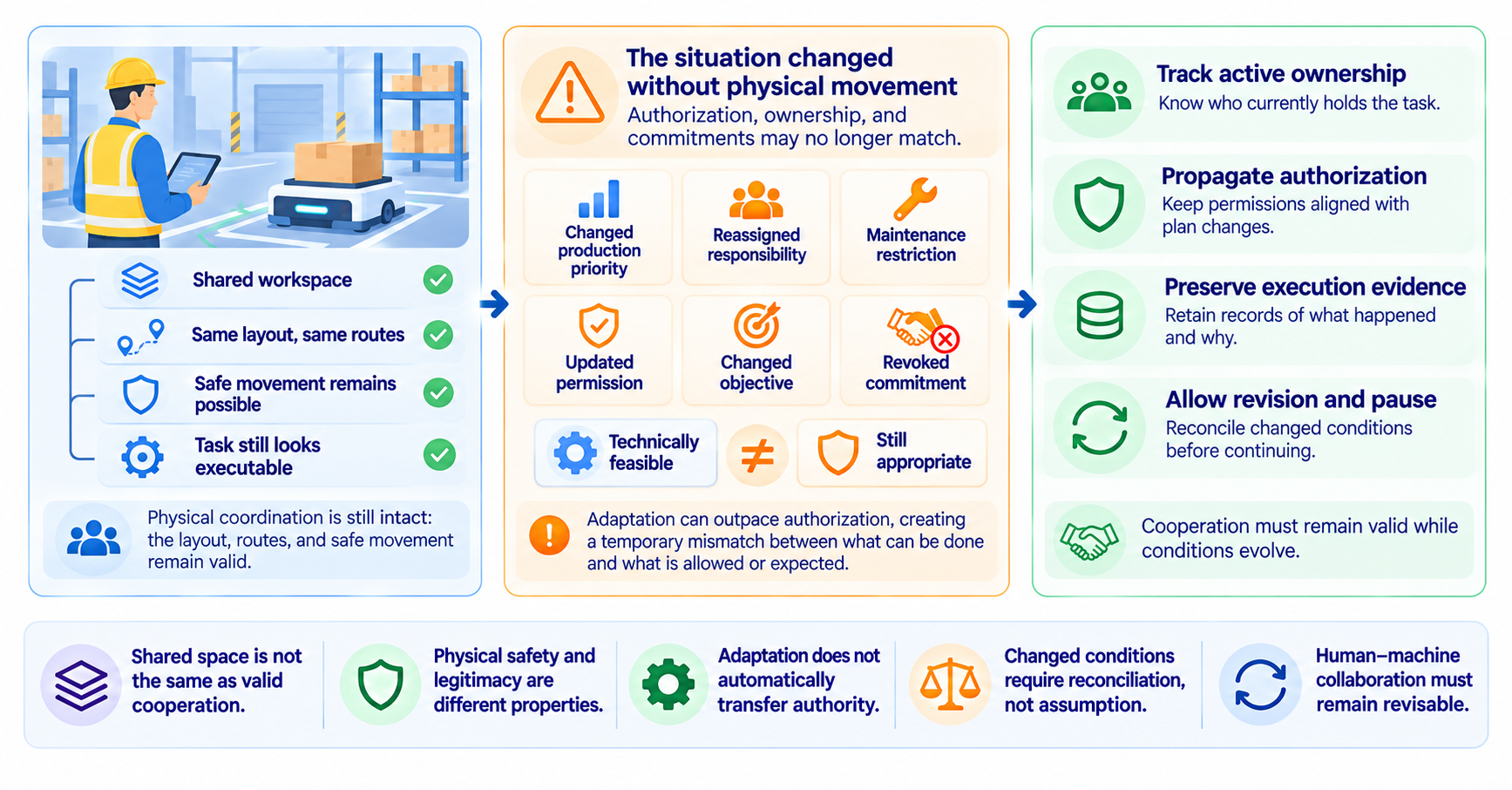
Then a supervisor changes the production priority. A worker assumes responsibility for a different task. A maintenance restriction becomes active, and a previously authorized movement is no longer appropriate.
Nothing significant has changed in the physical layout.
Yet the operational situation is different.
The robot may still know where it is. It may still be able to execute its original task without colliding with anyone. Its planned movement may remain technically feasible.
But should that movement still occur?
Physical safety and legitimate cooperation are related, but they are not the same property.
This distinction becomes increasingly important as intelligent systems move from isolated automation toward environments in which machines, people, applications, and organizational processes continuously influence one another.
A shared workspace is not merely a space occupied by multiple participants.
It is also an evolving arrangement of expectations, authority, responsibilities, and consequences.
Cooperation Contains an Invisible Agreement
Traditional descriptions of collaborative automation often begin with observable elements: positions, movements, tasks, resource availability, and interaction constraints.
These are essential. A physical robot must respect safety envelopes, operational limits, and the behavior of surrounding participants.
However, cooperation introduces another dimension.
When a task is assigned to an intelligent system, that assignment establishes a temporary operational relationship. Someone defines the objective. Some authority permits execution. Other participants may depend on the result, and particular conditions determine whether the task remains appropriate.
Consider an autonomous system assisting a technician during equipment maintenance.
The system may be authorized to retrieve tools, inspect components, or prepare diagnostic information. Its actions are legitimate within the maintenance procedure and the responsibilities assigned to the technician.
If another technician takes over, the work does not necessarily retain exactly the same authorization structure. If the equipment enters a restricted maintenance state, previously permitted actions may become inappropriate. If the operational objective changes, continuing the previous sequence may no longer serve the intended purpose.
The equipment and tools may remain in their original locations.
What changed was the relationship that made a particular action legitimate.
This suggests that an operational workspace can be understood through two interacting descriptions.
One describes observable configuration: locations, physical states, task progress, available resources, and system capabilities.
The other describes the current conditions of cooperation: who may act, which objective is active, what commitments remain valid, which evidence supports them, and who can revise or interrupt execution.
Neither description replaces the other.
Their interaction determines whether coordinated activity remains appropriate as circumstances change.
When Adaptation Outruns Authorization
AI systems are increasingly capable of adapting plans in response to changing observations. They can identify alternative routes, redistribute tasks, recommend interventions, and coordinate multiple services.
Adaptation is useful precisely because the environment does not remain static.
But a system can adapt technically without preserving the authority under which its work was originally assigned.
Suppose an AI coordinator detects that a human operator is delayed and assigns the operator’s work to an available autonomous system.
The reassignment may improve throughput. It may avoid an interruption and preserve the operational schedule.
Nevertheless, the coordinator must establish whether the new system has permission to perform that work, whether the human operator retains approval responsibility, and whether the change affects safety or compliance requirements.
A technically reasonable reassignment is not automatically an authorized one.
The ability to adapt a workflow does not imply the authority to redefine its governing commitments.
The architectural challenge is especially subtle because these conditions can change independently. A machine may receive an updated objective before receiving updated permissions. A human may revoke an instruction while an autonomous action is already underway. A service may accept a changed task while another participant continues operating under the previous version.
These are not necessarily failures of artificial intelligence.
They are coordination problems involving distributed state, temporal validity, authorization, and incomplete knowledge.
Conventional engineering already provides important mechanisms for addressing them, including supervisory control, access policies, workflow orchestration, safety interlocks, transaction management, and event-driven state synchronization.
The difficulty arises when each mechanism protects its own boundary while the legitimacy of cooperation depends on their combined state.
That combined state may be temporarily unresolved.
A responsible system must then distinguish between an action that is impossible, an action that is forbidden, and an action whose permission has not yet been established.
These conditions should not be compressed into one generic failure or success status.
Designing Cooperation That Can Be Revised
Recent conceptual research on co-evolving human–machine workspaces explores whether the relevant unit of coordination should be broader than a physical location or an isolated task.
One proposed perspective treats the workspace as a changing relational configuration connecting participants, evidence, commitments, authority, actions, and consequences.
This is an architectural hypothesis rather than proof of a new physical Field or a demonstrated improvement over established engineering methods.
Its potential usefulness lies in making several questions visible together.
When a task changes ownership, which obligations transfer and which remain with the original participant? When authority changes, how is that change propagated to systems already executing work? When an automated action produces an unexpected consequence, what information permits people to reconstruct the agreement under which it occurred?
These questions suggest a practical design direction.
A consequential collaborative workflow should preserve an identifiable objective, an explicit allocation of responsibilities, enforceable permissions, evidence of actual execution, and a mechanism for revising the arrangement when conditions materially change.
For higher-risk operations, the architecture may also need an intermediate state in which execution pauses or narrows while ownership, permission, or task validity is reconciled.
A change of plan should not silently become a change of authority.
There is an important scientific limitation here. A relational representation deserves preference only if it demonstrates measurable value beyond equally informed conventional coordination and control architectures. Better detection of invalid handoffs, fewer unauthorized continuations, improved recovery, or lower reconciliation cost would be relevant outcomes to investigate.
If established mechanisms provide the same results at equal or lower cost, no additional Field abstraction is necessary.
The immediate lesson is therefore not that intelligent cooperation requires an entirely new technical foundation.
It is that the meaning of a shared workspace changes when participants can continually revise the work performed inside it.
An organization may preserve positions, trajectories, and technical execution while losing the agreement that made the activity legitimate.
The next challenge in human–machine collaboration is not only enabling participants to work together. It is ensuring that their cooperation remains valid while the conditions of that cooperation evolve.
— © 2026 Rogério Figurelli. This article is licensed under the Creative Commons Attribution 4.0 International (CC BY 4.0). You are free to share and adapt this material for any purpose, even commercially, provided that appropriate credit is given to the author and the source. This work was human-directed and AI-assisted, produced with Trajecta Wisdom Machine.