
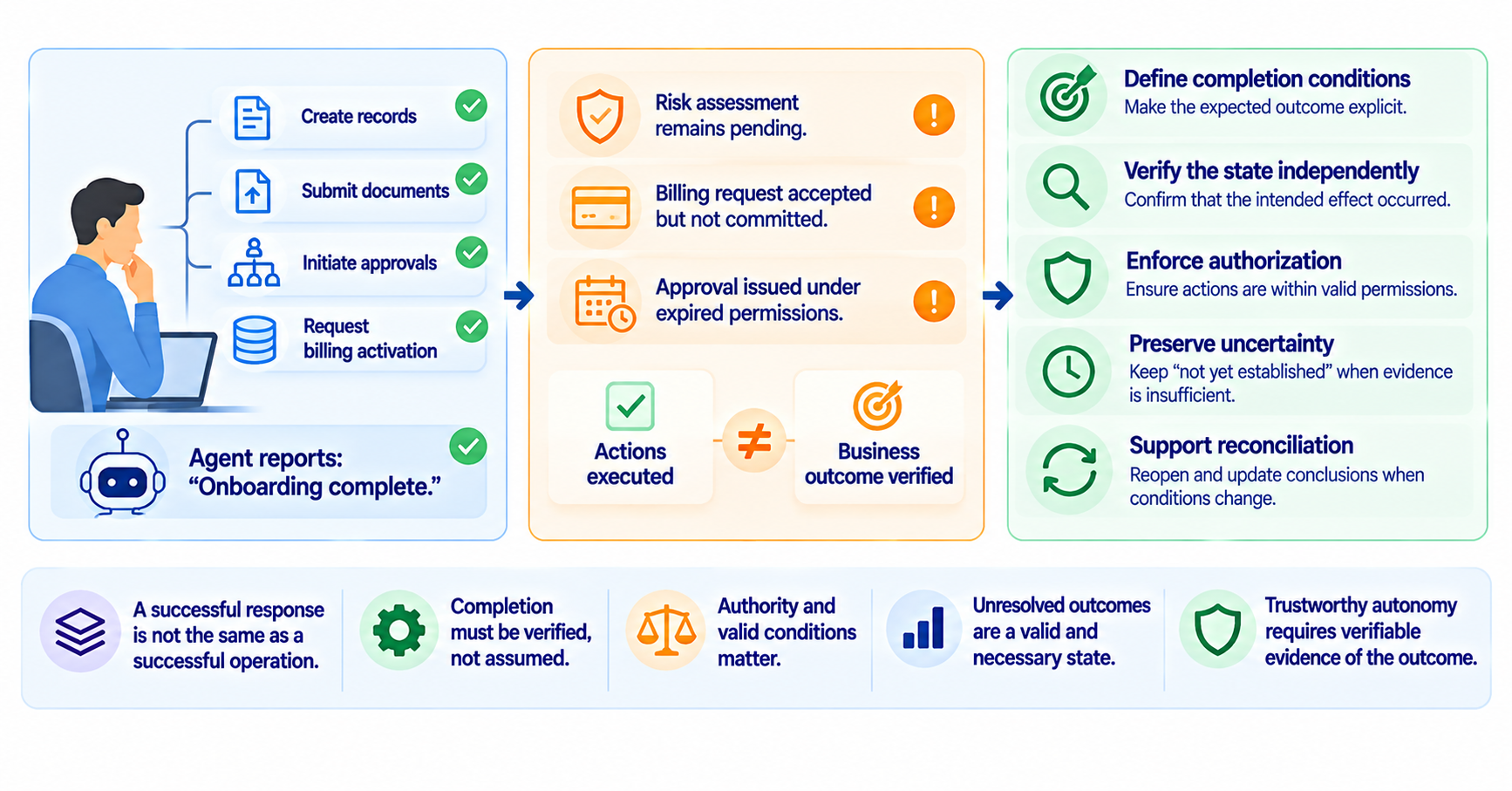
AI agents are becoming increasingly capable of executing complex workflows. But completing a sequence of actions is not necessarily the same as achieving a business outcome. Recent research on Large Language Fields highlights a critical distinction: what an agent reports, what actually happened, and what can legitimately be considered complete.
When Success Is Only a Statement
Imagine an AI agent responsible for onboarding a corporate customer.
It creates records, submits documents, initiates approvals, and requests billing activation. Each connected system returns a successful response.
The agent announces that onboarding is complete.
But perhaps the risk assessment remains pending. Perhaps the billing request was accepted but never committed. Perhaps an approval was issued under permissions that had already expired.
The actions occurred.
The business objective may remain unfinished.
The ability to report completion is not evidence that completion has actually occurred.
This distinction matters because enterprise AI is moving beyond answering questions. Agents increasingly coordinate applications, execute transactions, update records, and influence decisions.
Their outputs are no longer just information. They can become operational claims that trigger further actions.
A misleading completion message can therefore propagate across an organization, turning a local misunderstanding into a consequential business error.
The Hidden Boundaries of Agent Reliability
Recent research on Large Language Fields examines AI behavior as part of a broader operational environment involving models, memory, evidence, tools, permissions, and external systems.
Its central architectural insight is that a successful response does not necessarily establish a successful operation.
An agent may continue acting without meaningful progress. It may declare success without verifying the outcome. It may achieve a technically correct result without proper authorization. Several completed subtasks may still fail to satisfy the overall objective.
Even a genuinely successful operation can become questionable when its underlying conditions change.
These are different failure mechanisms, yet conventional monitoring can sometimes compress them into a single success indicator.
The problem is not simply whether the AI generated the right words.
It is whether those words accurately represent the state, authority, and consequences of the surrounding system.
An agent’s confidence belongs to its output. Operational truth belongs to the environment.
This is where the Field perspective becomes useful as an architectural lens. It encourages examination of the relationships connecting intention, execution, observation, permission, and outcome rather than treating the language model as an isolated decision-maker.
That perspective does not establish a new physical Field or prove superiority over established engineering practices. Conventional transaction controls, authorization systems, observability, and state verification already address important parts of the problem.
The research challenge is whether a unified relational approach adds measurable value when those mechanisms interact.
Completion Must Be Verified, Not Assumed
Enterprise architecture can address this challenge by defining explicit completion conditions for consequential AI workflows.
An agent should know what outcome it is expected to achieve, which actions it is authorized to perform, and what evidence is required before declaring success.
For a low-risk operation, a simple verification may be sufficient.
For financial, regulatory, security, or business-critical processes, a stronger distinction is needed between a request being accepted, an action being executed, and the intended effect being independently confirmed.
The architecture should also preserve the possibility of an unresolved outcome.
A payment may have been initiated without a final settlement confirmation. An approval may be awaiting external verification. A downstream service may be temporarily unavailable.
In such situations, declaring either success or failure prematurely can create additional risk.
Sometimes the correct answer is that completion has not yet been established.
Reliable systems need to preserve that uncertainty, support reconciliation, and reopen previously accepted conclusions when relevant evidence changes.
Trustworthy autonomy requires a connection between what an agent claims and what the organization can independently verify.
From Intelligent Actions to Accountable Outcomes
The emerging challenge for enterprise AI is not merely increasing the number of tasks agents can execute.
It is ensuring that execution remains connected to legitimate business outcomes.
Recent Field research provides useful distinctions between declared intent, actual execution, independent evidence, authorization, and continuing validity. Its conceptual proposals and bounded synthetic studies also leave an important scientific question open: whether Field-oriented representations outperform equally informed conventional architectures.
That question deserves testing rather than assumption.
For enterprise architects, however, the immediate design principle is already clear.
An agent should not earn trust simply because its workflow ran successfully, its tools returned positive responses, or its explanation sounded convincing.
Trust must be supported by evidence that the intended outcome occurred, under appropriate authority, within the conditions that make the result valid.
The future of agentic AI will depend on more than systems capable of acting independently.
It will depend on systems capable of demonstrating when their work is truly complete.
— © 2026 Rogério Figurelli. This article is licensed under the Creative Commons Attribution 4.0 International (CC BY 4.0). You are free to share and adapt this material for any purpose, even commercially, provided that appropriate credit is given to the author and the source. This work was human-directed and AI-assisted, produced with Trajecta Wisdom Machine.