
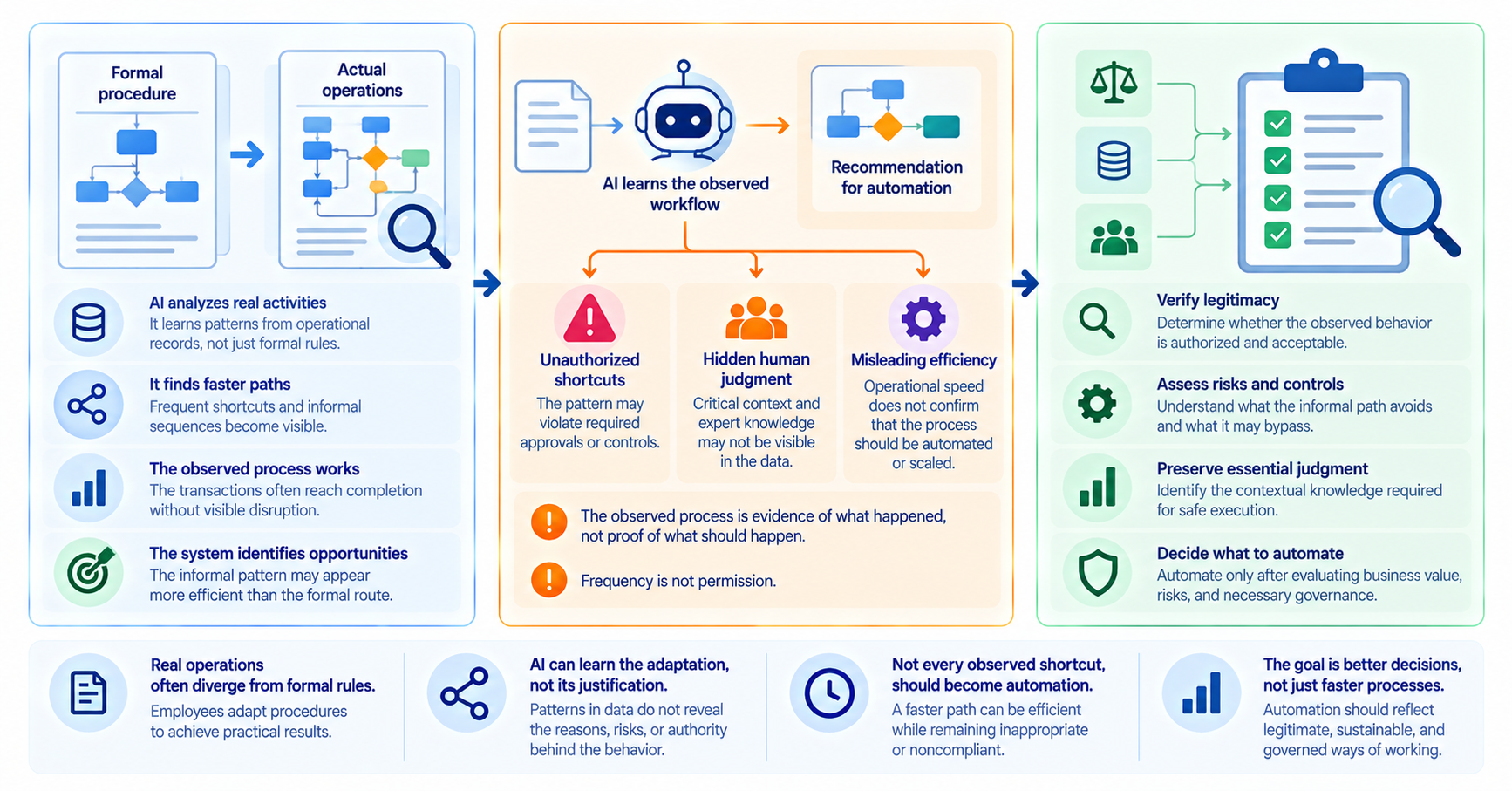
AI can reconstruct how an organization actually operates, revealing workflows that differ from formal procedures. But accurately learning existing behavior does not establish that the behavior should be automated, preserved, or scaled.
The Shortcut That Looks Like a Successful Process
Consider an enterprise procurement operation where employees regularly need urgent purchases approved faster than the official workflow allows.
The formal process includes several approval stages, defined responsibilities, and controls intended to protect financial accountability. Under ordinary conditions, the arrangement works reasonably well. Under urgent conditions, however, the approval sequence takes longer than the business can tolerate.
Employees gradually develop an informal solution.
A manager provides approval through email. Procurement begins coordinating with the supplier before every formal step has been completed. The transaction is subsequently entered into the enterprise system, where the records appear to follow an acceptable sequence.
Over time, this behavior becomes familiar. Experienced employees know when to use it, whom to contact, and how to resolve the administrative inconsistencies afterward.
Now imagine introducing AI to analyze operational records and identify opportunities for process automation.
The system discovers that certain purchases move quickly through a recognizable sequence of activities. These transactions often reach completion without visible disruption. Compared with the formal route, the informal pattern may appear more efficient.
An optimization initiative could interpret that pattern as an opportunity to simplify procurement.
Yet the evidence supports a narrower conclusion: people found a way to complete work despite friction in the official process. It does not establish whether the workaround was authorized, whether its risks were accepted, or whether the apparent success depended on informal human judgment absent from the recorded data.
The observed process is evidence of what happened, not proof of what should happen.
This distinction becomes critical when process discovery is connected to generative AI, intelligent automation, or autonomous agents. What begins as descriptive analysis can become an executable recommendation, and eventually a permanent operating rule.
The organization may then automate an adaptation it never consciously approved.
Operational Frequency Is Not Institutional Authorization
Organizations rarely operate exactly as their procedure documents describe.
Employees adjust sequences, resolve exceptions informally, compensate for missing information, and coordinate across organizational boundaries. Some deviations reflect avoidable inefficiency. Others represent legitimate adaptations to circumstances that formal processes did not anticipate.
Still others may violate important controls.
These variations cannot be treated as equivalent simply because they appear in the same operational records.
A process-mining system can reveal that a particular activity sequence occurs frequently. An AI system may identify correlations between that sequence and a favorable operational outcome. Neither observation independently determines whether the sequence is appropriate.
Frequency is not permission.
A shortcut used hundreds of times may reflect a legitimate need that the formal process has failed to accommodate. It may also reflect insufficient supervision, ambiguous ownership, or incentives that reward speed while concealing exposure elsewhere.
The same evidence can therefore support different organizational interpretations.
Suppose employees bypass an approval stage because the responsible manager is routinely unavailable. Eliminating that stage may improve performance, but only if the organization first determines what the approval was intended to protect.
Perhaps the control is redundant. Perhaps authority could be delegated under defined conditions. Or perhaps the approval prevents consequential decisions that should not be made without independent review.
Automation cannot resolve those questions through transaction frequency alone.
This is not an argument against learning from real operational behavior. Formal procedures can be incomplete, outdated, or disconnected from practical requirements. Employee adaptations can reveal weaknesses that conventional governance overlooks.
The more useful distinction is between describing operational behavior and establishing its legitimacy.
An exception can reveal a broken process or a broken control. Its presence in the data does not tell us which.
Both possibilities deserve investigation before the behavior becomes software.
When Automation Removes the Judgment That Made the Shortcut Work
Informal procedures often depend on information that enterprise systems do not preserve.
An experienced procurement manager may recognize that a request is genuinely urgent, understand the supplier’s reliability, know the financial exposure, and determine whether an exceptional approval is justified.
The recorded transaction may show only that an order was processed through an abbreviated sequence.
If an automation system reproduces that sequence, it may preserve the visible actions while removing the judgment that originally made the exception tolerable.
This is a subtle form of knowledge loss.
The organization appears to have transferred a successful practice from people into technology. In reality, it may have transferred only the observable portion of that practice.
The missing elements might include contextual judgment, informal verification, responsibility for exceptions, or an understanding of consequences outside the workflow being optimized.
A similar problem can occur in customer operations, software delivery, incident response, and financial processing. An employee resolves a case through an unusual sequence because the standard procedure cannot accommodate the circumstances. A system records the successful outcome without capturing why the deviation was necessary.
An AI workflow designer may interpret the observed sequence as an effective alternative.
But when that alternative becomes automated, the surrounding conditions may disappear. The human who recognized the exception is no longer evaluating it. The informal communication that supplied missing context no longer takes place. A judgment previously exercised occasionally becomes a repeatable rule.
The shortcut scales.
So does whatever uncertainty was previously managed by people.
There is also an incentive problem. If employees are measured on speed or transaction completion, the data available to AI may systematically favor the workarounds that satisfy those measures. Longer-term consequences, delayed corrections, and unrecorded coordination effort may remain invisible.
An accurate model of the recorded process can therefore be an incomplete model of the work required to make that process reliable.
The easiest workflow to automate may be the one least examined.
The implication is not that organizations should reject operational evidence. Rather, they should recognize the boundary between what event records demonstrate and what business authority, human expertise, and consequential responsibility require.
Discover the Process Before Deciding What Deserves Preservation
A disciplined approach to AI-enabled process improvement begins with two separate questions.
The first is descriptive: How does work actually move through the organization?
The second is normative and architectural: Which parts of that behavior should become the future operating model?
Existing disciplines such as process mining, conformance checking, internal control design, and business process management already provide important methods for examining this distinction. AI can extend their analytical reach, but it does not eliminate the need to evaluate the reasons behind deviations.
When a recurring workaround is discovered, the organization can investigate its origin, frequency, business purpose, authorization conditions, and consequences.
It should also examine what the available records omit.
Was the deviation a response to unnecessary bureaucracy? Was it a formally permitted exception? Did it rely on expertise that automation would not reproduce? Did the apparent efficiency come from shifting work to another team or deferring a risk that emerged later?
Different answers call for different interventions.
One workflow may deserve simplification. Another may require an explicit exception path with documented authority. A third may need stronger controls because the existing shortcut exposes the business to unacceptable consequences.
In some cases, the most valuable finding is that the formal process should change.
In others, the organization must preserve the judgment conditions that made a deviation acceptable, rather than merely reproducing the sequence of activities.
This suggests treating AI-generated process recommendations as design candidates, not automatic specifications for implementation.
A candidate should be evaluated against business outcomes, operational constraints, legitimate authority, and the information necessary to distinguish routine cases from exceptions. Once deployed, monitoring should examine not only whether execution became faster, but whether the new process preserved the relevant controls and avoided transferring hidden work or risk elsewhere.
The distinction also matters for organizational learning.
A workaround is valuable evidence. It can reveal a mismatch between procedure and reality, a missing capability, an ineffective control, or an opportunity for redesign. Automating it without investigation may eliminate that learning opportunity by turning an unresolved organizational question into fixed system behavior.
As enterprises use AI to discover patterns and generate workflows more rapidly, the passage from observed practice to automated policy may become increasingly short.
That makes the quality of the boundary between discovery and authorization more important, not less.
A process should not be preserved merely because it is common. Nor should it be rejected merely because it differs from the documented standard.
The better question is what the behavior reveals about the work, the organization, and the responsibilities that must survive automation.
AI can help enterprises understand how they operate.
The real architectural opportunity begins when that understanding is used to decide what should change, rather than simply making existing behavior run faster.
— © 2026 Rogério Figurelli. This article is licensed under the Creative Commons Attribution 4.0 International (CC BY 4.0). You are free to share and adapt this material for any purpose, even commercially, provided that appropriate credit is given to the author and the source. This work was human-directed and AI-assisted, produced with Trajecta Wisdom Machine.