Innovation often promises a better future while requiring customers to endure a more difficult present. For companies developing AI-enabled products and services, competitive advantage may depend not only on the value of the innovation itself, but also on how effectively they help customers cross the distance between their existing operations and the new possibilities.
When a Better Solution Creates a Worse Working Day
Consider a hypothetical manufacturer introducing an AI-powered predictive maintenance service for industrial equipment.
The service analyzes operating conditions, identifies patterns associated with potential failures, and recommends maintenance activities based on equipment behavior rather than fixed schedules.
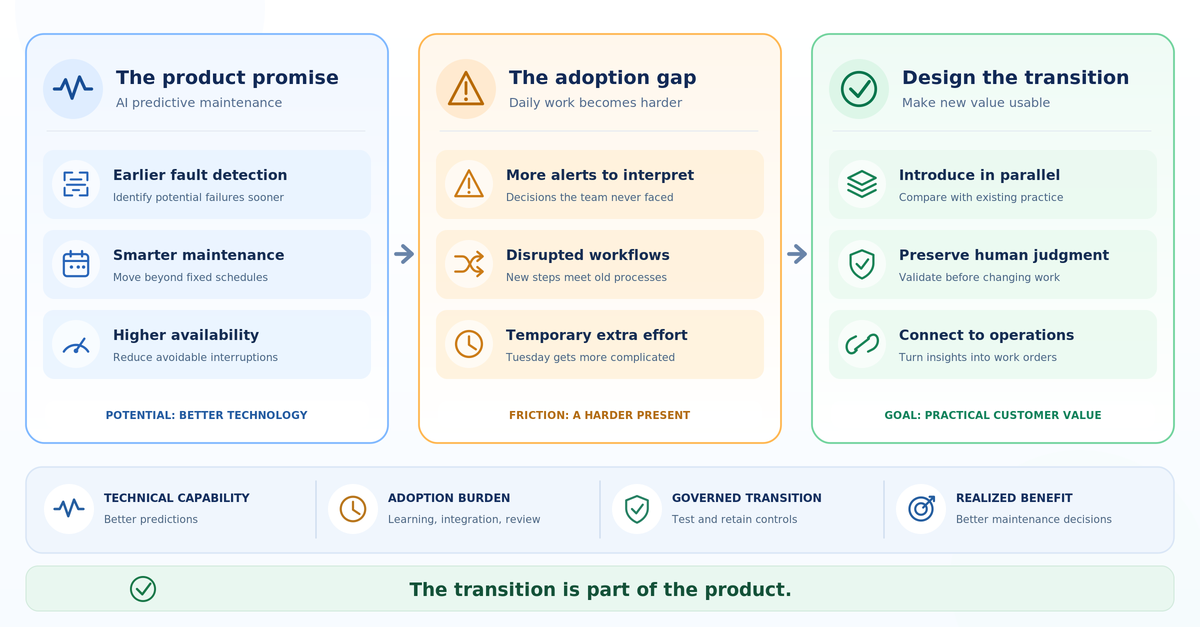
The proposition is attractive. Customers may be able to reduce unnecessary inspections, identify emerging problems earlier, and improve equipment availability.
The manufacturer demonstrates the technology to a large industrial customer. The engineering team recognizes its potential, and management approves a limited deployment.
Then the service reaches the maintenance department.
Technicians who previously followed established inspection schedules must now review algorithmic recommendations. Supervisors need to decide how those recommendations should affect work orders. The maintenance planning team must reconcile the new system with an existing enterprise application.
When the AI flags a potential problem, someone must determine whether the warning deserves immediate intervention, additional inspection, or continued observation.
The new solution provides information that was previously unavailable.
It also creates decisions that the customer’s existing operating model was not designed to make.
On an ordinary Tuesday, the maintenance supervisor may spend more time interpreting the new recommendations than the previous scheduling method required.
The innovation has increased analytical capability while temporarily making daily work more complicated.
The product may be better while the customer’s experience of adopting it is worse.
That distinction matters because customers do not experience innovation through product capability alone. They experience it through the work required to incorporate that capability into their lives or organizations.
The Value Proposition Has a Missing Period
Innovation proposals often compare a customer’s current condition with a desirable future condition.
The existing process is expensive or inefficient. The new solution promises improved performance, lower costs, greater reliability, or better decisions.
This comparison can be useful, but it may leave out the period between those conditions.
During that period, customers must learn unfamiliar procedures, modify responsibilities, update systems, absorb temporary productivity losses, and establish confidence in results they have not yet experienced.
For the industrial customer, predictive maintenance may eventually allow technicians to spend less time on routine inspections and more time addressing meaningful equipment risks.
But reaching that outcome requires changes beyond installing sensors and activating an AI platform.
Maintenance plans may need revision. Employees must understand how recommendations relate to existing engineering practices. Supervisors need procedures for resolving disagreements between automated indications and professional judgment.
Historical records may also contain inconsistencies that limit the initial quality of the recommendations.
The investment therefore has an adoption period in which the customer carries additional work before receiving the full expected benefit.
The business case describes the destination, but the customer must operate through the journey.
This creates an important asymmetry.
The technology provider can demonstrate the future value of the solution under controlled conditions. The customer must bear the operational consequences of introducing it into an environment where other responsibilities continue.
A maintenance team cannot stop maintaining equipment while learning a new maintenance system.
A hospital cannot suspend patient services while changing its information infrastructure. A retailer cannot pause fulfillment while introducing a different inventory process.
Innovation enters an operating business that must remain functional during the transition.
Ignoring that requirement can make an otherwise attractive solution difficult to adopt.
Design the First Month, Not Only the Final Capability
The manufacturer can improve its offering by treating adoption as part of product design rather than as a separate implementation activity.
Instead of immediately replacing the customer’s existing maintenance process, the AI service could initially operate alongside it.
The system would generate recommendations while technicians continue following approved procedures. Maintenance teams could compare those recommendations with actual equipment conditions, investigate disagreements, and identify where the system provides useful additional information.
This parallel period has a cost.
Employees must examine more information, and the organization temporarily maintains two approaches to the same activity.
But the investment may help establish whether the new system is sufficiently reliable, understandable, and useful to justify changing operational responsibilities.
The purpose is not to preserve parallel operations indefinitely.
It is to create a controlled passage from the existing process to the proposed one.
The manufacturer could also provide practical support around the decisions introduced by its technology.
For example, the service might distinguish between observations requiring immediate human assessment and indications suitable for routine monitoring. It could explain which operating conditions informed a recommendation and make uncertainty visible when the available data is insufficient.
A technician encountering an unexpected alert should not have to choose between blindly trusting the system and ignoring it completely.
The design should support investigation.
As confidence develops, the customer may decide that selected maintenance activities can be adjusted, while others continue requiring established inspections or engineering approval.
The adoption path becomes a sequence of decisions supported by evidence.
This approach changes what the manufacturer sells.
It is no longer offering only a predictive model and a dashboard. It is helping the customer establish a new operational capability without unnecessarily disrupting an existing one.
The transition is part of the product, even when it does not appear on the product roadmap.
Compete on the Cost of Becoming Better
Two providers can offer similar technological performance while imposing very different adoption burdens on their customers.
One may require extensive integration work, specialized training, and immediate changes to existing procedures.
Another may provide narrower initial capabilities but integrate with familiar workflows, preserve existing approval processes, and support a gradual transition.
The first solution might ultimately offer greater technical potential.
The second may produce useful business results sooner because the customer can incorporate it with less disruption.
This does not mean organizations should always choose the easiest solution to adopt.
A major architectural change can be justified when the long-term benefits are sufficiently important. Some innovations cannot deliver their intended value without substantial changes to processes, skills, or infrastructure.
The strategic question is whether the transition costs are visible, justified, and manageable.
For the equipment manufacturer, this means evaluating not only how accurately the AI service detects potential maintenance problems, but also how much work customers must perform to make those recommendations operationally useful.
Relevant observations could include the time technicians spend reviewing alerts, the number of recommendations requiring clarification, the effort needed to maintain data quality, and whether maintenance decisions become more effective over time.
The manufacturer should also examine the burden of incorrect or poorly timed recommendations.
An unnecessary alert may create additional inspection work. A missed problem can have more serious consequences. These outcomes should be evaluated according to their actual operational significance rather than compressed into a single product-performance claim.
Better AI does not automatically mean better maintenance.
The value emerges when the technology’s recommendations can be incorporated into legitimate, reliable decisions.
This is where commercial strategy and product design intersect.
A provider that helps customers reduce transition effort may be creating value that is not immediately visible in comparisons of technical features.
That advantage can be especially important in enterprise markets, where purchasing decisions involve not only the person attracted to a new capability, but also the employees and departments responsible for living with it.
Make Adoption a Source of Innovation
There is another consequence of taking the transition seriously.
The difficulties customers experience during adoption can reveal opportunities that the original product team did not anticipate.
Suppose the manufacturer observes that maintenance teams rarely dispute the AI’s technical diagnosis but frequently struggle to translate its recommendations into executable work orders.
The obvious response might be additional training.
But the recurring difficulty could reveal a product limitation: the system identifies a condition without providing the operational context needed for the next decision.
The manufacturer might then develop an integration that connects the recommendation with equipment service requirements, available maintenance windows, and the customer’s established authorization procedures.
That improvement may create more customer value than another incremental increase in predictive accuracy.
The provider has learned something important about the actual problem being solved.
The customer did not simply need better predictions.
The customer needed better maintenance decisions that could be carried through an existing organization.
This distinction provides a richer source of innovation than feature development alone.
Product teams can investigate what customers must change, what information they need during the transition, which responsibilities become ambiguous, and where promised benefits fail to appear in ordinary operations.
Sometimes the resulting improvement belongs in the technology.
Sometimes it belongs in onboarding, integration, service delivery, commercial terms, or the design of customer responsibilities.
Not every adoption problem should be solved by making the product more complicated. In some cases, better documentation or a narrower initial deployment will be sufficient.
The important point is that the transition itself becomes a legitimate object of innovation.
The Future Has to Work on Tuesday
Technological progress expands what products and services can accomplish.
Artificial intelligence can make software more adaptive, automate aspects of analysis, and introduce capabilities that were previously difficult to deliver economically.
But customers must still incorporate these capabilities into environments shaped by existing systems, professional responsibilities, financial constraints, and established expectations.
For innovation leaders, this changes the meaning of a successful offering.
The strongest product may not be the one with the largest technical advantage in isolation. It may be the one capable of delivering meaningful improvement while helping customers navigate the changes required to obtain it.
That does not diminish technical excellence.
It gives technical excellence a path toward practical value.
Organizations can strengthen this path by evaluating the full adoption experience, designing for gradual evidence-based change where appropriate, and treating early operational difficulties as information about the product rather than automatically attributing them to customer resistance.
A customer who struggles during implementation is not necessarily rejecting innovation.
They may be revealing the distance between the provider’s promise and the operating conditions required to fulfill it.
The future described in a product demonstration can be impressive.
The more demanding innovation is making that future useful on an ordinary working day.
— © 2026 Rogério Figurelli. This article is licensed under the Creative Commons Attribution 4.0 International (CC BY 4.0). You are free to share and adapt this material for any purpose, even commercially, provided that appropriate credit is given to the author and the source. This work was human-directed and AI-assisted, produced with Trajecta Wisdom Machine.