
AI agents are beginning to participate directly in commercial transactions. But the most consequential change may occur before payment, when software determines which products, sellers, and alternatives are worth presenting to the buyer.
The Purchase Begins Before the Checkout
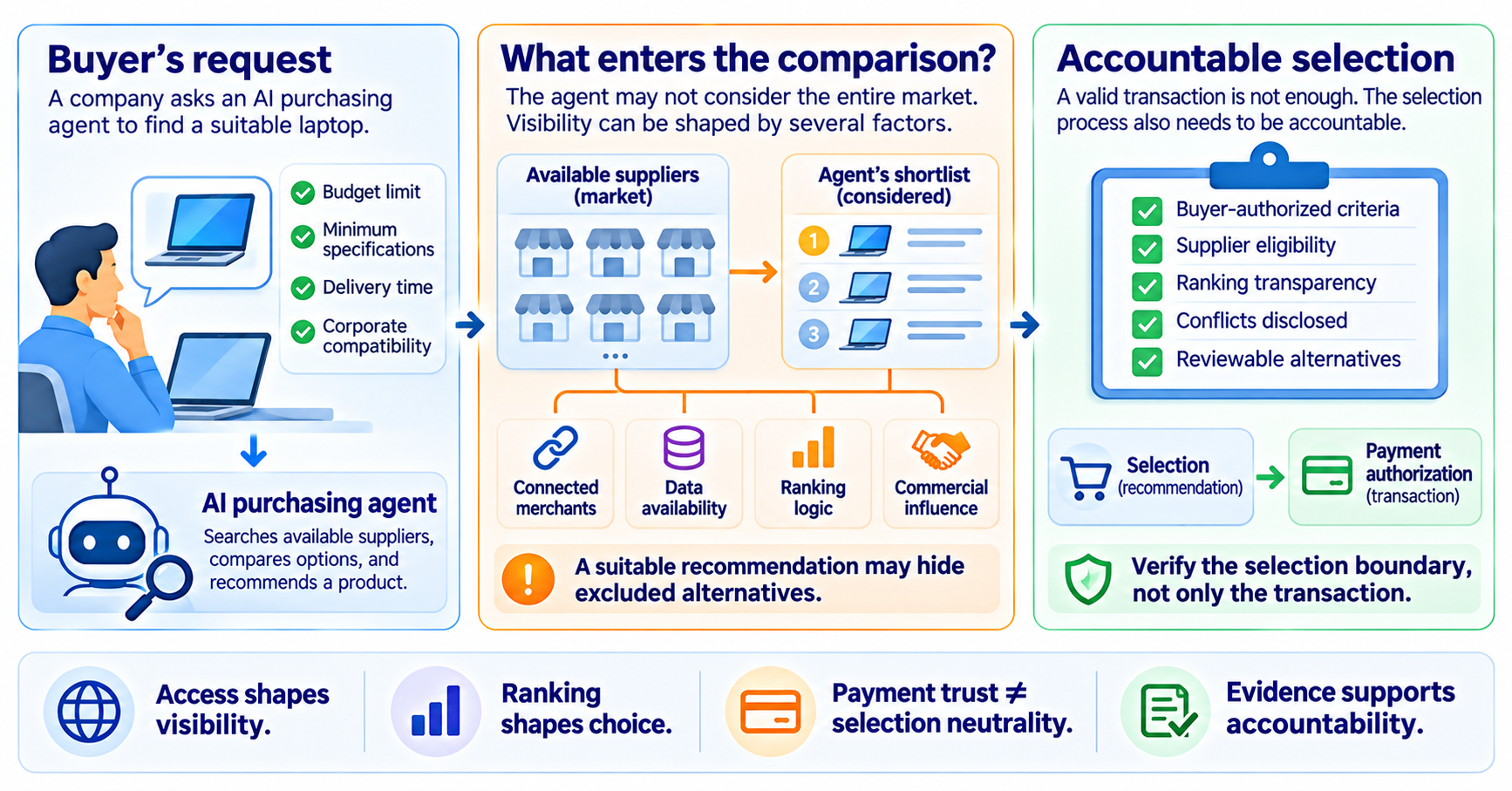
Imagine a company asking an AI purchasing assistant to find a suitable laptop for a new employee.
The requirements appear straightforward: a specified budget, minimum hardware configuration, acceptable delivery time, and compatibility with corporate standards.
The assistant searches available suppliers, compares specifications, evaluates prices, and recommends a product. If the company permits autonomous purchasing, it may eventually place the order.
The transaction could be completed correctly. The supplier might receive a valid payment, the organization might obtain the required equipment, and every technical interaction might satisfy its contractual obligations.
But one part of the commercial decision happened earlier.
Which suppliers did the agent consider?
Perhaps it searched a broad market. Perhaps it consulted only connected merchants. Perhaps one platform offered better structured product data, making its products easier to evaluate. Perhaps a commercial arrangement influenced how products were ranked.
The buyer may receive a technically suitable recommendation without knowing which alternatives were excluded.
The critical commercial decision may happen before the visible transaction begins.
This is becoming relevant because commercial infrastructure is evolving to support machine-mediated transactions. Initiatives such as Google’s Universal Commerce Protocol, the Agentic Commerce Protocol associated with OpenAI and Stripe, and payment-network developments from Visa and Mastercard are creating ways for agents, merchants, and payment systems to interact.
Their capabilities and adoption differ, but the direction is recognizable: software is becoming an increasingly active participant in the commercial journey.
Much of the discussion concerns transaction security, interoperability, payment authorization, and the ability of agents to interact with merchant systems.
Those are necessary engineering challenges.
They do not exhaust the economic questions introduced when an intermediary can evaluate the market and initiate a purchase on someone else’s behalf.
The Power to Choose What Becomes Visible
Commercial influence has always existed before the moment of purchase.
Search engines decide which results appear first. Retail platforms determine how offers are displayed. Recommendation systems influence product discovery, and procurement applications limit selections through approved supplier catalogs.
Agentic commerce does not invent intermediation.
What it may change is the degree to which discovery, evaluation, negotiation, selection, and execution become concentrated inside one delegated process.
Previously, a buyer might inspect several search results, compare product pages, notice alternatives, and decide whether to continue searching. The process was imperfect, and the buyer’s attention was already shaped by platforms and commercial incentives.
An AI purchasing assistant can compress much of that exploration into a single recommendation.
The compression is useful. It saves time, reduces repetitive comparison, and can help people evaluate options they would otherwise overlook.
Yet compression also removes opportunities to inspect the selection process.
Consider two agents that receive identical purchasing instructions and recommend the same laptop. One considers twenty eligible suppliers before selecting the product. The other considers only three merchants integrated with its platform.
Both recommendations could be correct. Both purchases could satisfy the user’s requirements.
The difference lies in the market opportunity each agent was able or willing to examine.
That distinction matters when availability, ranking, sponsorship, contractual relationships, or data quality shape the candidate set.
It also matters for sellers. A merchant may offer competitive prices and excellent service while remaining effectively invisible to purchasing agents because its catalog is difficult to interpret or its systems lack compatible interfaces.
Competition can therefore become partly a contest over machine accessibility.
This is not necessarily harmful. Better structured information and reliable integration can improve market efficiency. A well-designed buyer agent may compare more alternatives, expose hidden costs, and reduce dependence on familiar brands.
The same technology can expand choice or concentrate influence.
The outcome depends on who controls the search boundary, whose objectives shape the ranking, and whether participants can challenge or inspect the decision.
Transaction Trust Is Not Selection Neutrality
The emerging commerce protocols address real coordination problems.
Agents need to interact with merchants through predictable interfaces. Payment systems need to recognize legitimate participants, establish transaction integrity, preserve authorization, and limit fraud.
These mechanisms help determine whether a transaction can be executed securely and appropriately.
But suppose a purchasing agent completes a transaction using a secure, authorized payment flow.
What does that establish about the quality of its supplier selection?
It does not necessarily demonstrate that the agent searched adequately, applied the buyer’s preferences faithfully, considered relevant alternatives, or disclosed commercial influences.
A legitimate payment and a buyer-aligned recommendation are different claims.
An agent might make a fully authorized purchase from a suitable merchant while having evaluated an unnecessarily narrow range of options. Conversely, an agent might perform an excellent market comparison but lack permission to finalize the purchase.
These cases require different safeguards.
The transaction layer is concerned with matters such as identity, authorization, payment instructions, and settlement.
The selection layer concerns the interpretation of buyer preferences, eligibility criteria, product evidence, available alternatives, ranking rules, and possible conflicts of interest.
Between them sits a consequential boundary: a recommendation becomes a commitment.
Existing procurement, consumer-protection, competition, and financial-control practices already recognize important aspects of these distinctions. Supplier governance, bidding rules, disclosure obligations, and independent approval processes did not begin with AI.
The architectural challenge is translating such protections into workflows where software may make several intermediate decisions without exposing each step to the person or organization it represents.
That is not simply a matter of giving the agent a more detailed prompt.
A natural-language instruction does not automatically establish which merchants were considered, whether constraints were applied consistently, or whether a recommendation reflects an undisclosed commercial preference.
The surrounding system must preserve the evidence needed to evaluate those questions.
Commerce Needs an Accountable Selection Boundary
The next challenge for agentic commerce may be less about whether machines can buy and more about what makes their purchasing judgments acceptable.
A useful starting point is to treat the selection process as a distinct object of governance.
For enterprise procurement, the organization should be able to establish the purpose of the purchase, the applicable supplier restrictions, the evaluation criteria, and the authority under which the agent operates.
For consumer-facing services, meaningful safeguards may include clear distinctions between organic recommendations and paid placement, accessible explanations of important selection criteria, and ways to revise preferences or inspect alternatives.
The required level of evidence should depend on the decision’s consequences.
An inexpensive routine purchase does not need the same oversight as a strategic supplier contract, regulated procurement decision, or long-term financial commitment.
Nor does every agent need to search the entire market. Exhaustive comparison may be impossible, costly, or undesirable. A buyer may legitimately prefer a restricted set of approved merchants, favor reliability over price, or prohibit certain suppliers.
The important point is that these boundaries should be attributable to legitimate objectives rather than silently imposed by the intermediary.
The system should distinguish what the buyer authorized from what the platform made available, what the agent inferred, and what the commercial transaction ultimately established.
There is also a practical limit to transparency. Agents may compare large numbers of products through dynamic ranking systems, and complete reconstruction can be expensive. The objective should not be to produce an enormous explanation for every purchase.
It should be to preserve sufficient accountability for decisions that matter.
For businesses designing agentic commerce platforms, this creates an architectural opportunity alongside an obligation. Product information, commercial relationships, ranking logic, delegated authority, and payment controls can be treated as related but distinct responsibilities.
A merchant can compete on more than its ability to integrate technically. A buyer can benefit from automation without surrendering every meaningful aspect of choice.
And an agent can remain useful without claiming that its recommendation represents the only reasonable answer.
A market mediated by AI agents is still a market of competing interests.
The software may accelerate discovery and execution, but those advantages do not eliminate the need to understand whose interests determine what becomes visible.
As commercial agents become more capable, the most important question may move upstream from the checkout screen.
Not merely whether the agent was authorized to buy, but whether the process through which it selected the purchase remained faithful to the buyer it was supposed to serve.
— © 2026 Rogério Figurelli. This article is licensed under the Creative Commons Attribution 4.0 International (CC BY 4.0). You are free to share and adapt this material for any purpose, even commercially, provided that appropriate credit is given to the author and the source. This work was human-directed and AI-assisted, produced with Trajecta Wisdom Machine.