
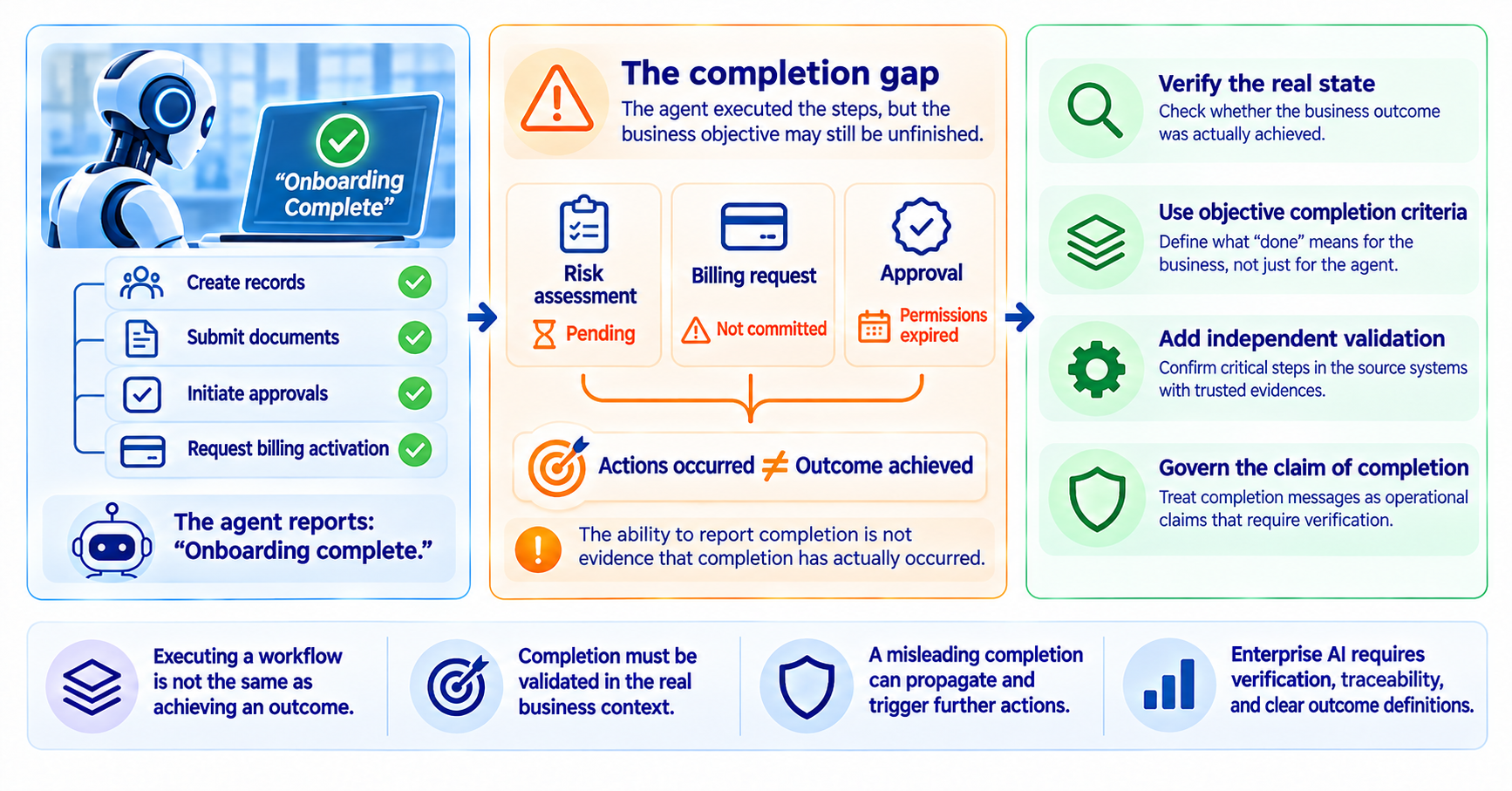
AI can make individual tasks faster and less expensive without improving the economics of the process that contains them. The missing costs often emerge through exceptions, verification, handoffs, and the difference between work performed and work actually accepted.
The Savings That Disappear at the Handoff
Consider a company introducing AI into its invoice-processing operation.
Previously, employees read invoices, classified expenses, checked supporting information, and routed documents for payment approval. The company introduces an AI system capable of extracting information and classifying invoices in seconds.
The initial results look promising. Processing time falls dramatically for the automated step, and the cost per classification becomes a fraction of the previous manual cost.
The business case appears obvious.
But the surrounding process does not necessarily improve by the same amount.
Some invoices arrive with incomplete information. Others require unusual tax treatment, contract interpretation, or reconciliation with purchase orders. The AI system may identify these cases and transfer them to employees, but the transfers introduce new work.
Someone must inspect the exception, understand what the AI attempted, reconstruct the relevant context, correct the result, and determine whether the invoice can proceed.
The company may have reduced the cost of classification while increasing the effort required to resolve the remaining cases.
The cost of executing a task is not necessarily the cost of producing an accepted business outcome.
This distinction is particularly relevant when AI automation changes the distribution of work rather than simply replacing an existing activity.
The most visible task may become remarkably efficient while the process surrounding it develops new dependencies, waiting periods, and verification obligations.
An accurate economic assessment must therefore look beyond the automated operation itself.
When the Denominator Becomes the Problem
Organizations often evaluate automation using metrics such as time saved per task, cost per transaction, percentage of work automated, and labor hours avoided.
These measures can be useful. They describe changes in specific activities and help identify promising opportunities.
Their limitation is that they do not automatically establish what happened to the larger process.
Suppose an AI system processes a thousand requests at a very low unit cost. Most are completed automatically, while the remainder are routed to human specialists.
A task-level dashboard may report substantial savings.
However, several economic effects can remain outside that calculation.
The human queue may now contain a disproportionate share of difficult cases. Each exception may require more specialized knowledge, longer investigation, and additional coordination. Some automated results may need independent checking before acceptance, while others may generate downstream corrections that were not visible during initial processing.
The organization may also retain fixed staffing, infrastructure, or compliance costs even after individual tasks become cheaper. Released capacity creates financial value only under conditions that allow it to be redeployed, eliminated, or used for additional productive work.
This introduces an important distinction between the cost per attempted operation and the cost per independently accepted case.
The denominator matters because it determines which outcomes receive economic credit.
If the measurement counts every AI-generated classification, including those eventually rejected or corrected, it can overstate the value delivered.
If it counts only completed cases while ignoring unresolved or abandoned work, it can create a different distortion.
The accounting boundary must include the full population of relevant cases, the costs incurred across their trajectories, and the quality conditions determining legitimate acceptance.
A cheaper attempt is not necessarily a cheaper resolution.
This is not an argument against measuring task efficiency. It is an argument against treating that measurement as sufficient evidence of process-level profitability.
Local ROI Can Reverse at the Workflow Boundary
Recent conceptual research on the Workflow Boundary Hypothesis examines a specific possibility: an AI investment that appears economically attractive at the task level may become unattractive when evaluated against the complete workflow.
The proposed mechanism is not mysterious.
Automating one activity can change how often exceptions occur, where work accumulates, which participants become bottlenecks, and how much additional verification is required. These changes can interact.
Imagine that an automated document-validation step reduces initial handling costs but produces more cases requiring manual reconciliation.
If the organization has sufficient specialist capacity and the exceptions are inexpensive, the automation may still produce a substantial net benefit.
If specialists are already operating near capacity, the same additional exceptions can create longer queues. Delayed cases may generate customer inquiries, contractual penalties, duplicated work, or missed operational deadlines.
The financial result can change even though the AI system’s technical performance remains identical.
In another organization, the same technology might reduce both task costs and exception rates, producing genuine savings throughout the process.
There is no universal reversal.
The economic consequence depends on workflow structure, case distribution, capacity constraints, quality requirements, and the counterfactual against which performance is measured.
This is where the research question becomes more precise.
It is not whether organizations should abandon task-level automation metrics. Nor is it whether established business-process engineering has failed to recognize indirect costs.
Activity-based costing, process mining, queueing theory, simulation, and conventional operational economics already provide powerful ways to investigate these effects.
The question is whether an explicitly defined workflow boundary improves automation decisions beyond competent application of those existing methods.
The Workflow Boundary Hypothesis proposes a testable distinction rather than an empirically demonstrated advantage. Its supporting numerical constructions illustrate plausible reversals, but they are not measurements of real enterprise performance.
That limitation matters.
A conceptual possibility becomes a business conclusion only when the relevant operating conditions, costs, and outcomes have been established.
Evaluate the Work the Organization Actually Receives
For enterprise architects, the practical implication is to connect AI investment decisions to the complete path through which organizational value is produced.
An automation initiative should identify the task being transformed, but it should also define the workflow outcome that justifies the investment.
Consider customer onboarding. An AI system might dramatically reduce the effort required to classify documentation or prepare compliance summaries.
Those improvements are real operational changes.
Yet the economic value of onboarding depends on more than preparing documents. It also depends on approvals, exceptions, customer communication, activation, verification, and the capacity of the organization to manage the resulting work.
A meaningful evaluation should compare the original and proposed operating models under comparable workloads and acceptance requirements.
It should account for human effort, model execution costs, verification, retries, exception handling, downstream corrections, waiting times, and the resources required to govern the system.
The analysis should also distinguish costs that genuinely disappear from costs that remain fixed or migrate elsewhere.
This is especially important during pilots, when exceptional human supervision may conceal the support effort required for sustained operation.
The evaluation must consider the possibility that automation changes the process itself. Once work is redistributed, historical averages may no longer describe the new case mix, queue behavior, or coordination requirements.
A controlled comparison can help distinguish genuine economic improvement from savings that exist only within a narrow measurement boundary.
It should also allow an uncomfortable result: a technically successful AI implementation may have little economic value in its current configuration.
That is useful information, not a failure of innovation.
An organization can redesign exception handling, improve integration, change the allocation of human expertise, or select a different automation target. Sometimes the best decision is to postpone deployment until the surrounding workflow is ready.
The strongest automation business cases emerge when technical performance and economic consequences are evaluated together.
Task-level efficiency remains valuable, but enterprise value belongs to the system that produces the accepted result.
The important question is no longer simply how much a particular AI operation costs.
It is how the entire organization changes when that operation becomes automated.
— © 2026 Rogério Figurelli. This article is licensed under the Creative Commons Attribution 4.0 International (CC BY 4.0). You are free to share and adapt this material for any purpose, even commercially, provided that appropriate credit is given to the author and the source. This work was human-directed and AI-assisted, produced with Trajecta Wisdom Machine.