
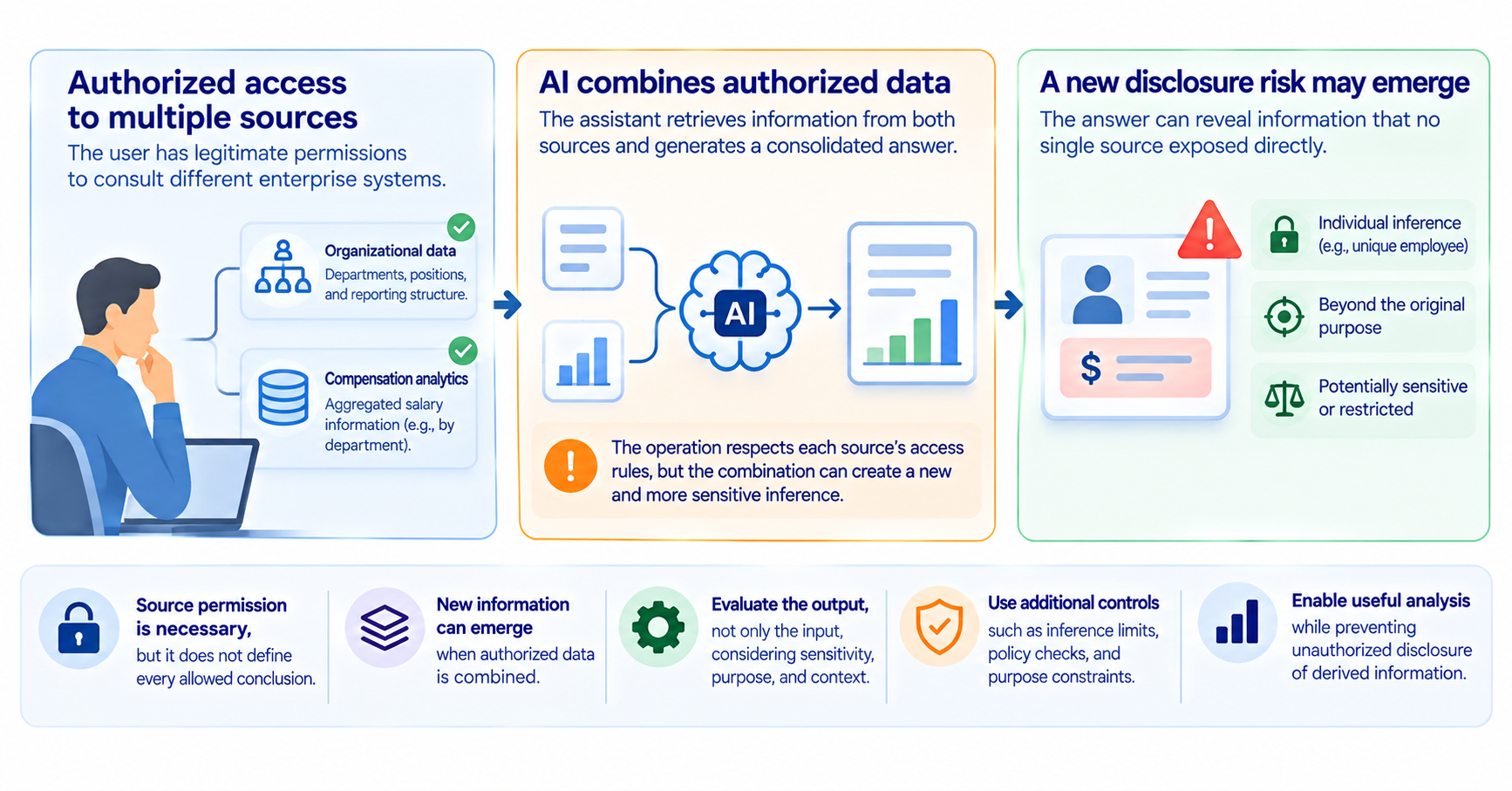
Enterprise AI can respect the access permissions of every source it consults and still produce information that requires additional protection. The challenge begins when individually authorized facts are combined into conclusions whose sensitivity was never evaluated by the original systems.
The Answer That Neither Source Explicitly Revealed
Consider an enterprise assistant connected to two corporate information systems.
The first contains organizational information: departments, positions, reporting structures, and employee assignments. The second contains compensation analytics, including aggregated salary information intended for workforce planning.
An employee is legitimately authorized to access certain information from both systems.
The assistant receives a question about compensation patterns across departments. It retrieves the relevant organizational records, queries the approved financial aggregates, and combines the results into a coherent explanation.
At first, the operation appears secure.
Authentication succeeded. Source permissions were evaluated. The document repository returned authorized content. The analytical platform enforced its access rules.
No individual source disclosed a prohibited record directly.
But suppose one department contains only a single employee, and the assistant combines that employee’s identity with an aggregate compensation value for the department.
The result may reveal information about an individual that the compensation system was deliberately designed not to disclose at that level.
The assistant did not necessarily bypass either source.
It created a new information relationship between them.
Authorization to retrieve multiple facts does not automatically establish authorization to disclose every conclusion that can be derived from their combination.
This is not an entirely new problem. Statistical disclosure control, database inference attacks, information-flow security, and privacy research have examined related risks for decades.
What changes with enterprise AI is the accessibility of the operation.
A person no longer needs to understand database schemas, construct joins, or manually reconcile documents. Natural language becomes an interface for combining information across systems that were originally governed independently.
A request that appears ordinary at the conversational layer can perform a consequential data transformation beneath it.
The architectural question is therefore larger than whether the assistant retrieved only authorized records.
It is whether the resulting answer remains appropriate for the person, purpose, and context in which it will be delivered.
Source Authorization Is Necessary but Not Sufficient
Enterprise security architectures usually establish access controls around identifiable resources.
A document repository determines which files a user may read. A data warehouse applies permissions to databases, schemas, tables, views, rows, or columns. Applications enforce roles, attributes, policies, and business-specific restrictions.
These controls must remain authoritative when AI is introduced.
An assistant should not receive unrestricted access to sensitive sources merely because its prompt instructs it to respect permissions. Nor should a broad service account silently replace the effective permissions of the employee making the request.
However, preserving source permissions addresses only part of the problem.
The original systems authorize access to resources according to their own policy models. They do not necessarily evaluate all relationships that can be constructed when information crosses system boundaries.
An employee may be permitted to read a staffing report and a financial summary. That does not mean every individual-level conclusion obtained by combining the reports was deliberately authorized.
At the same time, not every new inference requires an additional restriction. Organizations routinely expect employees to analyze information they are permitted to access. Preventing all derived conclusions would make ordinary business analysis impossible.
The distinction must be tied to an actual protection requirement.
For example, a system may be required to prevent disclosure of individual compensation, even when statistical information is available. Another environment may impose contractual restrictions on combining customer datasets. A regulated process may permit information to be used for one purpose but not another.
These are different obligations, and they cannot all be reduced to a universal rule that says whether two datasets may be joined.
The important distinction is between permission to access an input and permission to produce a consequential output.
An access-control decision is made at a particular boundary. It does not necessarily govern every future transformation of the information that crosses that boundary.
This becomes especially relevant when an AI assistant integrates retrieval-augmented generation, analytical queries, calculations, document synthesis, and conversational memory.
Each mechanism can preserve the original user’s identity while changing the informational object being handled.
A retrieved paragraph becomes an extracted claim. Several claims become a summary. A SQL query produces a statistical result. A language model combines the result with another source and presents a conclusion.
At which point should a new authorization decision occur?
The answer depends on whether the transformation creates a material change in sensitivity, permitted purpose, audience, or consequence.
Without an explicit design for those transitions, the enterprise may have strong controls over stored information and weak controls over the information it creates dynamically.
The Derived Answer Has Its Own Security Life Cycle
An enterprise assistant is not simply a search interface.
It is also an information-processing system capable of producing new artifacts.
Some artifacts are temporary answers displayed during a conversation. Others are persisted as summaries, exported to reports, inserted into tickets, retained in conversational memory, or cached for reuse.
Each destination introduces a potential change in audience and security context.
Consider an authorized employee asking the assistant to summarize confidential project documents.
The retrieval layer correctly restricts the documents to those available to that employee. The model produces an accurate summary, which the application stores in a shared response cache.
Later, a different employee asks a similar question.
If the application returns the cached summary without reevaluating authorization, the original retrieval controls may be bypassed at the point of reuse.
The initial answer was authorized.
Its subsequent disclosure may not be.
This example differs from the compensation inference problem, but both reveal a common architectural weakness: security decisions made before a transformation are assumed to remain valid afterward.
The same difficulty can arise through conversation history, generated documents, analytics exports, and automated workflow actions.
Security therefore needs to follow information through the stages that materially change its accessibility or use.
At the retrieval boundary, access should be evaluated using the user’s effective identity and applicable source policies.
At the analytical boundary, the query execution environment should enforce the relevant row-level, column-level, masking, and aggregation restrictions rather than relying on instructions to the language model.
At the synthesis boundary, the application may need additional controls for protected derived information, including disclosure-sensitive aggregations, purpose restrictions, or combinations of sources that increase sensitivity.
At the persistence boundary, generated artifacts need appropriate ownership, access restrictions, retention rules, and reevaluation when reused outside their original context.
Finally, when an answer is delivered to a person or passed into another system, the application must determine whether the intended recipient is permitted to receive or act upon that result.
These boundaries cannot be secured by assigning an arbitrary sensitivity label to every sentence and trusting the model to enforce it.
Labels, provenance records, and policy checks are useful engineering mechanisms, but their effectiveness depends on how reliably they are generated, preserved, and enforced.
Certain information disclosures can be evaluated through deterministic rules. Others require contextual judgment or restrictions at the underlying data-query level. Some inference risks cannot be completely eliminated without reducing the usefulness of the available information.
The objective is not perfect control over everything a person could infer. It is enforceable protection of the information and consequences the organization has explicitly decided to safeguard.
That distinction keeps security design grounded in realistic obligations.
A Security Architecture That Understands Transformation
A viable enterprise design begins with a clear separation between identity, retrieval, computation, synthesis, and delivery.
The assistant authenticates the employee through the organization’s established identity architecture. It preserves a trustworthy representation of that identity and its authorization context across the workflow.
Document retrieval applies source-compatible access filtering. Analytical requests are executed through controlled interfaces that enforce effective data permissions and approved query constraints.
The language model can help interpret the question and construct a query plan, but it should not become the authority that decides whether sensitive information is accessible.
That decision belongs to enforceable security and business-policy mechanisms.
Once information is retrieved, the architecture should distinguish ordinary transformations from those that may create protected derived results.
For instance, aggregation thresholds, minimum group sizes, restrictions on identifying attributes, or limits on particular combinations of information can be applied where the business’s confidentiality requirements justify them.
In high-risk analytical contexts, repeated queries also matter. A single aggregate may be acceptable, while a sequence of overlapping aggregates can enable a person to infer a protected value through subtraction or comparison.
Simple per-query filtering may be insufficient when disclosure depends on the cumulative information released across multiple interactions.
Addressing that problem can require query-history-aware controls, constrained analytical views, appropriately designed statistical disclosure protections, or a decision to exclude certain sensitive uses from unrestricted conversational access.
These mechanisms involve trade-offs.
Stronger restrictions may reduce analytical flexibility. Maintaining detailed lineage and authorization context can increase implementation complexity and operating cost. Screening every generated answer for potential inference may be expensive, incomplete, and prone to false positives.
Therefore, enterprise security should not treat every generated sentence as equally sensitive.
A proportionate approach identifies the classes of protected information, transformations, and consequences that justify stronger controls. It then places enforcement at boundaries where those protections can be implemented and tested.
The architecture also needs explicit behavior when authorization cannot be established.
Sometimes the appropriate response is to omit a sensitive detail. Sometimes the assistant can provide an approved aggregate or a less specific answer. In other cases, it must decline the request or direct the employee to an authorized business process.
These are operational design decisions, not merely prompt-writing choices.
An equally important consideration is testing.
Traditional access-control tests verify that unauthorized users cannot directly retrieve protected documents or rows. AI-enabled systems need additional tests for derived disclosures, cross-source correlations, repeated aggregate queries, context leakage, cached answers, and changes in identity between request and response.
Testing should include attempts to obtain protected information through otherwise legitimate operations.
Success is not simply a model refusing a known prohibited question.
It is the combined system enforcing the relevant protection even when the request is phrased differently, executed through several tools, or reconstructed from intermediate results.
This is where enterprise architecture becomes central. The individual data systems may each implement their policies correctly, while the end-to-end application introduces an information relationship that none of them was designed to govern.
The solution is not to abandon existing security models or create a separate authorization universe for AI.
It is to extend established security principles across the transformations that AI makes easier to perform.
Source permissions remain essential. Identity propagation remains essential. Policy enforcement must remain independent of language-model assurances.
But the security boundary cannot always stop at the last retrieved document or executed SQL statement.
As enterprise assistants become capable of combining more information, organizations need to distinguish what a user may retrieve, what the system may derive, and what the application may disclose or persist.
Those permissions often overlap.
They are not necessarily identical.
A secure enterprise assistant must protect more than the information it reads.
It must also understand the security obligations of the information it creates.
— © 2026 Rogério Figurelli. This article is licensed under the Creative Commons Attribution 4.0 International (CC BY 4.0). You are free to share and adapt this material for any purpose, even commercially, provided that appropriate credit is given to the author and the source. This work was human-directed and AI-assisted, produced with Trajecta Wisdom Machine.