
Organizations often celebrate leaders who make confident decisions and teams that adapt quickly. Yet neither consistency nor flexibility guarantees good judgment. The harder capability is knowing when new evidence genuinely justifies changing a decision, and when it does not.
The Decision After the Decision
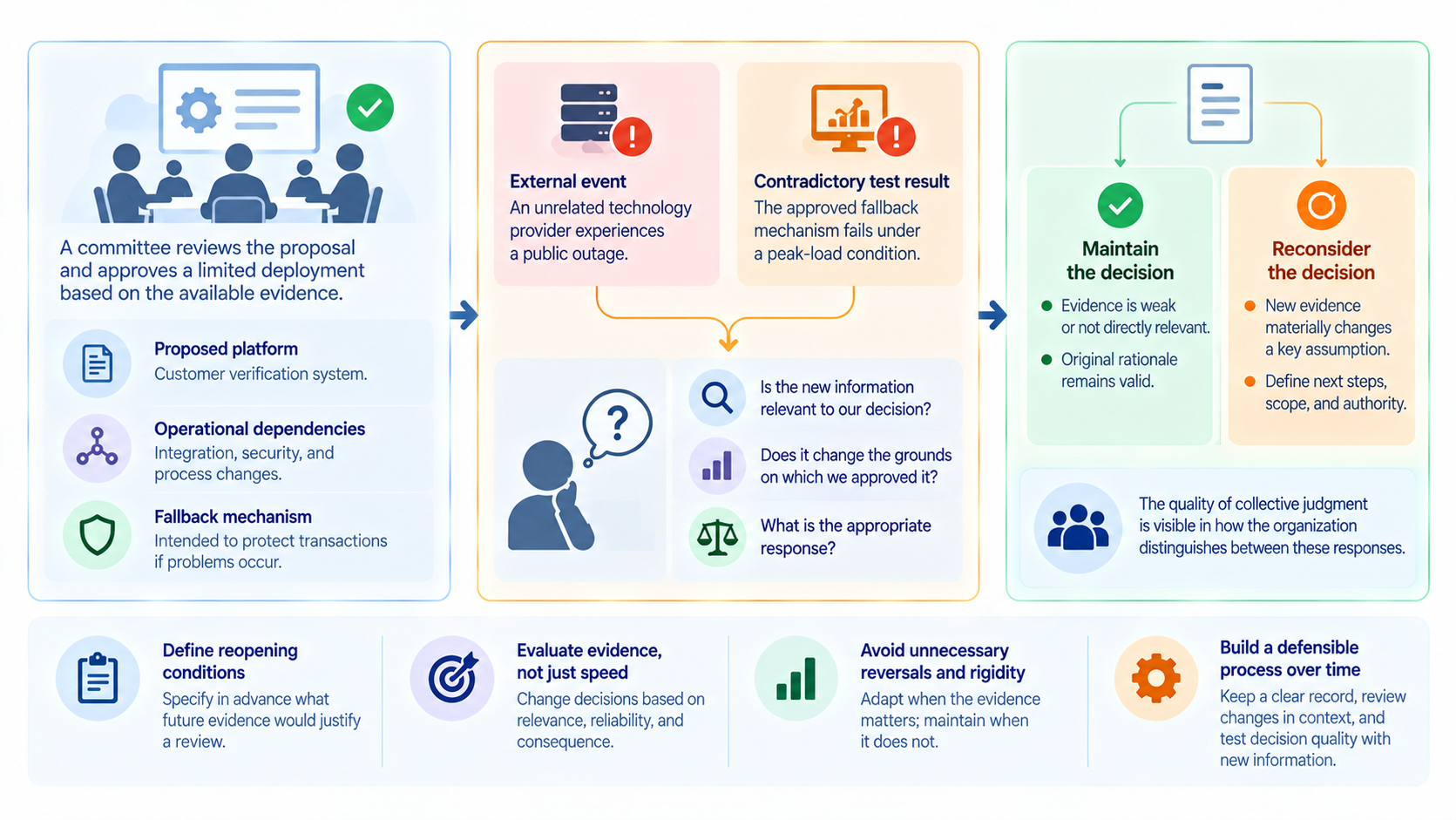
Imagine a hypothetical financial services company preparing to deploy a new customer verification platform.
An architecture council reviews the proposed system, examines its operational dependencies, and authorizes a limited rollout. The decision includes a fallback mechanism intended to protect customer transactions if the new platform encounters problems.
The council considers the available evidence sufficient for a controlled deployment.
Two weeks later, new information arrives.
First, an unrelated technology provider experiences a public outage. Senior executives become concerned about the reliability of digital platforms and ask whether the deployment should be suspended.
Later, engineers discover that the approved fallback mechanism fails under a particular peak-load condition. The test is performed against the relevant configuration and directly challenges an assumption underlying the original approval.
Both developments create uncertainty.
But they do not deserve the same response.
The external outage may justify checking whether the organization shares a relevant dependency or failure mechanism. By itself, it does not establish that the approved platform is unsafe.
The failed fallback test presents a more direct problem. It contradicts a protection mechanism on which the authorization depended.
A committee that reverses its decision whenever an alarming event occurs may appear responsive while introducing unnecessary disruption.
A committee that refuses to reconsider its decision despite decisive contradictory evidence may appear consistent while preserving an unjustified risk.
The quality of collective judgment becomes visible in the difference between these responses.
Why Adaptability Is Not the Same as Wisdom
Organizations frequently describe adaptability as a desirable leadership attribute. In changing environments, the capacity to revise assumptions is essential.
However, adaptability becomes difficult to evaluate when every change is treated as progress.
A committee might revise its recommendation because the evidence improved. It might also reverse course because a powerful executive expressed concern, an AI-generated summary emphasized a dramatic example, or a recent incident made an unlikely outcome feel more probable.
The visible behavior is similar: the organization changes its decision.
The underlying judgment is not.
A useful distinction is between appropriate correction and indiscriminate revision.
Appropriate correction occurs when new information materially changes the grounds on which a decision was justified. Indiscriminate revision occurs when the organization changes position without sufficient relevance, reliability, or consequence.
The opposite distinction matters equally. Holding a decision can reflect disciplined judgment when new information is weak. It can also reflect institutional rigidity when contrary evidence is strong.
The challenge is not to maximize the number of revisions.
It is to improve the relationship between evidence and revision.
This is particularly important for committees because their decisions can acquire institutional momentum. Once a recommendation has been approved, budgets allocated, and implementation teams mobilized, reversing course becomes organizationally expensive.
The group may therefore face competing pressures: avoid appearing inconsistent, avoid delaying delivery, or demonstrate responsiveness to senior leadership.
None of those pressures determines whether the original decision remains justified.
The Missing Element in Decision Governance
Many enterprises record what a committee approved. Some also record the rationale, participants, and supporting documents.
Far fewer decision processes make explicit, at the moment of approval, what future observation would justify reopening the decision.
That omission creates a practical problem.
When new evidence appears, the organization must reconstruct not only what it decided but also which assumptions were essential to the authorization.
In the hypothetical platform rollout, the council’s original approval could include a clear condition: deployment remains authorized only while the tested fallback mechanism satisfies the declared operational requirements.
If subsequent testing invalidates that condition, the organization has a concrete reason to review the authorization.
By contrast, an unrelated technology incident would require a further connection to the approved system before becoming decisive evidence.
This is the purpose of a decision return mechanism: to preserve a pathway from future observations back to the grounds of the original judgment.
Such a mechanism should not convert every decision into a permanently open debate. It should specify meaningful reopening conditions, identify who is authorized to reconsider the action, and preserve the original record so that subsequent changes are distinguishable from hindsight.
The distinction is especially valuable in AI-assisted decision-making.
An AI assistant may help detect changes, retrieve relevant evidence, and compare new observations against earlier assumptions. It may also produce persuasive summaries that exaggerate the significance of recent events.
The organization therefore needs more than alerts or recommendations. It needs a way to determine whether the new information actually challenges the basis of the decision.
Measuring the Quality of Revision
A proposed experimental framework for collective wisdom offers an interesting way to investigate this capability.
Instead of evaluating a decision team only at the moment of its first recommendation, researchers can introduce a second wave of evidence after the original decision has been recorded.
Some observations would genuinely contradict the initial rationale. Others would reinforce it. Additional observations would be plausible distractions with limited relevance.
Teams would then decide whether to maintain, revise, suspend, or reopen their original recommendation.
The evaluation would examine how appropriately each team responds to different kinds of evidence, including the cost and timing of its response.
A team that changes every decision would not automatically receive a favorable assessment. Nor would a team be rewarded merely for remaining confident.
The stronger question is whether its revisions correspond to the strength and relevance of the information received.
For enterprise leaders, the practical value of this approach lies in making decision maintenance observable.
The original forecast remains part of the record. A revised judgment receives its own timestamp and explanation. Reviewers can examine whether the organization recognized a meaningful contradiction, whether it responded within a reasonable period, and whether its response respected the applicable authority.
This remains a proposed research approach, not an established empirical finding that structured committees outperform simpler methods.
A conventional review checklist or a capable individual could conceivably achieve the same result at lower cost.
Indeed, that is a serious competing explanation that any proposed collective-wisdom intervention must confront.
If a simple evidence-update procedure performs equally well, organizations should not impose elaborate deliberation merely to make collaboration appear sophisticated.
From Confident Decisions to Defensible Decisions
The practical opportunity is to evaluate decision processes across time rather than judging them solely by their initial outputs.
For consequential technology approvals, investment decisions, or operational exceptions, enterprises can test whether review teams distinguish decisive evidence from distracting information more effectively than their current procedures.
That evaluation should include the consequences of both unnecessary reversals and delayed corrections.
It should also recognize that some real-world evidence remains ambiguous. When the connection between an observation and a decision cannot be established, an honest unresolved status may be more defensible than manufactured certainty.
A mature organization does not need to reconsider every decision continuously. It needs proportionate mechanisms for recognizing when the original grounds for action have changed.
Collective wisdom, if it can be demonstrated as a distinctive organizational capability, should therefore involve more than producing a strong initial recommendation.
It should help an organization remain accountable to evidence after that recommendation becomes a commitment.
The most reliable committee is not necessarily the one that changes its mind most often or defends its decisions most confidently.
It is the one that can explain why its decision still deserves to stand, and recognize when that explanation no longer survives the evidence.
— © 2026 Rogério Figurelli. This article is licensed under the Creative Commons Attribution 4.0 International (CC BY 4.0). You are free to share and adapt this material for any purpose, even commercially, provided that appropriate credit is given to the author and the source. This work was human-directed and AI-assisted, produced with Trajecta Wisdom Machine.