
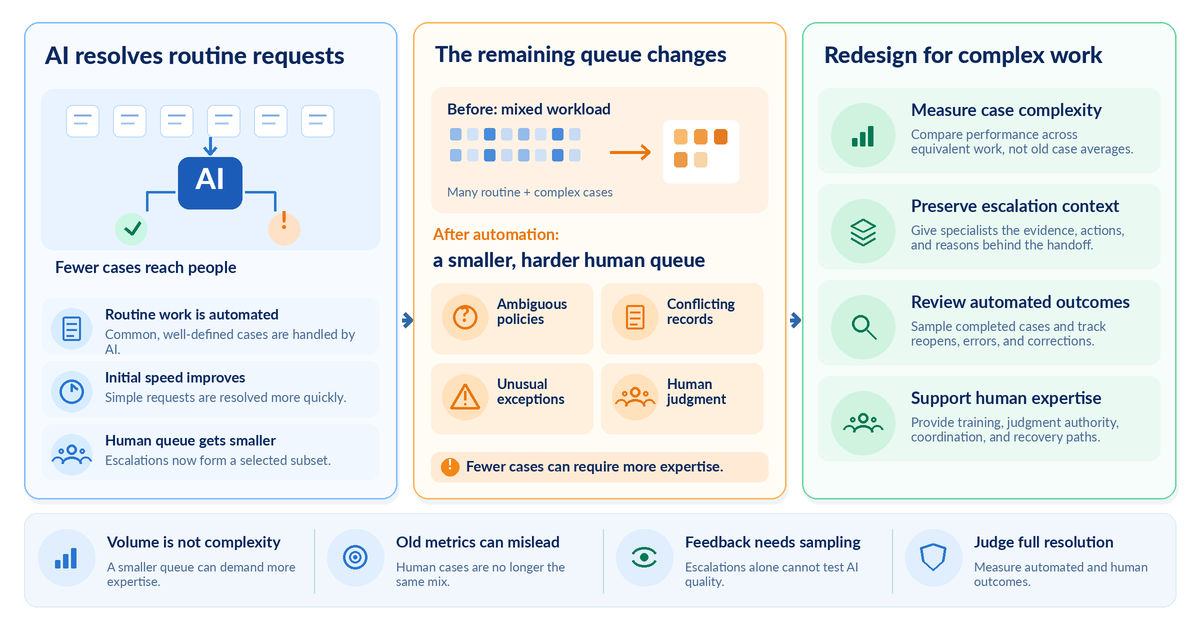
As AI automates routine activities, the work remaining for people can become more complex, uncertain, and expensive to resolve. Measuring automation primarily by the volume of work removed may conceal a fundamental change in the nature of the work that remains.
The Queue Is No Longer the Same Queue
Imagine a customer service operation introducing AI to classify requests, answer common questions, and resolve straightforward cases automatically.
Initially, employees handle a mixture of simple inquiries, moderately difficult problems, and exceptional situations. Some cases require little investigation. Others involve conflicting records, unusual customer circumstances, or decisions that cannot be made through established procedures.
After automation, many routine requests disappear from the human queue.
The immediate performance indicators may be encouraging. More requests are completed without human intervention, automated resolution becomes faster, and the number of cases requiring employee attention declines.
Yet the employees who remain may experience a very different working environment.
Instead of handling a representative mixture of requests, they increasingly encounter situations that automation could not resolve. These cases may involve incomplete information, ambiguous policies, emotional complexity, technical failures, or conflicting business obligations.
The composition of the work has changed.
Automation does not simply reduce the quantity of work. It can change the statistical and operational characteristics of what remains.
This distinction matters because organizational capacity is rarely determined by transaction volume alone. It also depends on variability, difficulty, the availability of reliable procedures, and the effort required to make a defensible decision.
A smaller queue can demand greater expertise.
And an operation that processes fewer human cases may still require more specialized coordination, supervision, and recovery mechanisms than its earlier workload suggested.
When Productivity Metrics Lose Their Original Meaning
Suppose an organization measures employee productivity through the number of cases resolved per hour.
Before automation, this metric describes performance across a broad mixture of requests. After routine requests are automated, the same metric measures employees working on a more difficult subset.
Average handling time may increase. Resolution rates may decline. Employees may close fewer cases despite making better decisions on more challenging problems.
Interpreting these changes as declining human productivity would be misleading.
The denominator has changed.
The employees are no longer processing the same population of work, even if the dashboard continues to display the same metric.
This is a selection problem. Automation removes cases according to their suitability for automated handling, not through a random process. The cases that remain are therefore selected for characteristics that may also make them harder to resolve.
Comparing performance before and after automation without accounting for that selection can distort the interpretation of both human productivity and automation effectiveness.
The same problem affects cost calculations.
An organization may estimate the value of automation by multiplying the number of automated cases by the historical average cost of human handling. That calculation can be useful as an initial approximation, but it may overstate realized savings if automated cases were disproportionately inexpensive or if the remaining cases require more expensive specialist attention.
Conversely, automation may generate substantial value by freeing skilled employees from repetitive work, even when the residual queue becomes more costly per case.
Neither outcome follows automatically from the automation rate.
The economic unit being optimized must reflect the work actually performed, not an average inherited from the pre-automation operation.
This calls for a more careful distinction between the cost of processing a transaction and the cost of resolving an entire customer or business problem. A request might be automatically closed yet subsequently reopened, escalated through another channel, or require manual correction.
Successful automation should therefore be evaluated against the full resolution process, including consequential work that may emerge elsewhere.
The Residual Workload Becomes a Learning Problem
The changing composition of work introduces a second architectural concern: the evidence available for improving the system also changes.
Before automation, employees encounter a wide range of situations. Their decisions, corrections, and interactions can provide information about common and unusual cases.
After automation, the human queue contains a more selective population. Routine cases may have little human involvement, while unresolved cases accumulate around conditions the automated system finds difficult.
This can create a useful concentration of expertise. Human teams gain deeper exposure to unusual situations and may discover weaknesses in business policies, data quality, or workflow design.
But it can also create a distorted feedback loop.
If improvement efforts rely mainly on cases escalated to people, they may overlook weaknesses in automated cases that never received independent review. Some apparently successful automated resolutions may be incorrect, incomplete, or accepted only because customers did not pursue the issue further.
At the same time, training or evaluating future automation exclusively against the residual queue may give an unrepresentative picture of the original workload.
The organization must distinguish several populations: cases handled automatically, cases escalated immediately, cases reopened after automated resolution, and cases that move through multiple channels before reaching a satisfactory outcome.
These groups are not interchangeable.
In particular, an absence of escalation is not necessarily evidence of a correct resolution. The meaning of that signal depends on the operation, customer behavior, and the availability of mechanisms to identify mistakes.
Automation changes not only the work being measured, but also the process through which evidence about that work is produced.
This is why feedback architecture becomes important. Selective human review, outcome sampling, error reporting, and traceable escalation reasons can help organizations assess automated performance without relying exclusively on the subset of cases the system already recognizes as difficult.
The objective is not to reintroduce human review into every routine interaction. That could defeat much of the value of automation.
It is to preserve enough independent evidence to detect failures that the automation process itself may not reveal.
Designing for the Work That Remains
If automation changes the composition of human work, operational design should change with it.
Staffing models based primarily on historical transaction volumes may no longer describe the expertise, judgment, or coordination needed in the residual queue. Training programs may need to emphasize investigation, policy interpretation, exception handling, and effective collaboration with automated systems.
The architecture should also make the reason for escalation visible.
An employee receiving an unresolved case needs more than the original customer message. Depending on the situation, the employee may need to understand what the AI attempted, which information it used, which constraints prevented resolution, and whether any consequential action has already occurred.
Without that continuity, automation can transfer a difficult problem to a person while withholding the context needed to solve it.
This creates unnecessary reconstruction work. It can also encourage repeated requests for information, duplicated actions, and uncertainty about responsibility.
A reliable escalation mechanism should therefore preserve the relevant decision context while respecting privacy, authorization, and information-retention constraints.
The organization also needs metrics that describe the new workload rather than pretending it is unchanged.
Automation rates remain useful, but they should be interpreted alongside measures such as end-to-end resolution quality, reopened cases, escalation causes, residual-case complexity, specialist workload, and the costs associated with correcting unsuccessful automated outcomes.
Not every organization needs an elaborate new measurement framework. The important requirement is to detect whether reduced transaction volume is accompanied by a disproportionate increase in the difficulty or consequences of the work left behind.
There is a further implication for human sustainability.
A job consisting almost entirely of unresolved problems may be more cognitively demanding than one containing a balanced mixture of routine and difficult tasks. Concentrating exceptional situations among a smaller group of employees can affect opportunities to develop expertise, distribute responsibility, and maintain operational resilience.
These effects are not inevitable. Automation can also remove frustrating repetition and create more meaningful work. The outcome depends on how the remaining roles, escalation paths, training, and support mechanisms are designed.
The point is not to preserve routine tasks merely to maintain the previous distribution of work.
It is to recognize that a changing workload requires a changing operating model.
As automation expands, organizations may discover that their most important human capacity is no longer the ability to process large volumes of standard transactions. It is the ability to understand and resolve situations that resist standardization.
That capacity deserves explicit architectural and managerial attention.
An automation program can legitimately celebrate the work it eliminates. But its long-term effectiveness also depends on whether the work it leaves behind remains understandable, manageable, and economically sustainable.
The real measure of progress is not simply how much work no longer reaches people.
It is whether the combined human and automated operation can resolve the whole workload more reliably than before.
— © 2026 Rogério Figurelli. This article is licensed under the Creative Commons Attribution 4.0 International (CC BY 4.0). You are free to share and adapt this material for any purpose, even commercially, provided that appropriate credit is given to the author and the source. This work was human-directed and AI-assisted, produced with Trajecta Wisdom Machine.