
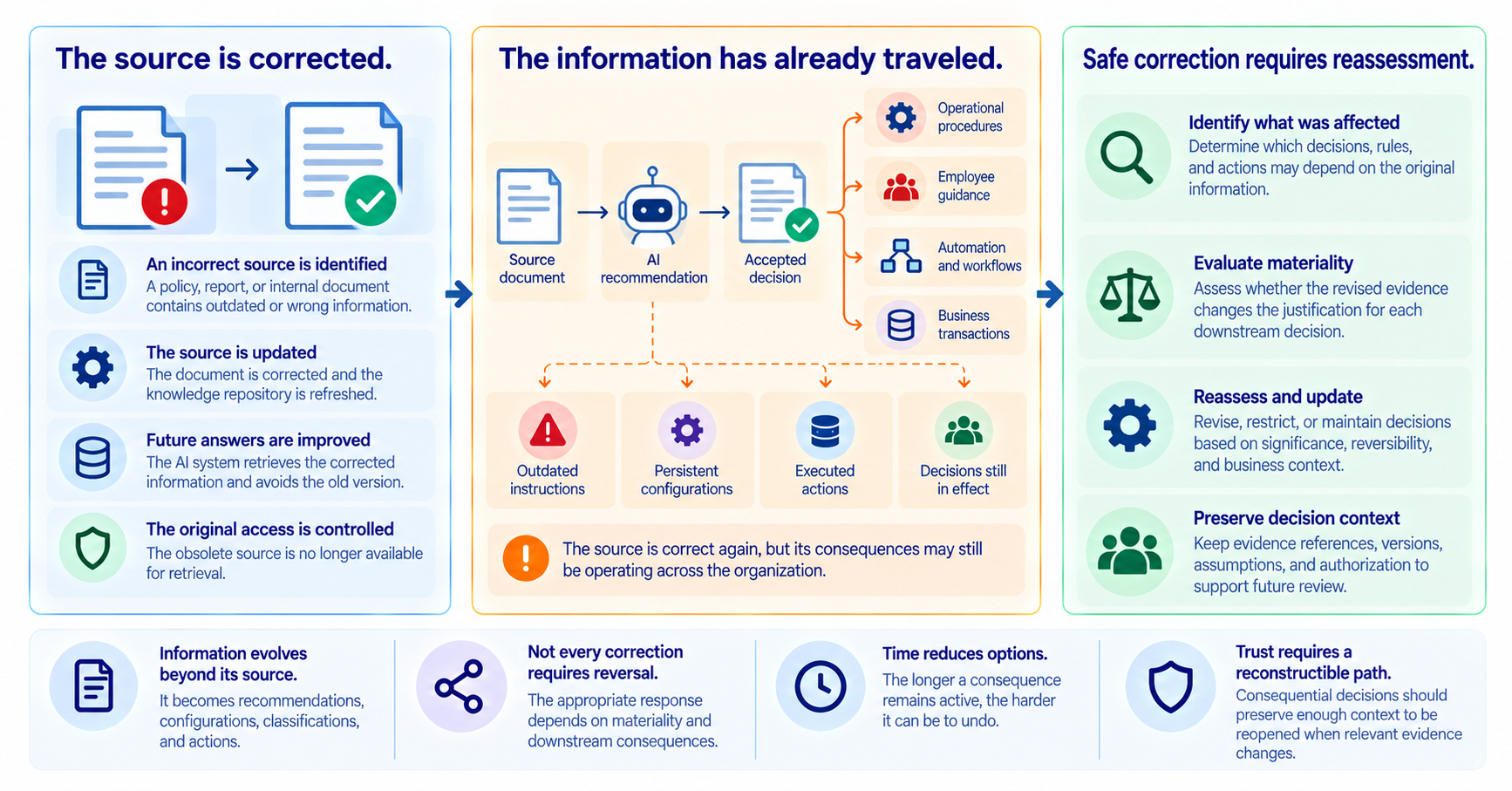
An AI system can stop using incorrect information while the decisions influenced by that information continue to operate elsewhere. Correcting knowledge and correcting its consequences are different architectural responsibilities.
The Error Has Already Left the Document
An enterprise AI assistant retrieves an internal policy document and produces a recommendation. The recommendation is reviewed, accepted, and incorporated into an operational procedure. Someone later discovers that the original document contained an outdated exception rule. The policy is corrected, the knowledge repository is updated, and the AI system is prevented from retrieving the obsolete version.
From the perspective of the knowledge platform, the problem may appear resolved. Future retrievals should encounter the revised information, and subsequent answers can reflect the new policy.
But the earlier recommendation may already have influenced decisions elsewhere. It could be embedded in a workflow configuration, incorporated into employee guidance, or used to justify an exception that remains operationally active. The original document has been corrected, while the organization continues to act on an interpretation produced before the correction.
The original document is no longer the only place the error lives.
This situation exposes a limitation in how organizations commonly think about information quality. Data governance usually emphasizes the accuracy, ownership, classification, and lifecycle of information assets. AI knowledge systems add concerns about retrieval quality, contextual relevance, grounding, and source freshness.
These disciplines are necessary, but the problem changes once information becomes part of a consequential decision.
The evidence can change after the decision has left the system that produced it.
Correcting the evidence does not automatically determine which downstream decisions need to be reconsidered. That requires understanding where the information traveled, how it was transformed, and whether the correction materially changes something the organization has already accepted.
Information Does Not Remain in Its Original Form
A traditional document-management system can often identify copies, versions, references, and distribution histories. AI introduces additional forms of transformation that make downstream dependencies harder to recognize.
A source document may be summarized into a short explanation. That explanation may become a recommendation. The recommendation may influence a business rule, which subsequently determines how an automated process handles thousands of transactions.
At the end of this sequence, the operational artifact may contain almost none of the language from the original source.
The dependency is semantic rather than necessarily textual.
Consider a risk assessment derived from several internal reports. An AI system interprets the available evidence and recommends classifying a supplier as low risk. That classification becomes an input to procurement decisions.
Weeks later, one of the underlying reports is corrected. The correction does not necessarily invalidate the supplier classification. Other evidence may independently support the original assessment. But neither can the organization assume that the classification remains justified merely because the classification record itself has not changed.
The relevant question concerns whether the revised evidence changes the justification for a consequential downstream state.
This is where ordinary document lineage becomes insufficient on its own. Knowing that one document contributed to another artifact does not establish whether a particular correction changes the validity of a derived conclusion. The relationship must be interpreted in terms of the decision, its evidentiary dependencies, and the conditions under which it was accepted.
The problem also has a temporal dimension. A recommendation can be defensible when issued and become unsuitable after circumstances change. Alternatively, newly discovered evidence may reveal that the original recommendation was never adequately supported.
Those situations require different responses.
A changed policy may apply only to future transactions, while the discovery of a factual error may justify reviewing earlier decisions. The appropriate treatment depends on business context, applicable obligations, and the consequences involved.
An architecture that treats every source revision as equivalent will struggle to distinguish these cases.
Why Universal Correction Propagation Is Not the Answer
One possible response is to construct complete dependency records for every AI-generated statement, recommendation, document, and subsequent business action. Whenever a source changes, the system would identify every downstream artifact and determine whether it should be revised.
The objective is understandable, but universal dependency reconstruction can become prohibitively expensive and may be technically impossible in an open organizational environment.
Information crosses human conversations, external systems, informal decisions, and organizational boundaries. Some influences are indirect. Others cannot be reconstructed from available records, even when technical systems preserve extensive logs.
Existing practices in data lineage, change management, event-driven systems, provenance tracking, and decision auditing already address important parts of this problem. The opportunity is not to replace those disciplines with an entirely new mechanism. It is to connect their capabilities to the specific circumstances under which AI-derived conclusions must be reconsidered.
Not every correction requires a recall.
A spelling correction in an internal knowledge article may have no operational consequence. A revised financial threshold could affect an active approval workflow. The withdrawal of a safety-related instruction may require immediate attention to decisions that relied on it.
The responsibility to propagate a correction should therefore depend on its materiality and the downstream consequences that can reasonably be identified.
The correction obligation should be proportional to the significance of the affected decisions, not simply to the number of documents containing related information.
This suggests a practical distinction between general informational outputs and consequential derived artifacts. For low-risk content, updating the source and preventing future use may be sufficient. For significant decisions, the organization may need durable references to the evidence, versions, assumptions, and decision context that supported the original result.
Such records will not eliminate all uncertainty. They can, however, make it possible to identify important affected decisions without attempting to reconstruct every informational influence across the enterprise.
The Architecture of a Decision That Can Be Reopened
A more robust approach begins by treating consequential AI-assisted decisions as objects that may need to be revisited.
When a recommendation becomes operationally significant, the system can preserve the relevant evidence references, their versions or effective dates, the decision context, and the authority under which the result was accepted.
This creates a basis for selective reassessment.
When an important source is corrected, superseded, disputed, or withdrawn, the organization can identify known dependent decisions and evaluate whether the change affects their validity. Some decisions may remain unchanged because their justification survives the revision. Others may require new evidence, a different interpretation, or an authorized intervention.
The architecture should also distinguish correction from automatic reversal. A business decision may have produced effects that cannot simply be undone. In those cases, the appropriate response may involve remediation, notification, compensation, or a revised decision governing what happens next.
There is an additional challenge when AI-generated recommendations have been translated into persistent automation.
A recommendation might originally have required human approval, but its interpretation could later become embedded in configuration rules or executable workflows. Correcting the original source will not necessarily modify those implementations. The organization needs a mechanism for identifying when a changed assumption requires reconsidering the operational rule itself.
This makes the boundary between knowledge and action especially important.
The central architectural requirement is not that every AI output maintain an exhaustive history of everything that influenced it. It is that consequential decisions preserve enough reconstructible context to support correction when relevant evidence changes.
The appropriate level of preservation depends on the risk, reversibility, and significance of the decision. A low-impact recommendation may require little more than a reference to its source. A consequential automated decision may demand stronger evidence retention, dependency tracking, and explicit mechanisms for reassessment.
A system should also be able to acknowledge when its dependency information is incomplete. Missing lineage cannot safely be interpreted as proof that no affected decisions exist.
There is a broader organizational implication. AI makes it easier to transform information into recommendations, instructions, and executable decisions. As this transformation accelerates, the time available for detecting and correcting mistaken assumptions before they produce consequences may become shorter.
Knowledge management must therefore account for what happens after knowledge has been used.
An organization can maintain an accurate repository while continuing to operate on obsolete conclusions. It can correct an AI system’s future answers without repairing earlier consequences. And it can preserve extensive records without knowing which decisions should be reopened.
The next step in trustworthy enterprise knowledge architecture may be to establish a more explicit relationship between evidence revision and decision reassessment.
Because the most consequential correction is not always the one that changes what the system knows.
Sometimes it is the one that changes what the organization is still doing because of what the system once believed.
— © 2026 Rogério Figurelli. This article is licensed under the Creative Commons Attribution 4.0 International (CC BY 4.0). You are free to share and adapt this material for any purpose, even commercially, provided that appropriate credit is given to the author and the source. This work was human-directed and AI-assisted, produced with Trajecta Wisdom Machine.