
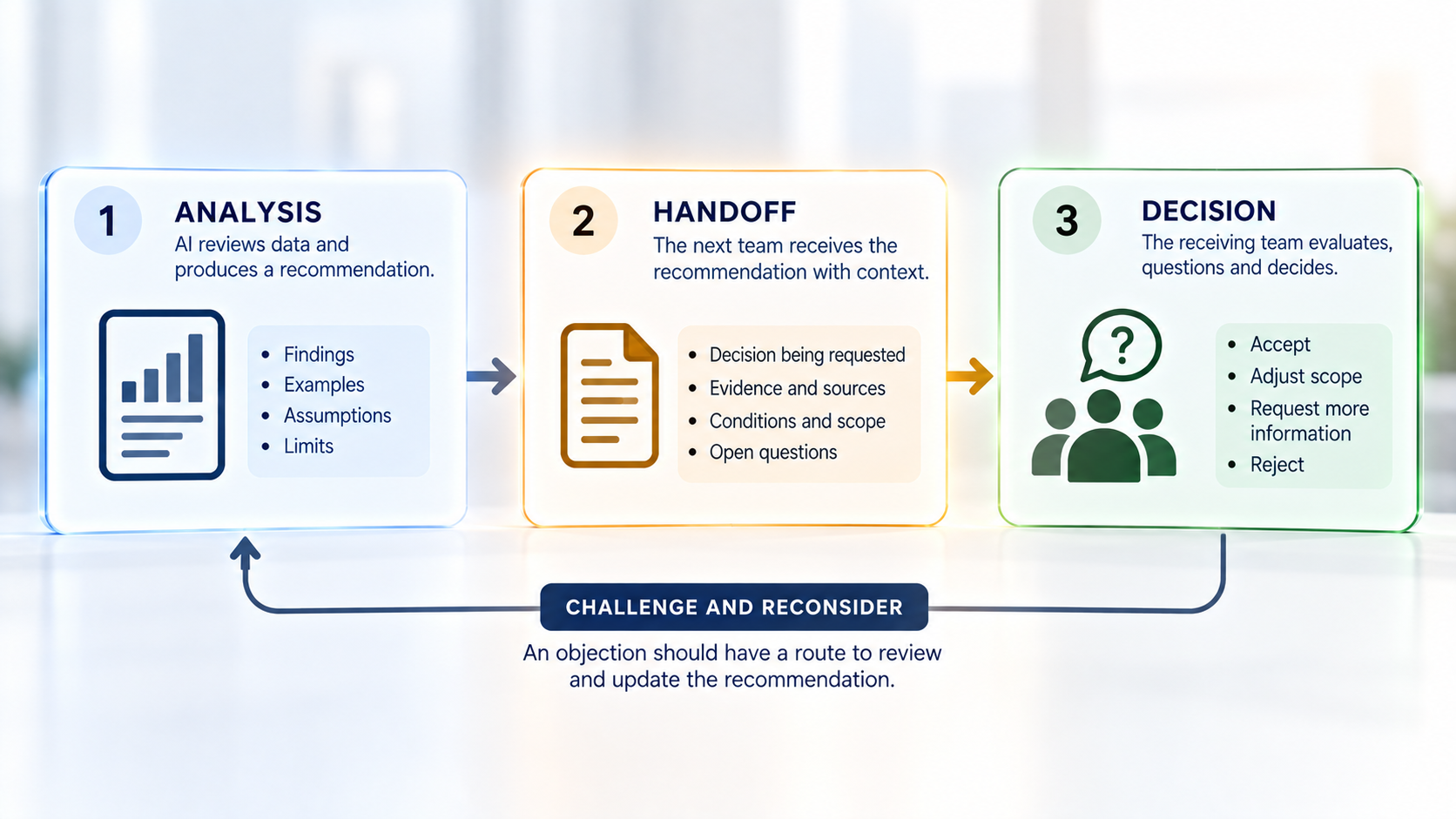
An AI recommendation can reach another team with its conclusion intact and its assumptions missing. A useful handoff preserves enough evidence, scope, and ownership for the next decision maker to question it.
What disappears between teams
Imagine an AI-assisted review recommending that a business combine two customer-support queues. The analysis identifies similar ticket categories, overlapping review steps, and an opportunity to reduce duplicate work. A summary enters a management presentation, then becomes an item for the operations team to implement. By that point, the examples behind the recommendation and the exceptions noted during analysis have disappeared from view. The conclusion has arrived, but the receiving team has little basis for deciding where it applies.
The next team has inherited a conclusion.
A receiving manager might know that the queues contain cases with different response commitments and escalation rules. That knowledge could justify combining some work while preserving separate handling for other cases. To make that judgment, the manager needs access to the conditions that made the recommendation reasonable. Otherwise, acceptance and rejection both become harder to justify.
Build the handoff around a real decision
Start by naming what the receiving team is being asked to decide. A recommendation to investigate consolidation carries a different burden from a recommendation to change the live service. The handoff should make that distinction explicit, along with the tradeoff the analysis favored. Reducing duplicate effort, improving response time, and preserving specialist review can lead to different choices even when everyone sees the same tickets.
For the queue example, the decision basis might include the ticket patterns examined, the criteria used to compare the queues, and the cases excluded from the proposed change. Link those points to records the recipient can inspect. State whether differences in response commitments were evaluated or remain an open question. A polished explanation can help organize this material, but its claims still need to be checked against the supporting evidence.
An explanation is useful when someone can use it to disagree.
A practical review can ask the receiving team to identify a condition that would change its choice. If the manager can locate the relevant evidence, explain an exception, and propose a narrower scope, the handoff supports independent judgment. If every substantive question requires reconstructing the original conversation with its participants, the apparent completeness of the summary is misleading.
Keep the burden proportional to the action. A small, reversible experiment may need a concise account of the hypothesis and its limits, while a consequential service change may require closer examination of the affected cases and operating commitments. The aim is enough information for the actual decision, with additional detail available where it matters.
Let an objection change the work
The ability to raise a concern also needs a path to reconsideration. Suppose the receiving manager finds that a subset of tickets requires a distinct escalation route. Someone must be able to decide whether that finding narrows the recommendation, calls for further analysis, or prevents the proposed consolidation. A comment left in a document has little effect if implementation continues under the original instruction.
Record the objection and its disposition alongside the recommendation. A challenge needs an owner who can reopen the recommendation. That owner may accept the new evidence, explain why it does not alter the proposal, or ask for a targeted check before work proceeds. The concern must be able to affect the decision.
Ownership becomes practical when an objection can change the work.
This also gives leaders a more useful way to review AI adoption across teams. Examine a consequential recommendation after it has moved beyond its original authors, and ask whether the current owner can still inspect its basis and obtain a review.
The handoff succeeds when the next owner has a reasoned basis for action and a working route back when that basis fails.
Those capabilities help an organization use AI recommendations while retaining the ability to correct them.
— © 2026 Rogério Figurelli. This article is licensed under the Creative Commons Attribution 4.0 International (CC BY 4.0). You are free to share and adapt this material for any purpose, even commercially, provided that appropriate credit is given to the author and the source. This work was human-directed and AI-assisted, produced with Trajecta Wisdom Machine.