
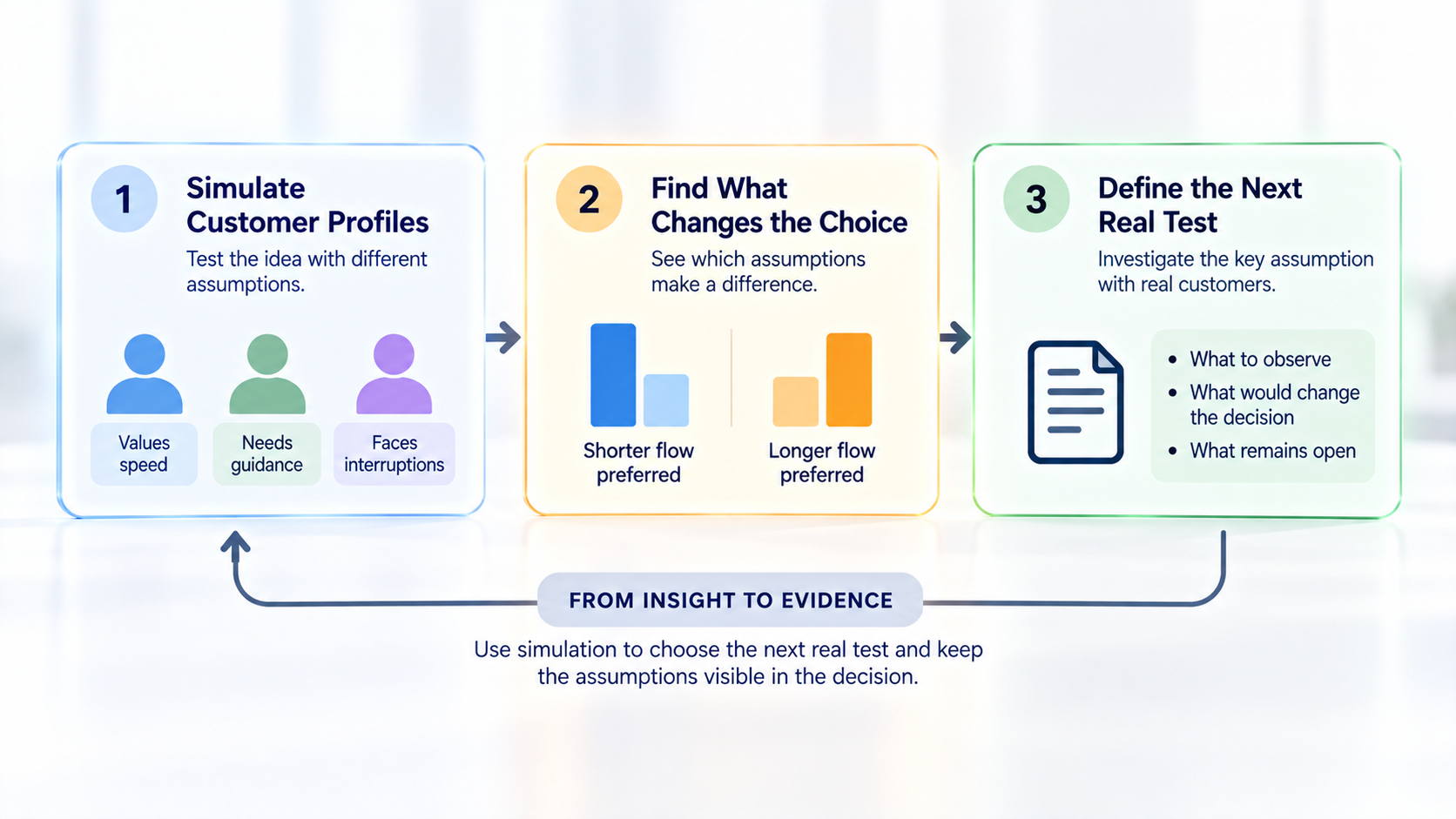
Simulated responses can reveal which customer assumptions deserve attention. Their business value depends on turning that exploration into a question that evidence from real customers can help resolve.
The customer is part of the hypothesis
Imagine a team considering a shorter onboarding flow for a digital service. The proposed design removes explanatory steps so people can reach the first useful task sooner. To explore the idea, the team creates synthetic customer profiles that emphasize convenience and speed. Those simulated customers prefer the shorter flow, and the result enters the planning discussion as support for the change.
The customer profile is part of the experiment.
The simulation has shown how the proposed design performs within a description the team supplied. That description includes what the team has assumed people value, how familiar they are with the service, and which difficulties they are likely to encounter. The favorable response may be informative about that constructed scenario, while the underlying assumptions still need examination.
Look for the assumption that changes the choice
Run the competing designs against different plausible circumstances. A person familiar with the task may value immediate access, while someone uncertain about the information required may need guidance before proceeding. Other circumstances might include an interruption during setup or the need to ask a colleague for missing information. The aim is to discover which changes in the imagined customer alter the preferred design.
Suppose the longer flow becomes preferable when uncertainty about the required information increases. A reversal identifies a question for research. The team now has a specific issue to investigate: whether that uncertainty occurs often enough, and matters enough, to change the design decision. Agreement across more variations can also be useful, provided the team retains a clear account of which assumptions those variations share.
Preserve the distance from simulation to demand
Running additional simulated participants can expand the exploration of the model and its setup. It can expose contradictions, suggest objections, or help a team compare alternative explanations. The number of generated responses, however, does not show how many actual customers encounter the condition being discussed.
More simulated agreement does not add customer observations.
If the simulation has been checked against observed behavior, make that connection explicit. Identify the kinds of behavior it has reproduced and the circumstances covered by those checks. This gives the result a bounded basis for use and makes it easier to recognize when a new business question reaches beyond what has been assessed.
Turn the sensitivity into a focused test
Choose the assumption whose resolution could most change the next action. In the onboarding example, the team could examine how people use the two flows when the required information is unfamiliar. Relevant observations might include whether they complete the first task, where they seek help, and which missing details interrupt progress. The purpose is to gather evidence that could change the choice.
Decide beforehand what those observations would mean for the design. A finding that guidance helps one group might support a targeted explanation rather than a longer flow for everyone. If the observations remain ambiguous, retain the question and narrow the next test. The simulation has still contributed by making the uncertainty specific enough to investigate.
Carry the question into the decision record
Keep the simulated result connected to the assumption that produced it and the real evidence subsequently obtained. A manager should be able to see why the team tested a particular issue, what the observations supported, and what remains unresolved. This also prevents an exploratory preference from losing its qualifications as it moves into a presentation or implementation brief.
The next question is the outcome worth carrying forward.
That gives simulation a practical role in allocating research attention. It helps a team choose where to look, what alternatives to compare, and which observations would justify proceeding with greater confidence.
— © 2026 Rogério Figurelli. This article is licensed under the Creative Commons Attribution 4.0 International (CC BY 4.0). You are free to share and adapt this material for any purpose, even commercially, provided that appropriate credit is given to the author and the source. This work was human-directed and AI-assisted, produced with Trajecta Wisdom Machine.