
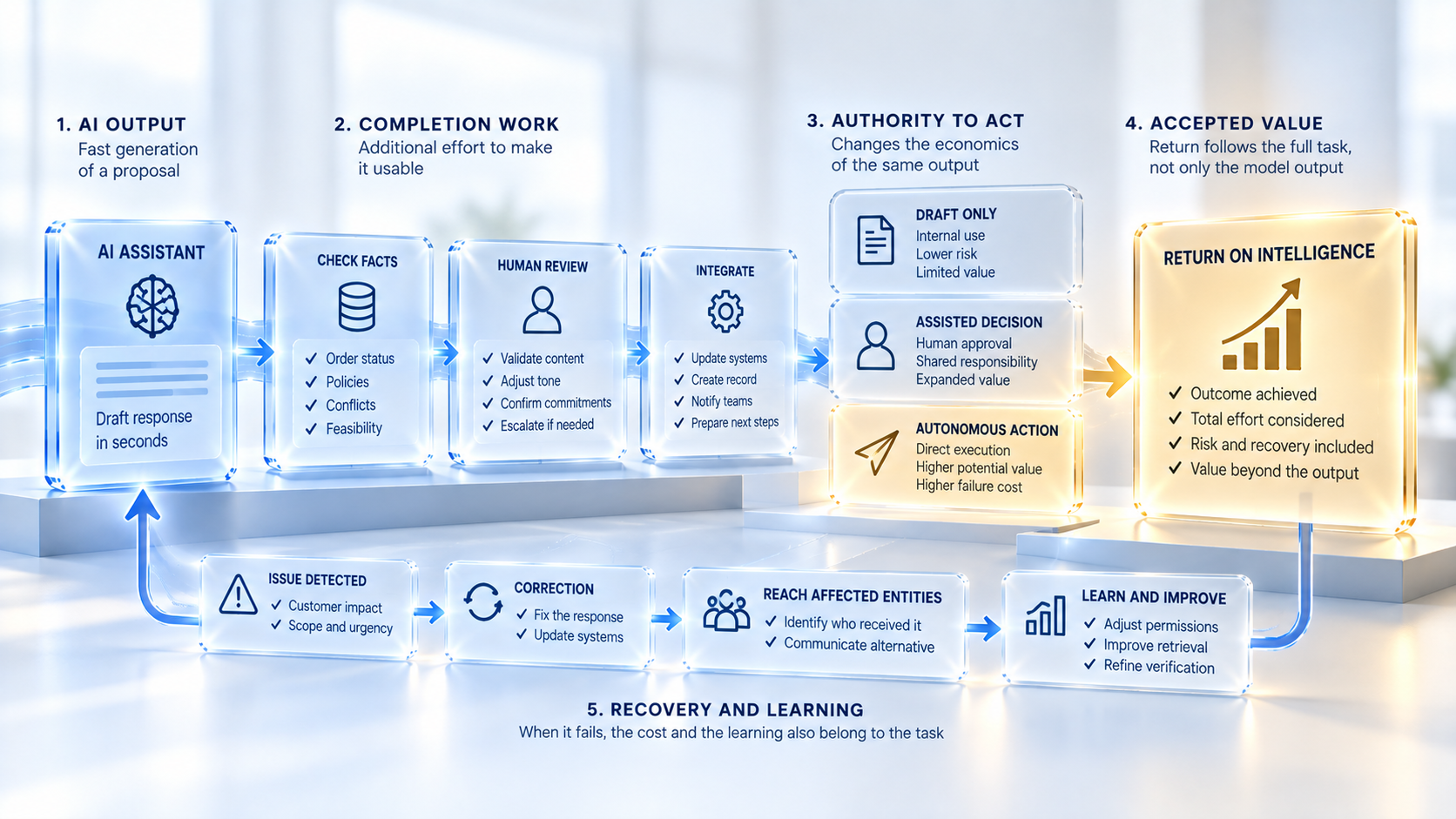
Return on Intelligence follows AI capability into accepted value. Its economics depend on the full work required to make a result usable, the authority granted to act on it, and the ability to recover when it fails.
The answer is still on its way
An AI assistant drafts a customer response in seconds. Before that response can be used, someone may need to check the order status, resolve a conflicting instruction, and establish whether the suggested commitment can be kept. The visible artifact arrived quickly. The accepted piece of work is still being produced.
Return on Intelligence, or RoI, examines that passage. It asks what the intelligence contributes to an agreed outcome once the effort required to use its contribution is included. Generating a response is one activity within that economic object.
The relevant boundary extends to the cost of completing the intended work. If a reviewer spends less time writing but more time reconstructing the basis for a recommendation, the gain needs to be assessed across both activities. If the recommendation makes the right evidence easier to find, that reduction in effort belongs in the account as well. RoI can recognize improvements in the surrounding workflow that an inference bill alone would miss.
A faster intermediate step can leave completion unchanged.
Acceptance depends on the mission. For a drafting task, a usable draft may be the intended result and deliver real value. For a task that promises to resolve the customer’s issue, the draft is an intermediate contribution. Those cases need different completion criteria even when the assistant produces exactly the same text.
Permission changes the economic object
Now give the same assistant permission to send the response. The text may barely change, but the system has acquired a consequential role. Review that previously happened before use may move to sampling, exception handling, or correction after the message has reached the customer.
This can reduce effort in a well-bounded task. It also changes which failures matter and when they become visible. A mistaken suggestion caught in a draft and a mistaken commitment already sent to a customer leave different work behind.
Authority changes the cost of being wrong.
Suppose the assistant promises a delivery date that the operation cannot support. Correcting the sentence is only part of the response. Someone may have to establish which customers received the promise and arrange a feasible alternative. The cost depends on how far the commitment traveled, how quickly the error was discovered, and what the system can reconstruct about its actions.
Recovery is therefore part of the design being evaluated. A system that records its commitments and supports targeted correction can require less repair effort than one that leaves people searching through messages. That improvement can raise the value of the intelligence in use without changing the model’s underlying ability to draft a reply.
The authority boundary still has to be satisfied.
Permission is a condition of the proposed work. A favorable return estimate cannot authorize an action that lies outside the assistant’s assigned role. RoI needs to preserve that distinction: some burdens can be reduced or priced, while the right to take the action must be established before the action qualifies for use.
Give the return a baseline and a horizon
A return claim needs a credible comparison. The alternative might be the existing human process, a simpler automation, or the same assistant with narrower authority. Compare the intended outcome under comparable conditions, including the effort carried by people around the system. Otherwise, an apparent improvement may come from completing less of the task or accepting a different quality level.
The boundary of the claim determines what the return means.
Time also matters. Immediate savings in preparation can coexist with correction work that arrives later. A short trial may establish that an assistant produces useful drafts while leaving its behavior under broader authority untested. That supports a bounded claim about drafting. Continued use needs evidence appropriate to the work the system is actually allowed to perform, including the consequences that emerge beyond the first interaction.
This makes the surrounding architecture economically visible. Reliable access to the relevant facts can reduce review effort; a narrower permission can keep a mistake from spreading; a usable correction path can shorten recovery. The return can improve because less work is required to make the same intelligence dependable. RoI makes those contributions part of the evaluation and asks whether the accepted outcome justifies the complete cost of reaching it.
— © 2026 Rogério Figurelli. This article is licensed under the Creative Commons Attribution 4.0 International (CC BY 4.0). You are free to share and adapt this material for any purpose, even commercially, provided that appropriate credit is given to the author and the source. This work was human-directed and AI-assisted, produced with Trajecta Wisdom Machine.