
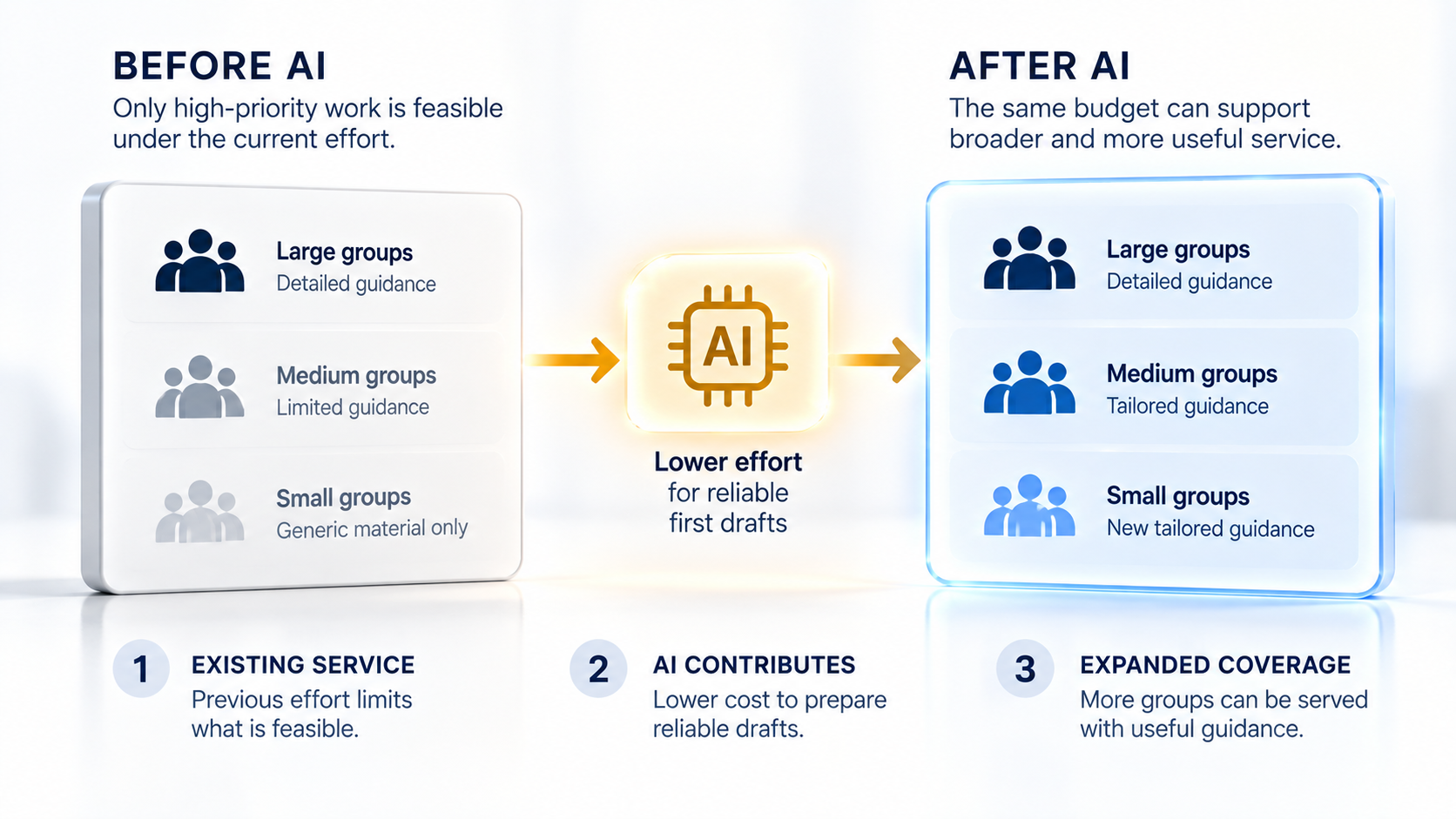
Lowering the effort behind a task can change which work an organization is willing to undertake. AI value can therefore appear as wider service or better coverage, even when total spending stays unchanged.
A lower cost can change the service itself
Imagine an organization that prepares detailed onboarding guidance only for its largest employee groups. Smaller groups receive generic material because producing and maintaining tailored guidance would require more effort than the organization can justify.
If AI reduces the effort needed to prepare a useful first draft, the team may be able to serve those smaller groups. Expert review remains necessary, but the balance of work changes. The same budget could support a broader service.
When the cost changes, the scope can change.
A savings calculation based on the original workload could miss this development. The organization may spend much the same amount while providing something it previously could not offer. The value claim then concerns the additional need being met.
Expanded coverage needs an outcome
The opportunity depends on a previously underserved need being met. Producing more material establishes that the organization has expanded its output. Establishing value requires evidence that the additional material helps people do something useful.
For the onboarding team, tailored guidance might help smaller groups complete unfamiliar tasks with fewer requests for assistance. That benefit would need to be examined in practice. Content that remains unused creates little justification for the expanded service.
An engineering team faces a related possibility. Lower investigation effort could make recurring exceptions worth examining instead of repeatedly handling them case by case. The useful result would be a workable improvement that reduces the burden of those exceptions.
More activity still needs a reason to exist.
The new work comes with new obligations
Expanded coverage creates a larger body of work to sustain. Guidance needs owners who can keep it accurate as processes change. Lower production effort can create a larger maintenance commitment. That commitment belongs in the assessment from the beginning.
The onboarding example therefore involves more than preparing drafts. The team must review the material and maintain it over time. Serving additional groups could be worthwhile, but its justification depends on those obligations remaining manageable alongside the benefit.
The same reasoning applies to engineering improvements. An investigation may become affordable while the resulting solution still introduces support work. The organization should examine the full path from initial effort to useful, sustainable adoption.
Keep the two sources of value visible
For work whose scope stays fixed, AI may produce a saving by reducing the total effort needed to deliver an acceptable result. That is a valuable outcome when the reduction survives review, correction, and ongoing operation.
Where the service expands, a different question arises. The organization needs to assess what the added work accomplishes and whether that benefit justifies its full cost. An unchanged budget can coexist with a worthwhile improvement in coverage.
An initiative may produce both kinds of benefit. Keeping these gains separate makes the trade-off visible. Leaders can then understand how much capacity was released and what the organization chose to do with it.
The return lies in useful work made possible at a justified cost.
— © 2026 Rogério Figurelli. This article is licensed under the Creative Commons Attribution 4.0 International (CC BY 4.0). You are free to share and adapt this material for any purpose, even commercially, provided that appropriate credit is given to the author and the source. This work was human-directed and AI-assisted, produced with Trajecta Wisdom Machine.