
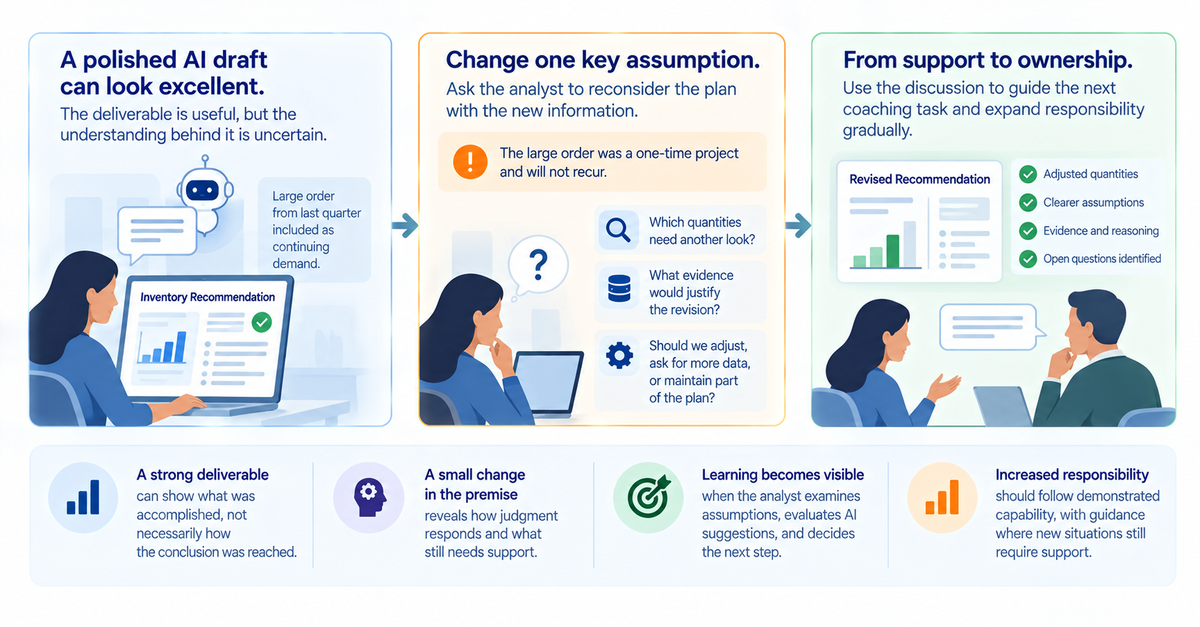
An excellent deliverable can show what an employee accomplished with AI while leaving their understanding uncertain. Employee development needs opportunities to see how judgment holds up when the situation changes.
When the Deliverable Stops Revealing the Method
Consider a hypothetical analyst using AI to prepare an inventory replenishment recommendation. The document explains recent demand and presents a coherent ordering plan. A manager reviewing the finished work could reasonably consider the recommendation useful while still having an unanswered question about the analyst’s readiness.
The recommendation treats a large order from the previous quarter as evidence of continuing demand. Suppose that order came from a customer completing a one-time project. Recognizing that distinction matters to the next purchasing decision, yet the document alone does not reveal whether the analyst examined that distinction or accepted an assumption supplied by the assistant.
This leaves two different judgments for the manager. One concerns whether the recommendation is suitable for use; the other concerns what responsibility the analyst is ready to carry. AI can help someone produce a strong answer before a manager has enough evidence to judge their understanding, making the quality of the work and the development of the worker separate questions.
Change One Assumption
A useful development conversation could begin with a small change to the case. The manager confirms that the bulk order will not recur and asks the analyst to reconsider the recommendation. The exercise is openly framed as practice, with the same tools available and a specific learning objective: understanding how the demand assumption affects the proposed purchase.
The revealing moment is what the analyst decides to reconsider.
An analyst might immediately reduce every order quantity, investigate which products were associated with the project, or ask whether ordinary demand has changed independently. Those responses point toward different reasoning needs. The manager can ask what evidence would distinguish the possibilities and observe whether the analyst connects that evidence to a revised recommendation.
AI can assist throughout this exchange. Before asking it to revise the plan, the analyst could state which part of the original recommendation seems vulnerable and why. After receiving a revision, they could inspect whether it addressed that issue and identify anything still requiring confirmation. These steps give the manager something more specific to discuss than the fluency of the final explanation.
The exercise should also permit a defensible pause. If the analyst explains that the available records cannot separate project demand from recurring demand, requesting the missing information may be an appropriate response. A development process that rewards only immediate completion would miss that evidence of understanding.
This conversation provides a limited observation of judgment in one case. Further supervised work can show whether the analyst recognizes similar issues without prompting, including situations where an unusual order should remain in the forecast because there is evidence it will recur.
Build a Path From Support to Ownership
For a leader, the practical task is to make learning visible within productive work. A team could use a small selection of completed recommendations for coached discussion, each chosen because it exposes a consequential assumption. The discussion can reveal a specific next step: learning how demand is classified or checking an assistant’s interpretation.
Support can remain available while responsibility increases.
A manager could initially review how the analyst identifies exceptions, then gradually delegate a wider range of cases as understanding becomes clearer. The progression should follow demonstrated capability within a defined scope. Handling one familiar variation offers useful evidence, while a new product category or a different demand pattern may still call for guidance.
The development question is what the person can reliably take responsibility for with the tools they use. That includes knowing when to seek help and being able to evaluate the help received. Manual completion can sometimes serve a learning objective, while assisted work can also expose understanding when the task requires the person to examine an assumption and defend an appropriate next step.
This has implications for how leaders plan AI adoption. Time released from drafting can create room for feedback and supervised practice, if that work is deliberately included in the operating model. An improved deliverable then supports both the immediate business task and a more informed decision about the employee’s next responsibility.
— © 2026 Rogério Figurelli. This article is licensed under the Creative Commons Attribution 4.0 International (CC BY 4.0). You are free to share and adapt this material for any purpose, even commercially, provided that appropriate credit is given to the author and the source. This work was human-directed and AI-assisted, produced with Trajecta Wisdom Machine.