
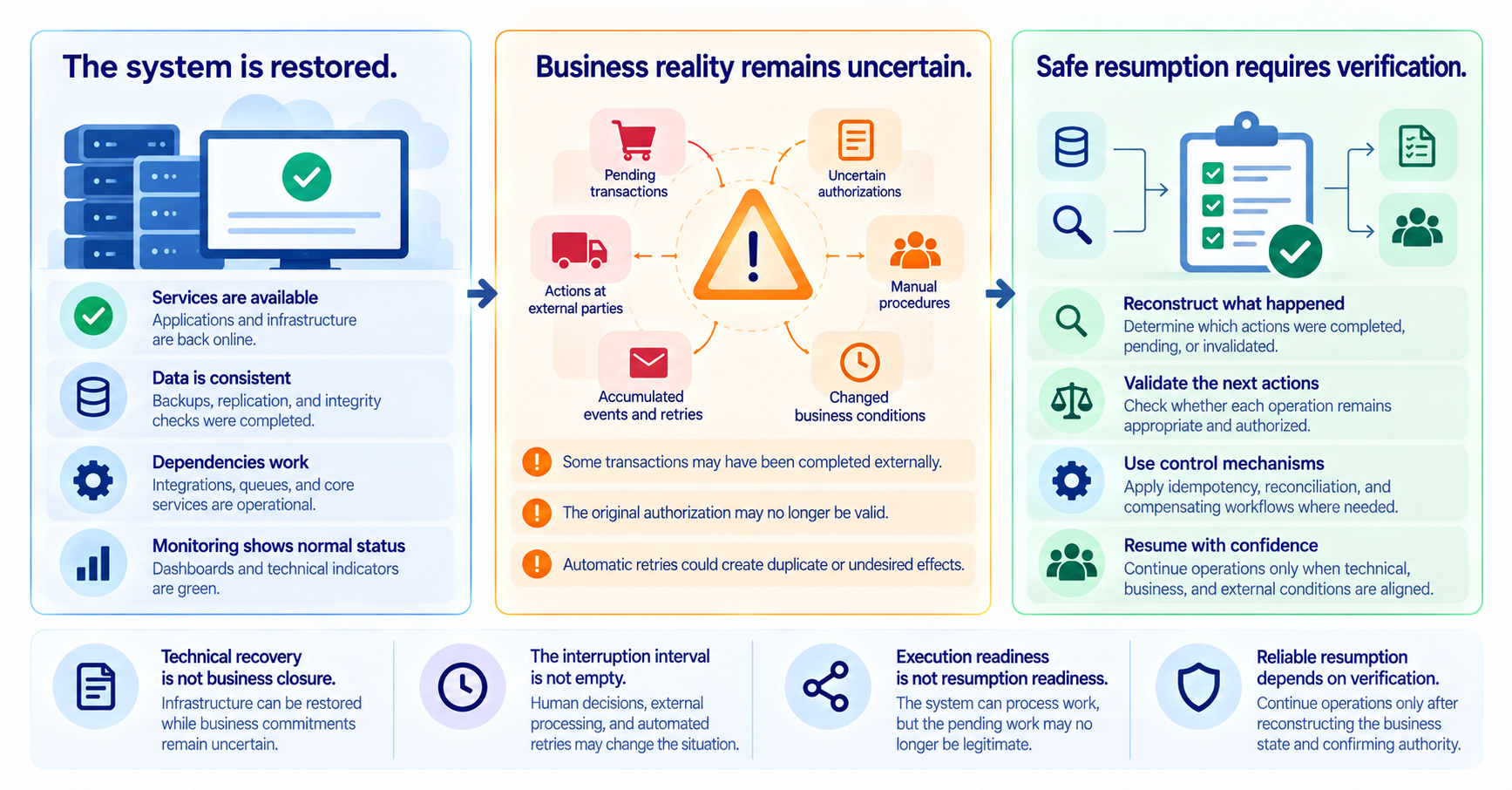
Technical recovery can restore infrastructure while leaving business transactions, authorizations, and obligations unresolved. Reliable resumption requires understanding what happened during the interruption and determining which actions can safely continue.
Recovery Restores a System to a State, Not Necessarily to Its Business Reality
A major system interruption creates an apparently straightforward objective: restore the affected services, recover the necessary data, and return the environment to normal operation. Infrastructure teams focus on availability, data integrity, service dependencies, and recovery targets. When the applications become accessible and the monitoring dashboards turn green, the recovery process may appear complete.
But the business does not necessarily return to the same state.
Imagine a purchasing platform that becomes unavailable while several transactions are in progress. Some purchase orders have been submitted but not confirmed. Others have reached external suppliers, although the corresponding internal acknowledgments were never recorded. Employees may have initiated manual procedures during the outage, and automated integrations may have accumulated events awaiting delivery.
Restoring the platform does not automatically resolve these conditions. It may recover the technical environment while preserving uncertainty about which business commitments already exist, which actions remain pending, and which operations should never be repeated.
Technical availability and business continuity are related, but they are not equivalent properties.
This distinction becomes increasingly important as enterprise processes extend across cloud services, event-driven integrations, external platforms, and autonomous software components. The technical boundaries used to organize recovery rarely coincide perfectly with the boundaries of business responsibility.
A database can be consistent within its own transaction history while the wider business process remains uncertain. A message queue can be operational while containing actions whose original authorization is no longer valid. An external API can be reachable while the organization’s understanding of the transaction it previously submitted remains incomplete.
The system may be working precisely as designed.
The unresolved problem is whether its next actions still make sense in the business state that now exists.
The Missing Interval Between Failure and Restoration
Traditional recovery planning often treats an interruption as a period to be minimized. Recovery Time Objective (RTO) and Recovery Point Objective (RPO) provide important measures of tolerable service downtime and data loss. They help organizations design backup, replication, failover, and restoration strategies.
Yet neither measure independently establishes that every business process can resume safely.
The interval between interruption and restoration is not necessarily empty. Human decisions continue, external systems may process requests, automated retries can accumulate, and business conditions may change while internal services remain unavailable.
Consider a payment instruction transmitted immediately before an outage. The originating application loses connectivity without receiving confirmation. After restoration, its local record still shows an incomplete transaction.
The technically obvious response may be to retry.
But if the payment was already executed by the receiving institution, the retry could create a duplicate financial effect. A reliable recovery process must determine whether the original action occurred, whether its result can be reconstructed, and whether another execution is permissible.
Established engineering techniques such as idempotency keys, durable transaction identifiers, deduplication, reconciliation, and compensating workflows can reduce these risks. Their effectiveness, however, depends on the actual boundaries they cover. An idempotent local API does not establish that every downstream external consequence can be safely repeated.
The essential recovery problem is therefore not limited to recovering stored state. It includes recovering enough knowledge about unfinished and externally completed actions to determine what may happen next.
In AI-enabled environments, this issue acquires an additional dimension. An agent may have selected an action using information that was valid before the interruption but is no longer current when execution becomes possible again.
The action could remain technically executable while its original business justification has expired.
Recovering the execution environment cannot, by itself, renew the authority under which that action was originally selected.
When Green Dashboards Create Premature Confidence
Operational monitoring is usually organized around observable technical conditions: infrastructure health, service availability, resource utilization, error rates, latency, and transaction processing.
These signals are valuable. They help establish whether the technology can process work.
They cannot always establish whether the work waiting to be processed is still legitimate.
A recovered workflow may contain delayed requests that were valid when created but no longer appropriate. An inventory reservation may have been fulfilled manually. A customer order may have been canceled through another channel. An automated approval may reference a policy version that was replaced during the interruption.
Blindly replaying the accumulated workload could reproduce outdated intentions in a changed business environment.
This creates a distinction between execution readiness and resumption readiness.
Execution readiness concerns whether the infrastructure, application, and dependencies can perform their designated technical functions. Resumption readiness additionally concerns whether the pending actions remain valid under the current business state, whether uncertain transactions have been reconciled, and whether unresolved cases can be identified before consequential execution.
The requirements will vary by domain. A content delivery service may tolerate automatic resumption after basic consistency checks, whereas a payment, healthcare, or critical infrastructure workflow may require stronger validation and explicit authorization.
The relevant distinction is proportional, not absolute.
Organizations do not need complete knowledge of every event before restoring any service. They need enough evidence to determine which activities can safely resume, which require restricted operation, and which must remain suspended until uncertainty is resolved.
This becomes particularly important when automated services are designed to recover independently. Restart policies, retry mechanisms, and self-healing infrastructure are useful mechanisms for technical resilience. Yet a restart mechanism that restores execution without reconsidering consequential business conditions may reintroduce precisely the actions that recovery should have held for examination.
A healthy service can still be carrying an unhealthy obligation.
Resumption Should Become an Explicit Architectural Decision
The practical implication is that recovery design should include an explicit business-resumption boundary rather than treating restored availability as automatic permission to resume all processing.
Such a boundary does not necessarily require a new centralized platform or a human approval for every transaction. It requires the architecture to preserve the distinction between restoring a component and authorizing its consequential behavior after restoration.
For a critical workflow, resumption controls might examine the last reliably committed business state, reconcile transactions with external systems, identify pending or ambiguous effects, validate the current authority for delayed actions, and determine which workloads can be released.
Where uncertainty remains, the organization may resume unaffected services while isolating particular transactions or workflows. In some cases, compensating operations or manual investigation will be necessary. In others, existing idempotency and reconciliation guarantees may provide sufficient evidence for automated continuation.
The essential question is whether the recovery process knows which assumptions make resumption safe and how to detect when those assumptions no longer hold.
A useful architectural extension would therefore distinguish the evidence supporting infrastructure restoration from the evidence supporting business resumption. Both may be obtained automatically when controls are sufficiently reliable. Their separation is conceptual and operational, not necessarily a requirement for additional organizational bureaucracy.
This also changes how recovery exercises should be designed.
Testing only whether services can be restored within a target interval may overlook the business consequences of delayed actions, partial completion, and external state changes. Recovery exercises can introduce interrupted transactions, uncertain acknowledgments, expired authorizations, and competing manual interventions to evaluate how the organization handles the resulting ambiguity.
The objective is not to manufacture failure scenarios indefinitely. It is to discover whether the organization can distinguish a technically recoverable system from a business process that is ready to continue.
There is a deeper architectural implication here.
As enterprises increase automation, the interval between technical recovery and consequential action may become extremely short. Systems that restart successfully may immediately begin processing accumulated decisions, sometimes before operational teams have understood what changed during the interruption.
The speed of recovery can therefore expose a weakness in the governance of resumption.
A mature recovery architecture should support rapid restoration where it is justified, controlled continuation where uncertainty remains, and deliberate suspension when consequential actions cannot yet be trusted.
Infrastructure recovery remains essential, but it is only one part of restoring organizational continuity.
The business has genuinely resumed when its next actions are not merely executable, but sufficiently consistent with the commitments, conditions, and authority that survived the interruption.
— © 2026 Rogério Figurelli. This article is licensed under the Creative Commons Attribution 4.0 International (CC BY 4.0). You are free to share and adapt this material for any purpose, even commercially, provided that appropriate credit is given to the author and the source. This work was human-directed and AI-assisted, produced with Trajecta Wisdom Machine.