Enterprise technology strategy is becoming more difficult because IT, data, cybersecurity, and artificial intelligence increasingly evolve through different priorities, investment cycles, and operating assumptions. The challenge for business leaders is no longer simply developing strong strategies for each domain, but ensuring that their combined decisions create an organization capable of moving in the same direction.
When Every Technology Strategy Makes Sense
Consider a hypothetical industrial equipment company developing its next three-year technology strategy.
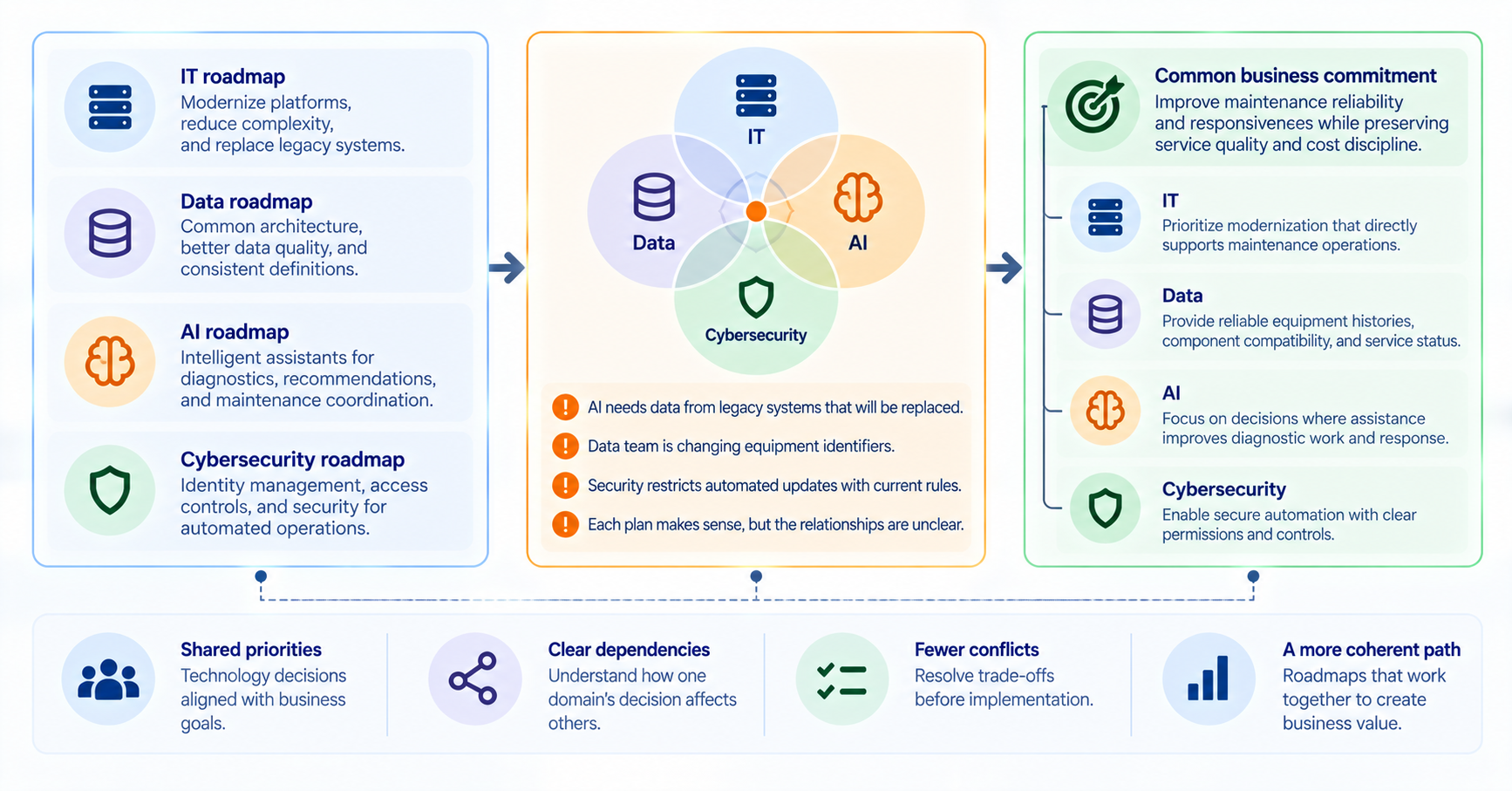
The IT organization proposes modernizing the enterprise resource planning platform, reducing integration complexity, and replacing legacy applications. Its priorities are understandable: improve reliability, lower technical debt, and create a more maintainable architecture.
The data organization proposes a common information architecture, stronger data quality controls, and consistent definitions for customers, products, and service activities.
Meanwhile, the AI team wants to introduce intelligent assistants capable of helping technicians diagnose equipment problems, recommend replacement parts, and coordinate maintenance activities.
Cybersecurity has its own priorities, including identity management, privileged access, and stronger controls over automated operations.
Every strategy addresses a legitimate problem.
Each team prepares a roadmap, identifies investments, and develops performance indicators. Leadership approves the initiatives because their individual business cases appear reasonable.
But an important problem emerges during implementation.
The AI assistant needs reliable access to equipment histories held in legacy systems that IT intends to replace. The data team is redefining equipment identifiers, while the AI project has already built integrations using existing definitions.
Cybersecurity restricts automated updates to maintenance records because the authority model was designed for human employees, not software agents.
The organization has several credible technology strategies but no sufficiently explicit agreement about how they should work together.
Individual strategic excellence does not guarantee collective strategic coherence.
The difficulty is not that the teams have developed poor plans. It is that their plans describe different parts of a future operating environment without fully governing the relationships between them.
Strategy Begins Where Roadmaps Intersect
Technology roadmaps are valuable instruments for sequencing investments, managing dependencies, and communicating planned changes.
But a roadmap primarily describes what an organization intends to do.
A strategy must also explain why certain choices take precedence, what alternatives are being rejected, and which commitments must remain valid when individual plans change.
These questions become more consequential as AI moves from isolated analysis toward participation in operational activities.
In the industrial equipment company, the AI assistant may recommend replacing a component based on technical evidence. But that recommendation must eventually interact with inventory availability, commercial agreements, maintenance schedules, and the authority to approve service work.
Each domain has its own rules and responsibilities.
The AI team may optimize diagnostic accuracy. IT may optimize platform reliability. Operations may prioritize service continuity, while finance focuses on the economic consequences of maintenance decisions.
None of these priorities is inherently wrong.
The strategic problem is deciding how they should interact when their preferred outcomes conflict.
For example, should an AI assistant recommend a technically ideal component when the required part cannot be delivered within the customer’s service window? Should it propose an alternative part, request human review, or defer the recommendation until inventory is confirmed?
The appropriate response depends on business commitments that cannot be determined by model performance alone.
The real architecture of enterprise strategy appears where one domain’s decision becomes another domain’s constraint.
This changes the role of enterprise architecture.
Architecture cannot remain limited to documenting applications, data flows, interfaces, and infrastructure. It must also help the organization understand how strategic commitments are translated into systems, information, permissions, and operational behavior.
A technically valid integration can still implement the wrong business relationship.
A successful AI model can still produce recommendations that the surrounding organization cannot responsibly execute.
Strategy must connect both.
Build Around Business Commitments, Not Technology Categories
The industrial equipment company can approach the problem differently by beginning with a specific business commitment.
Suppose leadership establishes a strategic objective: improve the reliability and responsiveness of equipment maintenance while preserving service quality and cost discipline.
This objective becomes the common reference for decisions across technology domains.
IT can evaluate which modernization activities most directly improve the continuity and adaptability of maintenance operations.
The data organization can prioritize the information needed to establish reliable equipment histories, component compatibility, and service status.
The AI team can focus on decisions where intelligent assistance improves diagnostic work or helps employees respond more effectively.
Cybersecurity can establish the conditions under which automated systems are permitted to access information, recommend actions, or initiate changes.
These remain different responsibilities.
The difference is that they now participate in a shared business commitment rather than pursuing independent definitions of technological progress.
That commitment must be sufficiently concrete to guide trade-offs.
For instance, leadership might determine that an AI assistant may recommend maintenance actions but cannot independently authorize a customer charge or substitute a component that requires engineering approval.
The organization would then need to implement those distinctions across its AI applications, service platforms, identity systems, and operational workflows.
The resulting architecture supports the business objective while making clear where different forms of authority reside.
Importantly, this does not require putting every initiative under one department or forcing all technology teams into a single delivery schedule.
Some modernization work must proceed independently because it addresses resilience, security, or technical obligations that exist regardless of the AI program.
The common strategy should coordinate material dependencies without eliminating legitimate specialization.
A unified strategy does not require identical roadmaps. It requires compatible commitments.
This provides leadership with a more useful basis for investment decisions.
Instead of asking whether every technology domain has delivered its roadmap, executives can examine whether those investments are collectively improving the capabilities the business actually needs.
Design for Technology That Will Change
A technology strategy must also remain useful when its underlying technologies evolve.
This is particularly important for AI, where model capabilities, provider offerings, integration approaches, and commercial conditions may change faster than traditional enterprise planning cycles.
Imagine that the industrial equipment company selects an AI model for maintenance diagnostics.
Over time, another model may offer better performance, a provider may change its commercial conditions, or a new regulatory or security requirement may affect the deployment.
If the organization’s maintenance processes, decision rules, and business knowledge are inseparably embedded in one provider-specific implementation, changing technology may require reconstructing much of the solution.
That dependency is sometimes acceptable. Deep integration can provide capabilities and efficiencies that generic abstraction cannot.
The strategic question is whether the organization understands which dependencies it is accepting and what business consequences would follow from changing them.
Where feasible, the company can maintain clear boundaries between its maintenance knowledge, operational rules, identity and authorization mechanisms, enterprise records, and the AI components performing specific analytical functions.
These boundaries need not make every component interchangeable.
Real portability involves migration effort, testing, interface differences, security review, and potentially changes in system behavior.
But a deliberate architecture can reduce the number of business commitments that must be reconsidered when one technological component changes.
The company might change its diagnostic model while preserving approved component catalogs, maintenance histories, and the rules governing service authorization.
It would still need to validate the new model’s outputs and assess its integration into the workflow.
The strategic advantage is not effortless replacement.
It is the ability to make a technology change without unnecessarily losing the organizational capabilities already established.
This distinction helps explain why long-term IT and AI strategies should not be based entirely on specific products, models, or vendor roadmaps.
Those choices matter for execution, but they are not necessarily the most durable part of the strategy.
The more lasting commitments concern what the organization must be able to do, what information and authority those activities require, and which qualities must survive technological change.
Make Strategic Coherence Measurable
Once the technology domains share a common business direction, leadership still needs evidence that the combined strategy is working.
Traditional technology measures remain useful.
IT can monitor system availability, modernization progress, incident rates, and technical debt. AI teams can evaluate model quality, operating costs, and task performance. Cybersecurity can assess control effectiveness and exposure to threats.
But these indicators do not necessarily reveal whether the organization is becoming strategically more capable.
In the maintenance scenario, a technically successful AI deployment might generate accurate recommendations that technicians rarely use because the information arrives too late or does not fit their workflow.
A completed data-platform migration might improve infrastructure consistency while leaving critical equipment information incomplete.
A modernization program might reduce the number of legacy applications without improving the time required to resolve customer problems.
Each initiative can report progress while the intended business capability remains constrained.
Leadership therefore needs to examine outcomes that depend on the interaction of these investments.
For the industrial equipment company, relevant evidence could include whether technicians can obtain trustworthy diagnostic information when needed, whether recommended actions can be carried through authorized workflows, and whether maintenance decisions improve service reliability without introducing unacceptable cost or risk.
These measures connect the strategy to operational reality.
They also expose where the organization’s assumptions need correction.
If model accuracy improves but technicians continue rejecting recommendations, the problem may involve workflow suitability, missing context, or trust in the available evidence.
If technicians accept recommendations but repairs remain delayed, the constraint may belong to parts availability or service coordination.
The answer is not automatically another AI investment.
It may require a change in data management, operating procedures, system integration, or the original strategic priority.
Strategic governance becomes more valuable when it can identify which part of the organization must change, rather than simply reporting that an initiative failed to meet a target.
The Strategy That Survives Its Technologies
The future of enterprise technology will not be defined by one roadmap.
Cloud infrastructure, enterprise applications, cybersecurity, data platforms, AI models, intelligent agents, and emerging technologies will continue developing at different speeds.
Organizations cannot eliminate these differences, and attempting to synchronize every decision may create unnecessary rigidity.
The strategic challenge is to establish a durable direction through which specialized technologies can evolve without repeatedly breaking the commitments that connect them to the business.
For CIOs, CTOs, CDOs, and AI leaders, this requires a shared understanding of which capabilities matter, which dependencies deserve coordinated investment, and which decisions need authority beyond an individual technology team.
It also requires recognizing that not every new technological capability should become an organizational priority.
A new AI model may improve performance without changing the business case. A new platform may reduce technical complexity without justifying migration. A new automation opportunity may be attractive while conflicting with more important operational commitments.
Strategy provides the basis for making these distinctions.
The strongest enterprise technology strategy is not necessarily the one with the most ambitious transformation portfolio or the largest collection of AI initiatives.
It is the one that allows the organization to make coherent choices as technologies, business needs, and operating conditions change.
IT strategy should not compete with AI strategy for ownership of the future.
Together, they should define which future the enterprise is capable of building, operating, and sustaining.
The technologies will change. The strategy must explain what is worth preserving through that change.
— © 2026 Rogério Figurelli. This article is licensed under the Creative Commons Attribution 4.0 International (CC BY 4.0). You are free to share and adapt this material for any purpose, even commercially, provided that appropriate credit is given to the author and the source. This work was human-directed and AI-assisted, produced with Trajecta Wisdom Machine.