
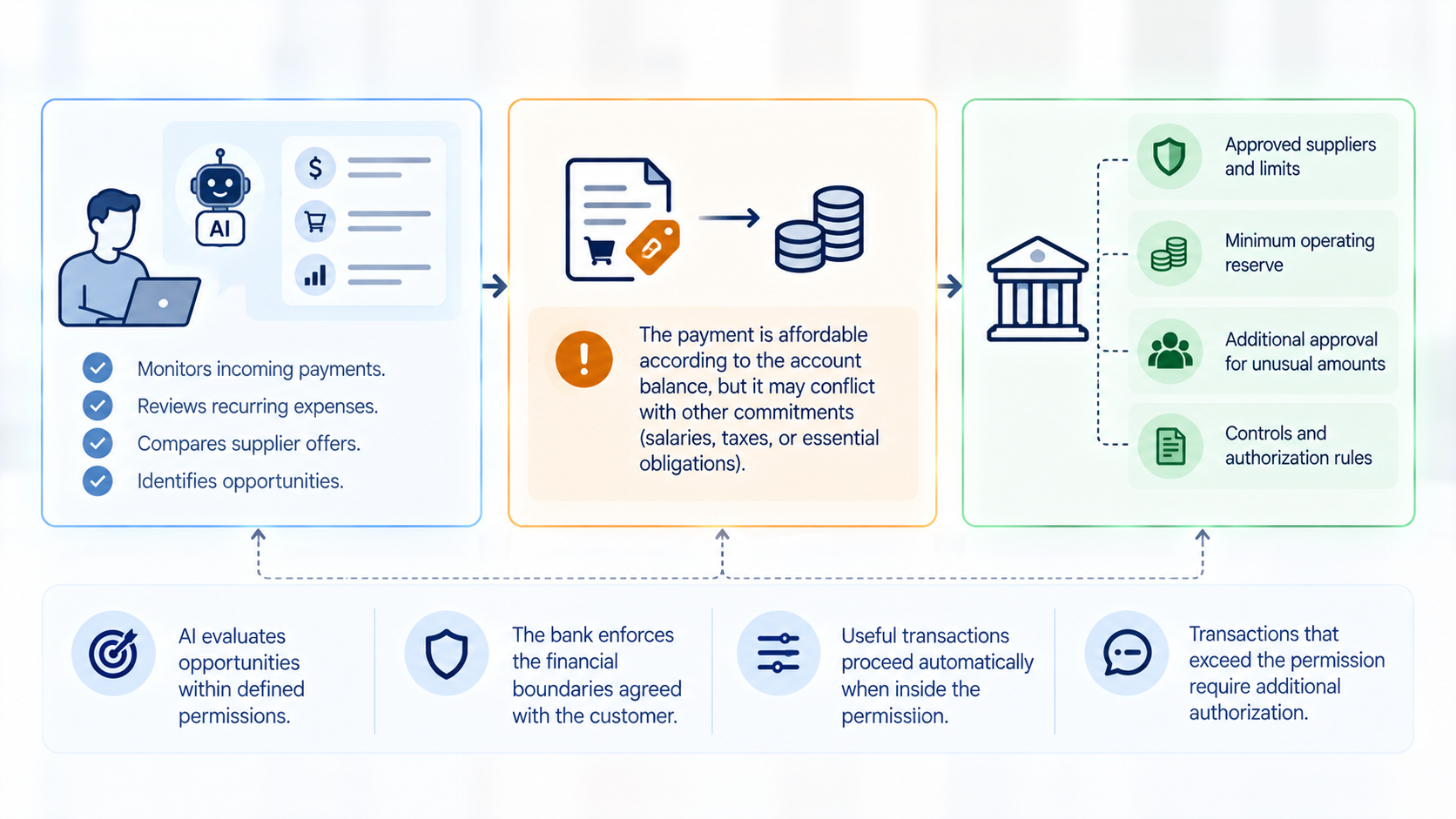
The future of banking may be shaped less by how easily customers can initiate transactions and more by how intelligently financial institutions protect the decisions made on their behalf. As AI agents begin to manage financial activities, banks face a new responsibility: preserving customer intention, authority, and trust when financial actions no longer require direct human interaction.
When the Customer Stops Initiating Every Transaction
Consider a hypothetical small business owner who uses an AI assistant to help manage everyday financial activities. The assistant monitors incoming payments, reviews recurring expenses, compares supplier offers, and identifies opportunities to improve cash flow.
The business owner has a straightforward objective: maintain sufficient liquidity for essential obligations while reducing unnecessary costs.
One morning, the assistant identifies a supplier offering a significant discount for immediate payment. The purchase would reduce future expenses, and the business account contains enough money to complete the transaction.
From a narrow financial perspective, the opportunity appears attractive.
But the available balance includes funds the owner intends to preserve for employee salaries and upcoming tax obligations. Those commitments are not immediately visible in the transaction itself, and the assistant’s information may not fully reflect their importance.
The proposed payment is affordable according to the account balance but potentially inconsistent with the customer’s broader financial purpose.
Money that is available is not necessarily money that is free to spend.
Traditional digital banking places much of the transaction decision directly in the customer’s hands. A person reviews an amount, selects a recipient, and authorizes a payment through an application or another banking channel.
With delegated AI, the relationship becomes more complicated.
An assistant may interpret financial objectives, evaluate alternatives, and initiate actions without asking the customer to reconsider every individual transaction.
The bank must now distinguish between a technically valid payment instruction and an action that remains within the authority the customer intended to delegate.
From Transaction Authorization to Continuing Permission
Banking security has traditionally devoted considerable attention to establishing identity, protecting credentials, detecting fraud, and confirming whether a transaction is authorized.
These responsibilities remain essential.
But AI-mediated financial activity introduces another question: what does authorization mean when a customer grants an intelligent system permission to make multiple decisions over time?
An instruction such as managing supplier payments contains considerable ambiguity.
It does not necessarily establish which suppliers are acceptable, which obligations have priority, how much liquidity must remain available, or when an unexpected transaction requires additional approval.
The assistant may be technically capable of executing a payment while lacking sufficient authority to determine whether the payment should occur.
For financial institutions, the opportunity is to help customers establish clear boundaries around delegated financial activity.
A business owner might authorize an assistant to pay approved suppliers within defined limits while requiring confirmation for unusual amounts, new recipients, or transactions that would reduce liquidity below a protected threshold.
Those conditions could be represented through explicit permissions, payment controls, and appropriate authorization mechanisms.
The bank would not need to interpret every aspect of the customer’s business strategy. It would need to enforce the financial boundaries it has legitimately agreed to support.
This distinction is important because banks cannot assume they possess complete knowledge of customers’ intentions.
A customer may maintain obligations outside the institution, hold funds across several providers, or face circumstances that are not represented in available financial data.
The future of financial autonomy depends on making permission more precise, not merely making execution more automatic.
The strategic opportunity is not unlimited delegation.
It is creating arrangements in which financial automation can operate usefully without silently expanding the authority originally granted.
The Bank as a Guardian of Financial Boundaries
Imagine that the small business owner establishes a minimum operating reserve for essential obligations.
The AI assistant remains free to evaluate supplier discounts and recommend payments. However, a proposed transaction that would cross the protected reserve requires additional authorization.
The system has not rejected the assistant’s analysis as incorrect.
It has recognized that a potentially useful transaction carries a consequence exceeding the permission available for automatic execution.
That difference creates a more useful relationship between intelligence and control.
The assistant can identify opportunities, while the bank’s payment infrastructure enforces agreed financial limits and ensures that the relevant authorization conditions are satisfied before committing funds.
The customer can then decide whether the opportunity justifies an exception.
Not every financial activity requires this level of intervention.
Recurring payments to established suppliers may proceed automatically when they remain within agreed conditions. New recipients, unusually large transfers, or changes affecting protected balances may require additional confirmation.
The appropriate boundaries depend on the customer, transaction type, applicable rules, and risks involved.
The objective is not to introduce unnecessary friction into every automated payment.
It is to place friction where the consequences justify it.
This also has implications for the competitive position of banks.
As customers increasingly interact with financial services through external AI assistants, the institution providing the account may no longer control the primary interface through which financial decisions begin.
The customer relationship could become distributed across AI platforms, financial institutions, payment networks, and specialized service providers.
Banks may therefore need to compete through capabilities that remain valuable even when the interaction occurs elsewhere.
Reliable authorization, protected financial boundaries, secure execution, understandable controls, and responsive dispute handling can become important elements of that relationship.
A bank may become less visible in the customer journey while becoming more important to its integrity.
That opportunity does not give financial institutions unlimited authority over customer decisions. Financial boundaries must remain understandable, appropriately governed, and subject to customer control within applicable legal and contractual requirements.
Make Financial Decisions Reconstructible
Delegated banking creates another practical difficulty when something goes wrong.
Suppose the AI assistant completes a payment that the business owner later disputes.
A conventional transaction record may establish the amount, recipient, execution time, and payment method.
Those details are important, but they may not explain why the assistant initiated the payment or whether its action remained within the authority granted by the customer.
The dispute could involve several different failures.
The assistant may have misunderstood the owner’s instructions. A supplier may have provided misleading information. The customer may have changed an authorization setting without understanding its consequences. The financial institution or payment provider may have failed to enforce an agreed control.
These situations require different responses.
A useful accountability process therefore needs evidence connecting the original permission, the proposed action, the authorization conditions applied, and the transaction that was ultimately executed.
That does not necessarily require storing every conversation or every intermediate operation performed by an AI system.
Excessive collection can create privacy, security, and operational problems of its own.
The important requirement is preserving sufficient, appropriately protected information to examine a consequential financial action and determine which responsibilities were actually exercised.
This becomes particularly relevant when several independent organizations participate in one transaction.
An external AI provider may interpret the customer’s objective. A merchant may supply the offer. A payment service may prepare the instruction, while a bank or another authorized participant performs the relevant controls.
Accountability cannot depend on assuming that one participant possesses the complete history.
Financial institutions and their partners may need interoperable arrangements for communicating authorization scope, transaction context, and evidence relevant to disputes.
The challenge extends beyond preventing unauthorized payments.
It includes making legitimately disputed actions understandable after they occur.
Trust requires more than confidence that a transaction was technically secure. Customers also need meaningful ways to understand, challenge, and correct financial activity carried out on their behalf.
Compete on Trust That Survives the Interface
The future of banking is often described through faster payments, digital currencies, embedded finance, open financial ecosystems, and increasingly intelligent customer experiences.
These developments can create substantial opportunities.
But the emergence of AI agents introduces a deeper architectural question.
What remains essential about a bank when customers no longer need to interact directly with its application to initiate many financial activities?
One possible answer is the institution’s ability to preserve reliable financial relationships across changing interfaces, technologies, and service providers.
A customer may replace an AI assistant, use several financial applications, or interact with different platforms over time.
The financial relationship should not become unintelligible or uncontrollable simply because the interface has changed.
For banking leaders, this creates strategic opportunities involving portable permissions, secure integration, transparent financial controls, and stronger mechanisms for reconstructing consequential decisions.
These capabilities must coexist with established responsibilities involving consumer protection, financial crime prevention, operational resilience, privacy, and regulatory compliance.
They also require careful commercial judgment.
Some customers may prefer direct control over every payment. Others may accept greater automation within clearly established limits. Businesses may need more sophisticated arrangements reflecting organizational roles and approval responsibilities.
No single model of financial delegation will be appropriate for everyone.
The competitive opportunity lies in supporting different levels of autonomy without sacrificing the customer’s ability to understand and govern what happens.
The most advanced bank may not be the institution that eliminates the greatest number of human interactions.
It may be the one that knows when interaction is necessary, when automation is appropriate, and how to preserve customer authority across both.
The future of banking is not simply a world where money moves without people touching an application.
It is a world where money can move intelligently without the person losing control of why it moves.
— © 2026 Rogério Figurelli. This article is licensed under the Creative Commons Attribution 4.0 International (CC BY 4.0). You are free to share and adapt this material for any purpose, even commercially, provided that appropriate credit is given to the author and the source. This work was human-directed and AI-assisted, produced with Trajecta Wisdom Machine.