
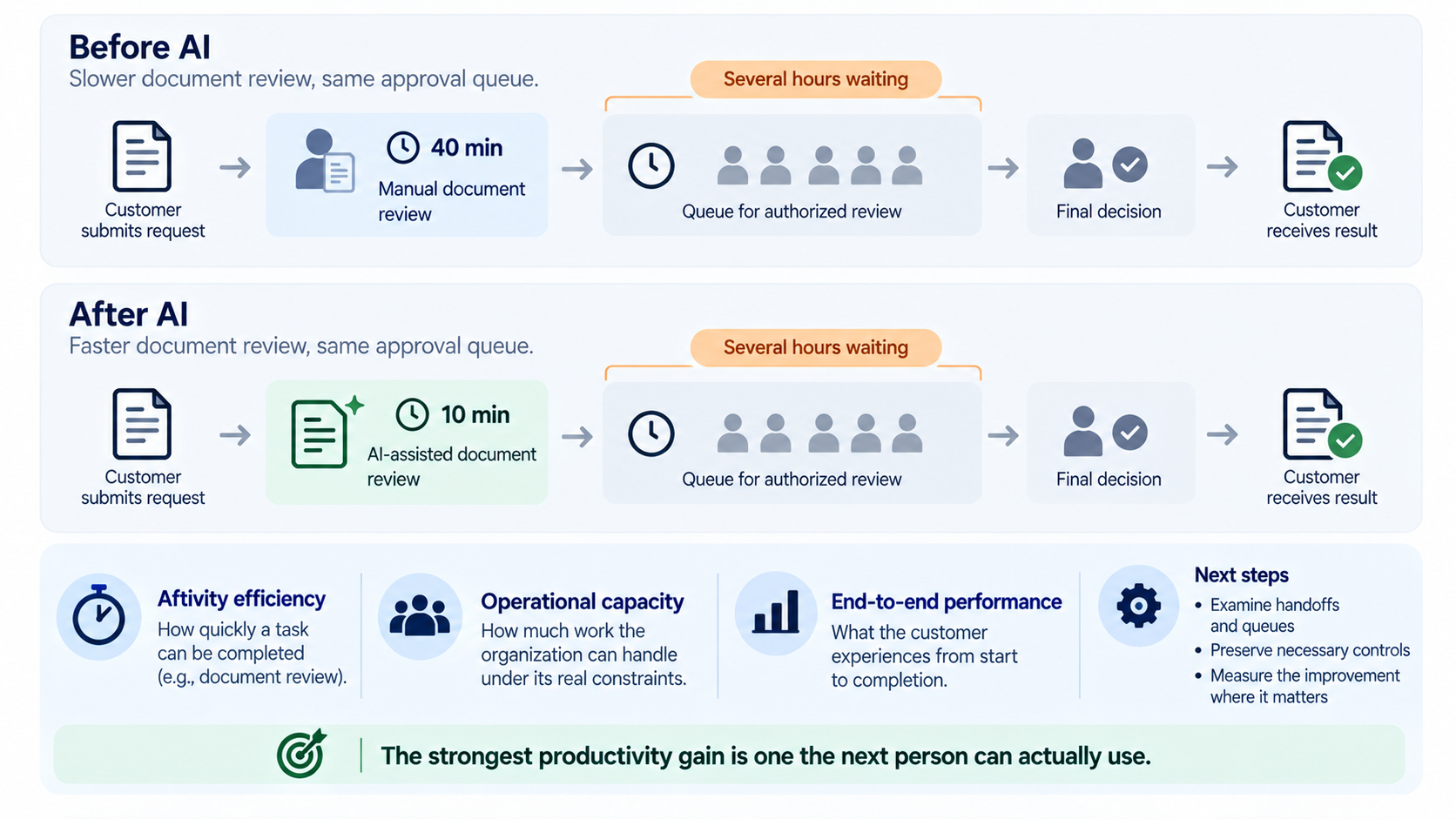
Automation can make individual activities significantly faster without reducing the time required to deliver a complete service. The strategic value of productivity improvements depends on whether the time saved can travel through the processes, decisions, and responsibilities that follow.
A Faster Review, the Same Customer Wait
Consider a hypothetical insurance company introducing AI to accelerate the review of customer documentation. Before automation, employees spend considerable time examining submitted records, identifying missing information, and preparing cases for approval.
The new system performs much of this preliminary work in minutes. It organizes the documents, highlights inconsistencies, and prepares a structured summary for the employees responsible for evaluating each case.
The improvement is visible. Review teams process more documents during their working hours, routine preparation becomes less repetitive, and managers see a measurable reduction in the time spent on individual activities.
But customers continue waiting almost as long as before.
The reason lies in what happens after the automated review. Completed cases enter a queue for an authorized employee who examines them at designated times. Even when the documentation is ready early in the morning, the next decision may not occur until late afternoon.
The original activity is faster, but the next stage operates according to an unchanged schedule.
The work became faster. The decision did not.
From the technology team’s perspective, the automation has succeeded. From the customer’s perspective, the improvement may be difficult to notice.
Both observations can be correct because they measure different parts of the same service.
Find Where the Clock Actually Runs
Organizations frequently evaluate productivity through the time required to complete particular activities. These measurements are useful because they reveal how resources are consumed and where repetitive work might be reduced.
Yet the time a customer experiences is usually determined by a larger sequence.
A service request may spend time being processed, waiting for another activity, moving between departments, or awaiting a decision that only certain employees are authorized to make.
Reducing one activity does not automatically reduce the duration of the complete sequence.
In the insurance example, the AI system may reduce document preparation from forty minutes to ten. But if a completed case waits several hours before the next authorized review, much of the improvement remains invisible to the customer.
Processing time is only one part of the time a customer experiences.
This distinction matters because productivity improvements are often communicated as though time saved at one stage represents an equivalent reduction in the overall process.
The relationship is not necessarily proportional.
A ten-minute reduction in a critical activity can produce substantial operational value if it removes a constraint that limits the entire service. A much larger reduction may have little immediate effect on completion time if the next activity remains unavailable.
The location of the improvement matters as much as its magnitude.
Business leaders therefore need to distinguish between activity efficiency, operational capacity, and end-to-end service performance. These measures are related, but each answers a different question.
Activity efficiency describes how quickly a task can be completed. Operational capacity concerns how much work the organization can handle under its actual resource constraints. End-to-end performance describes what happens to a request from initiation through completion.
A successful investment may improve one without immediately changing the others.
Understanding that difference prevents organizations from overstating benefits while revealing where additional value might be available.
Change the Handoff Without Losing the Control
Once the insurance company recognizes the delay, a tempting response is to remove the approval queue entirely.
But the queue may exist for legitimate reasons.
Certain cases could require specialized professional judgment, regulatory checks, separation of duties, or explicit authorization before a decision becomes effective. Faster document preparation does not establish that these responsibilities are unnecessary.
The opportunity is to examine whether the way the organization schedules and coordinates these responsibilities still makes sense.
For example, the company could investigate whether authorized reviewers can examine prepared cases more frequently during the day. It could evaluate whether routine and exceptional cases should follow different scheduling arrangements, provided the required controls remain intact.
It might also discover that some cases lack information needed for approval, even though the automated document review appears complete.
Those situations require different responses.
A scheduling problem may be addressed through changes in work allocation. An information problem may require better validation or clearer requests to customers. A capacity problem may require additional resources or a different distribution of responsibilities.
Automation alone cannot determine which intervention is appropriate.
A queue can preserve a delay that automation has already made unnecessary.
However, a queue can also preserve a control that the organization must retain.
Distinguishing these situations requires understanding why each waiting period exists, what conditions permit work to advance, and which responsibilities cannot legitimately be bypassed.
The business should not treat every delay as waste. Some waiting periods reflect necessary coordination, unavailable capacity, or controls that protect customers and the organization.
The objective is to identify delays that can be reduced without weakening the conditions required for a legitimate decision.
That is an organizational design problem as much as a technology problem.
Measure the Improvement Where It Matters
The insurance company now faces a more demanding evaluation question.
Instead of asking only whether AI reduced the time spent reviewing documents, leadership can examine what happened to the complete customer request.
Did the average completion time decrease? Did the number of unresolved cases change? Were customers asked for fewer corrections? Did employees receive better information when making decisions?
The company can also examine whether faster preparation created a larger queue at the approval stage.
That possibility is important.
When an upstream activity accelerates, it may send work toward the next stage faster than that stage can handle it. Under some operating conditions, the result is additional waiting rather than a shorter service experience.
The organization may appear more productive locally while accumulating unfinished work elsewhere.
A complete assessment therefore connects task performance with queue behavior, operating capacity, decision quality, and customer outcomes.
These measurements should also distinguish temporary improvements from sustained changes. An initial reduction in processing time may be valuable without producing a permanent reduction in staffing requirements or operating costs.
If the saved time is fragmented across hundreds of small activities, the organization may need to redesign work allocation before it can use that time for additional productive work.
The productivity gain is real at the activity level, but its economic value depends on what the organization can actually do with the released capacity.
This creates a practical distinction between identifying potential benefits and demonstrating realized benefits.
The company may ultimately discover that the strongest return from automation is not lower labor cost. It could be the ability to process more requests, improve service consistency, or release employees from repetitive preparation so they can concentrate on cases requiring judgment.
Each outcome represents a different business case and requires appropriate evidence.
Make Productivity Travel Through the Business
The broader lesson applies far beyond insurance.
A manufacturer can accelerate production while finished goods wait for transportation. A bank can automate application checks while decisions remain queued for specialist review. A retailer can improve order processing while customers continue waiting for fulfillment.
In each situation, technology changes the speed of one activity inside a larger arrangement of dependencies.
For leaders, the strategic question is whether the organization can convert that local improvement into a change in the complete service.
This does not mean every automation project must transform an entire process to be worthwhile. Reducing repetitive work, improving accuracy, or lowering operational effort may justify an investment independently.
It means that the benefits should be understood at the level where they actually occur.
Organizations can then make a separate decision about whether additional changes are needed to translate those benefits into better outcomes for customers, employees, or the business.
That translation may require different schedules, clearer handoffs, revised responsibilities, or better coordination between activities that were previously optimized independently.
The strongest productivity gain is one the next person can actually use.
An organization that measures only the time saved by technology may overlook the waiting that remains after the technology has finished its work.
Real operational improvement becomes visible when the shortcut changes the journey, not merely the speed of one step.
— © 2026 Rogério Figurelli. This article is licensed under the Creative Commons Attribution 4.0 International (CC BY 4.0). You are free to share and adapt this material for any purpose, even commercially, provided that appropriate credit is given to the author and the source. This work was human-directed and AI-assisted, produced with Trajecta Wisdom Machine.