
Wisdom in business is not simply the ability to make better decisions with more information. It is also the ability to recognize which decisions must be made now, which commitments should remain reversible, and when preserving a choice is more valuable than exercising it.
When an Opportunity Comes With a Deadline
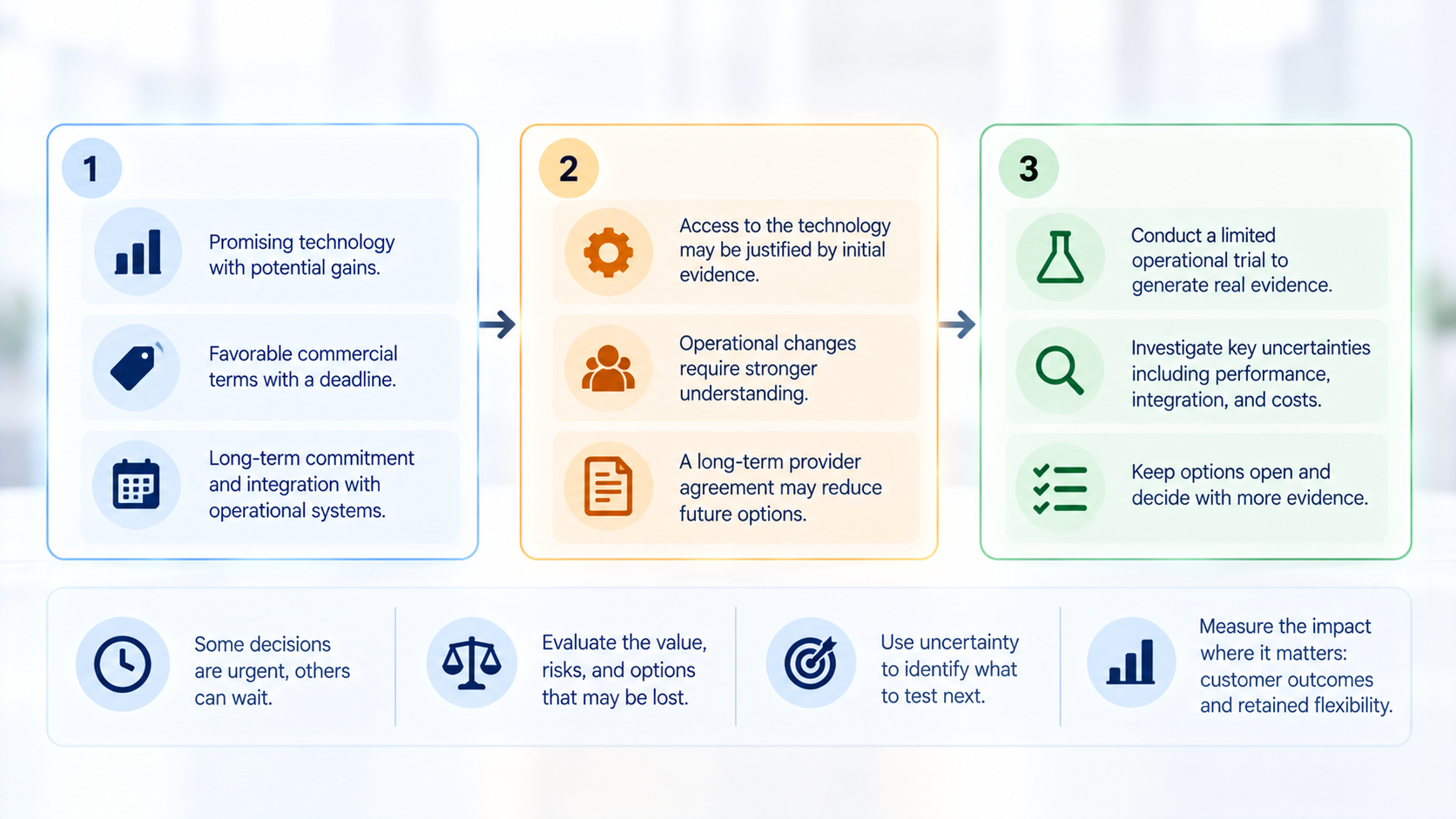
Consider a hypothetical logistics company evaluating an AI platform that promises to improve fleet maintenance planning. The system analyzes vehicle conditions, service histories, and operating patterns to help identify maintenance needs before they disrupt deliveries.
The technology appears promising. A preliminary evaluation suggests that the company could reduce unplanned maintenance, improve vehicle availability, and coordinate workshop schedules more effectively.
The provider offers favorable commercial terms, but the proposal requires a multiyear agreement and substantial integration with the company’s operational systems. The discounted pricing expires at the end of the month.
Leadership faces a familiar situation. The business opportunity appears attractive, the technical assessment is encouraging, and delaying the decision could mean losing a financial advantage.
The pressure to act is understandable.
Yet the information supporting the investment does not answer every question that matters. The company has not established how accurately the system will perform across different vehicle types, how maintenance teams will incorporate its recommendations, or what it would cost to change providers after the integration is complete.
The decision contains several commitments with different consequences.
Purchasing access to the technology is one decision. Reorganizing maintenance activities around it is another. Accepting a long-term dependency on the provider is a third.
Treating these commitments as a single yes-or-no decision can make the opportunity appear simpler than it is.
The deadline may be real without making every associated commitment equally urgent.
Separate the Decision From Its Consequences
Business decisions are often judged by whether they produce the desired outcome. A technology investment is successful if it delivers value, a market expansion is successful if it creates profitable growth, and an operational change is successful if it improves performance.
These outcomes matter, but they become visible only after decisions have produced consequences.
Before that point, leadership must act with incomplete knowledge.
The challenge is not to eliminate uncertainty. Some uncertainty cannot be resolved without acting, observing the results, and learning from experience.
Wisdom therefore involves understanding the relationship between the evidence currently available and the commitment being considered.
For the logistics company, the decision to conduct a limited operational trial may be justified by the initial technical evidence. The decision to restructure the entire maintenance operation around the platform requires a stronger understanding of its reliability, integration requirements, and organizational consequences.
Both decisions concern the same technology, but they do not carry the same burden.
A limited trial can generate evidence while preserving alternatives. A long-term agreement may make future changes more expensive or difficult.
This does not make reversible decisions automatically superior. Some opportunities require early commitment, and postponement can carry substantial costs.
The important distinction is whether the organization understands what it is giving up by acting now.
Wisdom requires evaluating not only the outcome a decision might create, but also the choices it may eliminate.
That perspective changes the meaning of decision quality.
A decision can be reasonable even when its eventual outcome is disappointing, provided its assumptions, alternatives, risks, and consequences were responsibly considered.
Conversely, a fortunate outcome does not establish that the original decision process was sound.
Good judgment cannot be measured solely through the benefit that happened to occur.
Give Uncertainty a Useful Role
Organizations sometimes treat uncertainty as an obstacle that must be removed before action becomes possible.
But uncertainty can serve a more useful purpose.
It can identify which questions deserve investigation and which decisions should remain conditional.
In the maintenance-platform scenario, the company could distinguish between uncertainties that can be reduced through testing and uncertainties that require commercial or strategic judgment.
Operational testing might reveal how reliably the system identifies maintenance needs across the fleet. Integration analysis might establish what information must be exchanged with existing systems. A contractual review could clarify whether the organization can retrieve its data and maintain essential operations if the commercial relationship ends.
These inquiries provide different kinds of evidence.
None can determine whether the technology will remain the best available option throughout a multiyear agreement.
That future cannot be completely known.
Leadership must therefore decide which uncertainties justify additional investigation and which can be managed through the structure of the commitment itself.
The company might negotiate a phased contract, establish performance conditions for expansion, or preserve an alternative maintenance process until the new arrangement has demonstrated sufficient reliability.
Each option changes the relationship between learning and commitment.
The organization is no longer trying to predict every future condition before acting. It is arranging the decision so that new evidence can influence what happens next.
However, preserving flexibility has a cost. Shorter agreements may be more expensive, parallel processes consume resources, and gradual implementation can delay benefits.
Those costs should be compared with the value of preserving alternatives rather than assumed to be worthwhile.
The most useful question is not simply whether additional information would be desirable. It is whether obtaining that information could change an important decision enough to justify the time and resources required.
Uncertainty becomes productive when it shapes the next responsible action.
Know When Waiting Becomes a Decision
Preserving options is not always the wise choice.
Imagine that the logistics company operates vehicles whose maintenance failures are becoming more frequent. Existing scheduling methods may be creating significant service interruptions, and employees may already be working beyond sustainable capacity.
In those conditions, delaying improvement also creates consequences.
Customers may experience unreliable deliveries, operating costs may continue increasing, and maintenance teams may remain exposed to preventable disruption.
Leadership cannot evaluate the proposed investment against an imaginary situation in which nothing changes while the company waits.
The alternative to adopting the platform is the continuation of existing operations, potentially with their own costs and risks.
This makes the decision more demanding.
A company can preserve an option for so long that the opportunity it was intended to protect disappears. It can also spend excessive resources seeking confidence that no reasonable amount of analysis will provide.
Wisdom must therefore distinguish useful patience from avoidance.
For the logistics company, this might mean committing immediately to improvements that are well understood while leaving broader platform dependencies subject to further evidence.
It could also mean accepting a larger commitment if the operational need is urgent, the alternatives are inadequate, and the risks are understood well enough to justify action.
The purpose of judgment is not to avoid irreversible decisions. It is to make them with sufficient understanding of what they put at stake.
The appropriate timing depends on the relationship between available knowledge, the urgency of the underlying problem, and the consequences of both action and inaction.
A deadline alone cannot resolve that relationship.
Neither can a demand for perfect certainty.
Make Wisdom Part of the Decision Process
The broader lesson extends beyond technology procurement.
Organizations regularly make decisions involving strategic partnerships, acquisitions, hiring, infrastructure, market expansion, and business transformation. Each combines uncertainty with consequences that unfold over time.
Modern analytical systems can help organizations examine more alternatives, detect patterns, and estimate potential outcomes.
These capabilities can improve decision support.
But they do not automatically determine which commitments are legitimate, which risks are acceptable, or which future possibilities an organization should preserve.
Those questions require explicit objectives, responsibility, and judgment.
For business leaders, wisdom can become a practical discipline by examining decisions through their consequences over time.
What must be decided immediately? Which assumptions could materially change the choice? What becomes difficult to reverse? Who will bear the consequences if the assumptions prove wrong? Which alternatives deserve to remain available?
The purpose of these questions is not to slow every decision. It is to prevent the speed of a decision from becoming confused with its quality.
Sometimes the appropriate response is an immediate commitment.
Sometimes it is a smaller commitment that creates the evidence needed for a larger one.
Sometimes it is a decision not to proceed because the expected benefit does not justify the obligations the organization would assume.
Wisdom does not guarantee that these judgments will produce the best possible outcomes. It helps organizations make commitments that are proportionate to what they know, what they value, and what they can responsibly sustain.
Intelligence can expand the range of choices an organization understands. Wisdom helps determine which choices deserve to become commitments.
The future is shaped not only by the decisions we make, but also by the possibilities we choose to keep alive.
— © 2026 Rogério Figurelli. This article is licensed under the Creative Commons Attribution 4.0 International (CC BY 4.0). You are free to share and adapt this material for any purpose, even commercially, provided that appropriate credit is given to the author and the source. This work was human-directed and AI-assisted, produced with Trajecta Wisdom Machine.