
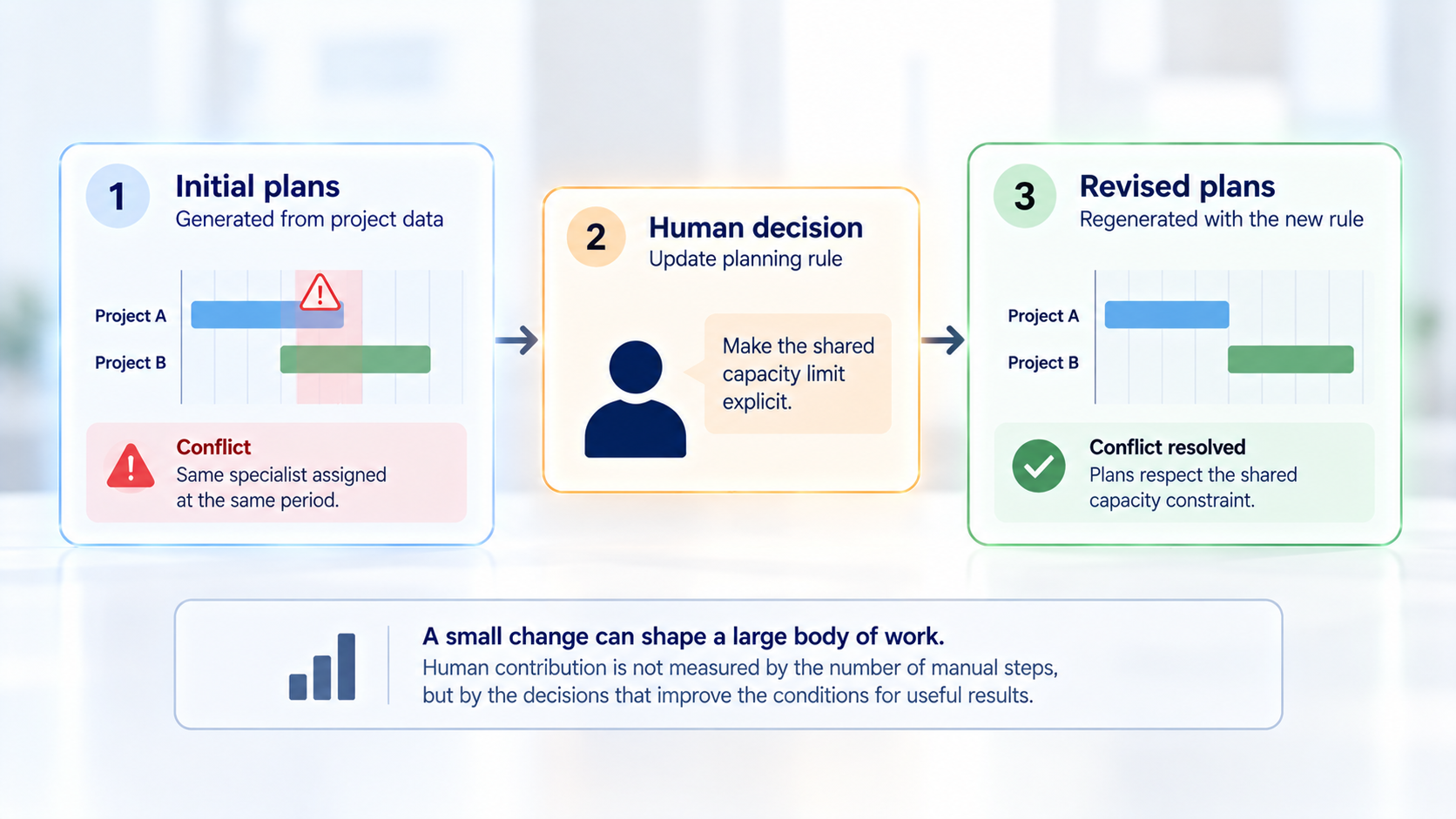
When AI performs the visible steps, human contribution can become harder to recognize. A useful account connects a person’s decisions to the outcomes they helped shape.
An activity record can miss the decisive choice
Imagine a team using AI to prepare delivery plans from project data. A planner notices that two projects each assume they can use the same specialist during the same period. With responsibility for the planning rules, she makes the shared capacity limit explicit and asks for the plans to be regenerated. Most of the resulting schedules are produced automatically. The planner’s visible activity may consist of a small change, even though that change affects which commitments the team can reasonably make.
The number of manual steps misses the scale of the decision.
An activity measure based on schedules prepared, edits made, or time spent can capture execution without capturing that contribution. The person who changes a governing assumption may leave less visible work than someone who manually adjusts each affected schedule. Their significance depends on whether the assumption was sound and whether the resulting plans improved.
Look for the change that affected the outcome
Start with a consequential choice and identify what it altered. In the planning example, the relevant change is the treatment of shared capacity across projects. Its importance can be examined through the commitments the revised plans support, the conflicts they expose, and the work still requiring a decision. This gives the contribution an operational meaning beyond the fact that someone intervened.
Evidence should connect a person’s decision to the difference it made to the work. Comparing the initial and revised plans can show which allocations changed, while later delivery records can help assess whether those changes were useful. A plausible explanation of an intervention is a starting point for that assessment. It does not establish that the intervention caused every improvement observed afterward.
Where a result depends on several people, an automated check, and the quality of the underlying data, describe those relationships. A shared account of how the result was produced can preserve contribution without assigning precise percentages that the evidence cannot support.
Keep contribution separate from presence
Involvement by itself leaves the value question unanswered. A human correction might improve a plan, add delay without changing its quality, or introduce an error. Recognizing contribution requires room for each possibility.
Contribution needs evidence of an effect.
The record should show what a person helped the team accomplish. It should also preserve uncertainty where the contribution cannot yet be separated from other changes.
If an automated check surfaced the shared constraint, the account should say so. The planner may still have contributed by testing its significance, choosing an acceptable response, or resolving a conflict between project priorities. Those are distinct contributions, and each deserves an assessment on its own terms. The record becomes more useful when it identifies the work each participant actually performed.
Make consequential work visible
The operating record can preserve the important decision, its reason, and the evidence used to assess its effect. This can fit within the existing planning or delivery review. The amount of detail should follow the significance of the choice, with enough information for another person to understand why it mattered.
A small intervention can shape a large body of work.
Leaders can then examine performance through both execution and contribution. Output counts remain useful for understanding volume and effort, while the decision record helps reveal who improved the conditions under which that output became useful. It also makes work available for learning: a successful planning rule can be reused, an ineffective intervention can be reconsidered, and a remaining uncertainty can receive focused attention.
As execution is delegated, the account of human work needs to follow the places where people still affect the result. That evidence helps leaders see where judgment is creating value and where the workflow can become simpler.
— © 2026 Rogério Figurelli. This article is licensed under the Creative Commons Attribution 4.0 International (CC BY 4.0). You are free to share and adapt this material for any purpose, even commercially, provided that appropriate credit is given to the author and the source. This work was human-directed and AI-assisted, produced with Trajecta Wisdom Machine.