
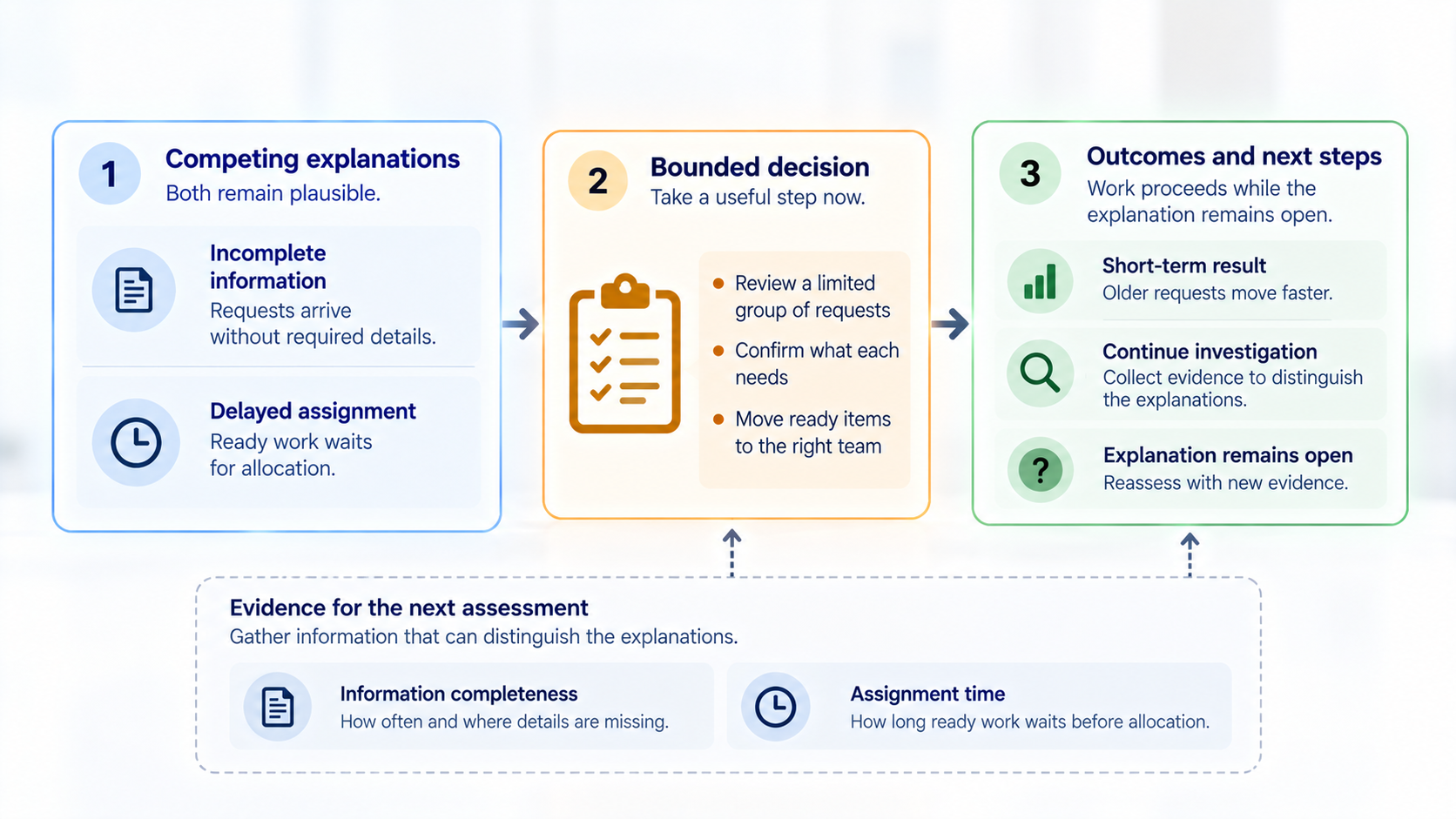
A team can lack sufficient evidence to settle a cause while still having grounds for a limited action. Keeping those questions separate allows useful work to proceed without presenting an open explanation as a resolved fact.
Separate the choice from the explanation
Imagine an AI-assisted review of delays in an internal service queue. It preserves two credible explanations: requests arrive with incomplete information, or ready work waits too long for assignment. The available records do not establish which explanation accounts for most of the delay. Choosing a broad remedy would require stronger evidence about that distinction, but the team also has an immediate problem: older requests still need attention.
The next action and the final explanation are different questions.
A temporary owner could review a limited group of those requests, confirm what each needs, and move ready items to the appropriate team. An unresolved cause does not automatically make every action unjustified. The case for this step would rest on its usefulness under either explanation and on the cost and limits of the review. It would leave the broader diagnosis open.
Find a step that survives the live alternatives
Examine the proposed action under each explanation the team still regards as credible. If information is missing, the review can identify the gap. If assignment is the problem, it can identify work ready to move. In both cases, the same limited review may help the team deal with outstanding requests, provided it has the capacity and authority to act on what it finds.
The action needs a reason that survives the uncertainty.
That reason should be specific enough to assess. Define the work covered, the resources available, and the consequence that would make the action unacceptable. A temporary review should have a clear limit and an owner who can reconsider it if the situation changes. These conditions make the choice defensible across the alternatives being considered; they do not establish that the team has imagined every possible explanation.
Some actions still need the disputed fact.
A permanent staffing change, for example, may depend on whether capacity is actually causing the delay. A process redesign may depend on whether missing information is the recurring obstacle. The grounds for a small review cannot automatically justify either larger choice. Where the action depends materially on the unresolved distinction, the team needs further evidence or a narrower action.
This gives AI-assisted decision support a useful role. It can make the competing explanations visible and show which assumptions each proposed action requires. The human owner can then examine whether a recommendation remains acceptable while those assumptions are unsettled.
Carry uncertainty into what happens next
Record the chosen action alongside the question it leaves open. The service team might authorize the limited review, retain both explanations, and identify which observations could distinguish them. Evidence about information completeness and assignment time can inform the subsequent assessment, with the limits of those records preserved. The immediate action and the later diagnosis can follow different paths.
A useful result can support continuing an action without establishing why the problem occurred. The record should preserve that difference.
If older requests move faster after the review, the team has learned something about the step it took. That improvement alone cannot determine whether missing information, delayed assignment, or another factor caused the original problem. The review may have addressed more than one obstacle. Extending it requires attention to its continuing benefit and cost, while a claim about the underlying cause requires evidence that distinguishes the alternatives.
Keep the explanation open when the evidence remains open.
A later finding may justify narrowing the alternatives, changing the action, or reopening a question the team thought it had settled. Assign responsibility for that reconsideration so uncertainty remains connected to the work it could affect. A team can then proceed with a bounded decision while retaining a clear account of what it knows, what it is doing, and what still needs to be established.
— © 2026 Rogério Figurelli. This article is licensed under the Creative Commons Attribution 4.0 International (CC BY 4.0). You are free to share and adapt this material for any purpose, even commercially, provided that appropriate credit is given to the author and the source. This work was human-directed and AI-assisted, produced with Trajecta Wisdom Machine.