
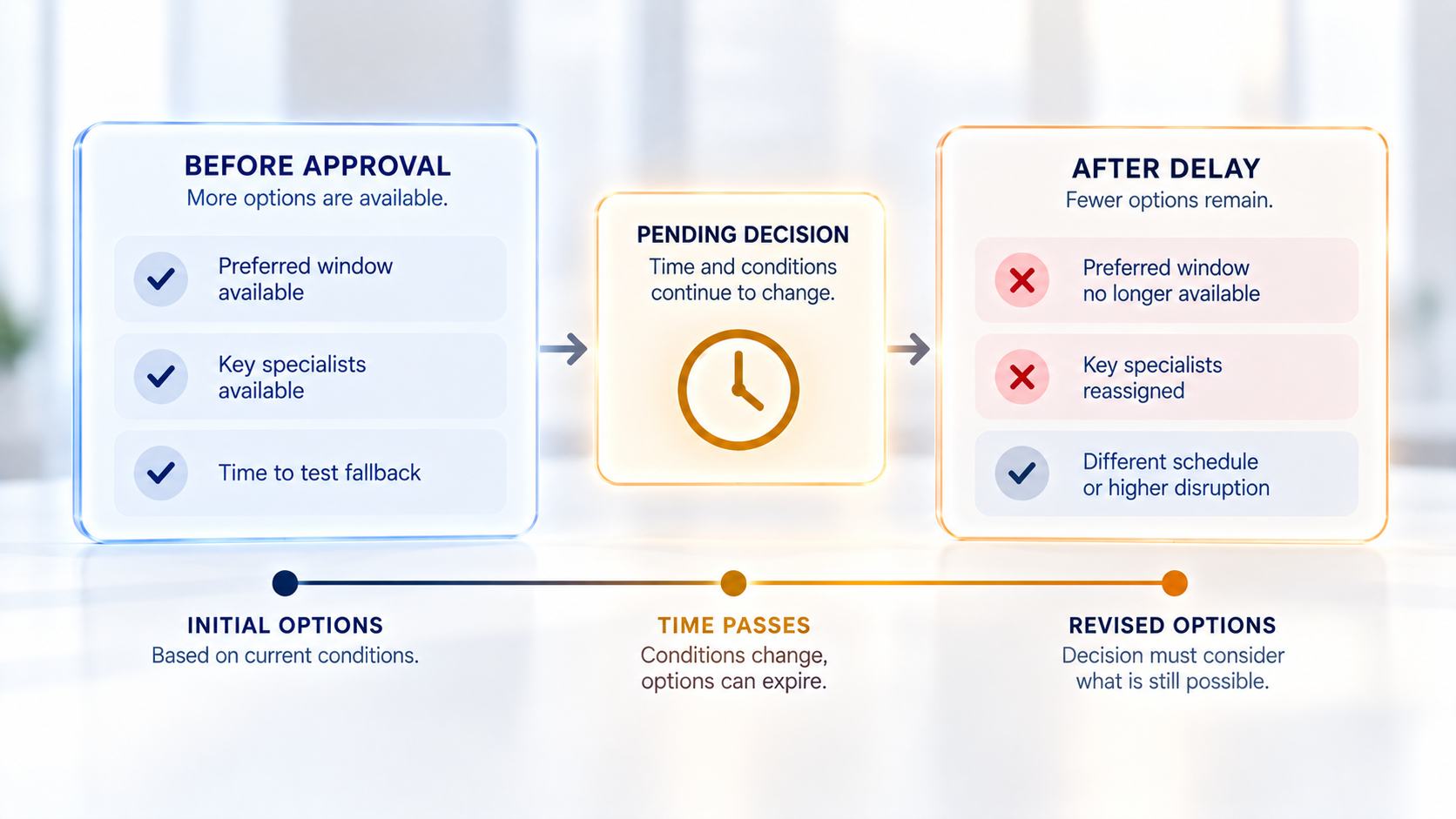
A pending decision can lose options as conditions change. Useful deliberation considers both the information waiting may provide and the alternatives it may remove.
The calendar can alter the choice
Imagine an operations team preparing a system migration. The proposed schedule includes a suitable maintenance window, available specialists, and enough time to test a fallback. Approval is postponed while the team gathers additional evidence about compatibility. During the review, the specialists are reassigned and the preferred window closes. The proposal remains pending, but executing it now requires a different schedule, additional coordination, or greater disruption.
The choice is already changing.
The proposal can remain unchanged while its alternatives change. A decision process needs to recognize when the option set is moving, because a later approval may authorize an action with different costs, dependencies, and consequences.
Keep the option set visible
An approval record can show the owner, budget, and next review date while leaving time-sensitive options invisible. Strategic visibility requires an additional view: what can still be done, under which conditions, and what would cause each useful alternative to disappear. The relevant detail might be a delivery slot, access to a key team, or the remaining time to run a reversible pilot.
The available choices can narrow while approval remains pending.
Time can also create options: a supplier may finish qualification, a technical uncertainty may be resolved, or a new execution window may open. The purpose is to track the changing balance, including alternatives that become more attractive. That makes it possible to distinguish a delay that preserves flexibility from one that quietly consumes it.
Waiting should earn useful information
A useful delay has an informational purpose. Before postponing a choice, name the uncertainty it is expected to reduce and the evidence that could change the decision. Waiting for a completed integration test may be valuable when its result determines whether a migration is viable. Asking for more analysis without identifying a decision it could change leaves the benefit of delay unclear.
Compare that expected benefit with the options that may expire during the wait. A team might preserve a maintenance slot provisionally, run a narrower test first, or stage a reversible portion of the work. These choices allow uncertainty to fall while retaining room to act. Where no reasonable means of preservation exists, the cost of waiting should become part of the decision itself.
If critical evidence is missing and the available action is difficult to reverse, postponement can remain responsible even when it costs an option. The record should make that tradeoff explicit, including what remains uncertain and why the team accepts the lost flexibility.
Use triggers tied to changing conditions
A weekly review can keep a process orderly, yet a time-sensitive option may need attention before the next meeting. Set review triggers around the conditions that make the choice materially different: the last date to reserve capacity, a change in operating requirements, or the arrival of evidence that resolves a critical question. Each trigger needs an owner who can reopen the discussion.
The trigger should follow the option at risk.
In AI-assisted planning, this changes what a useful recommendation should show. It should explain which assumptions still hold, which alternatives have become unavailable, and whether new evidence changes the reason for waiting. A repeated recommendation based on an expired execution window has little strategic value. The human owner remains responsible for choosing among the alternatives that are feasible now.
Preserve the reason for the delay
A decision record should retain why approval was deferred, what benefit the team expected, and the condition that would justify reconsideration. Waiting needs a condition for ending. That condition may be the arrival of evidence, the loss of a protected option, or a change in the organization’s priorities. If further delay is warranted at that point, the reason should be renewed against the current alternatives.
This makes a later review more useful. A team can examine whether the expected evidence arrived, whether options were preserved as intended, and whether the review happened when it should. A disappointing outcome can then be assessed alongside the information and alternatives available at the time, instead of treating elapsed time as an explanation on its own.
A decision can remain deliberate without leaving its timing undefined.
— © 2026 Rogério Figurelli. This article is licensed under the Creative Commons Attribution 4.0 International (CC BY 4.0). You are free to share and adapt this material for any purpose, even commercially, provided that appropriate credit is given to the author and the source. This work was human-directed and AI-assisted, produced with Trajecta Wisdom Machine.