
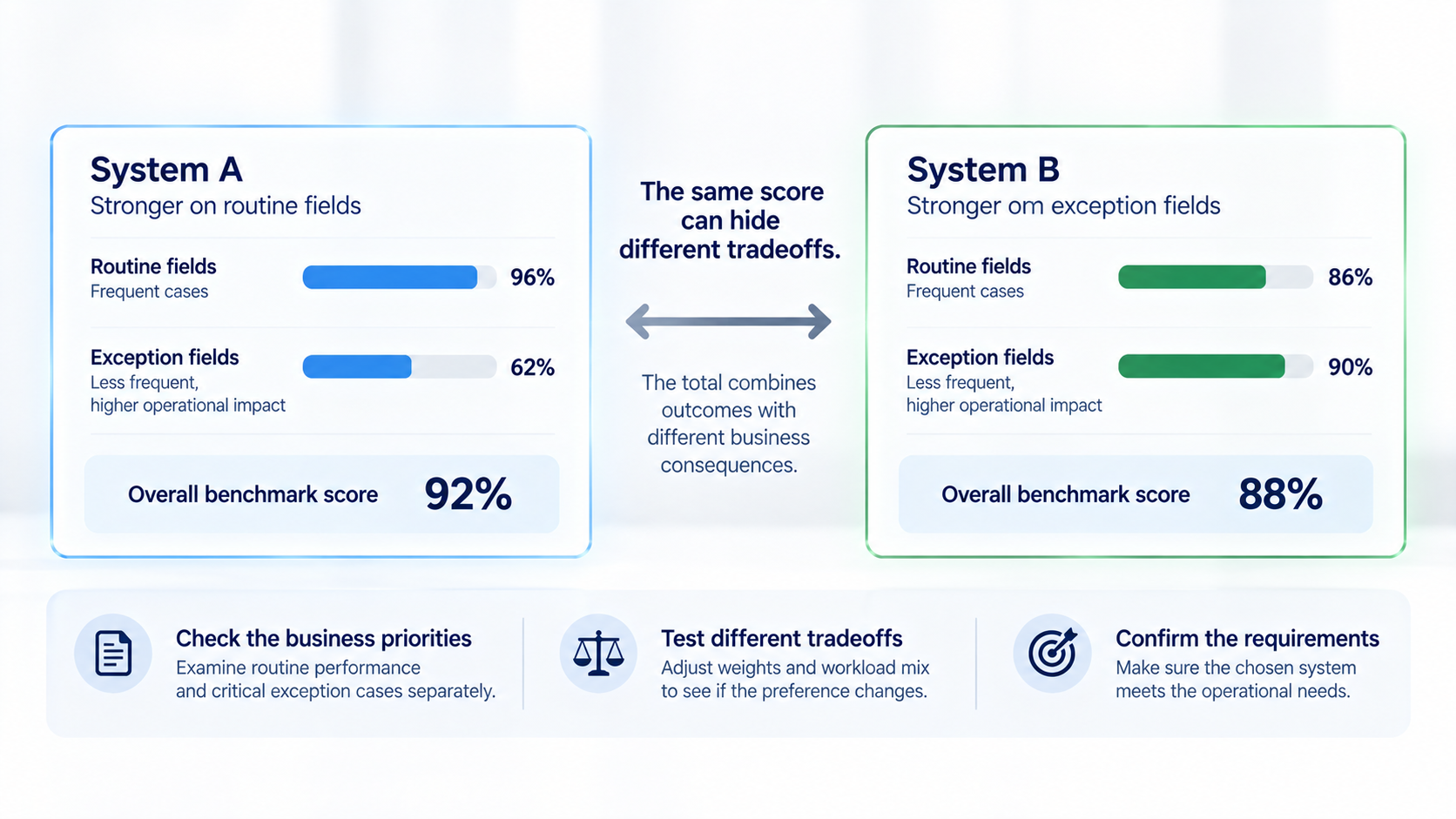
An overall result can conceal where performance improves and where it deteriorates. Evaluation becomes more useful when business priorities remain visible alongside the score.
What the total combines
Imagine two AI systems extracting information from shipment records. Most fields are routine identifiers, while a smaller subset describes exceptions that change how a shipment should be handled. One candidate extracts the routine fields more consistently; the other recognizes the exceptions more reliably. The first wins a benchmark scored by total fields extracted correctly. A team automating routine data entry may find that result relevant, while a team using the records to direct handling still needs to examine the exception cases.
The score has already made part of the tradeoff.
The measure can correctly describe performance on the test and still conceal an operationally significant difference. Aggregation combines outcomes that may carry different consequences. Once a team treats that single result as sufficient for selection, it inherits the priorities implicit in the scoring rule.
Separate frequent work from consequential errors
Begin by mapping the benchmark’s outcomes to the work the organization intends to perform. Identify which errors require a quick correction, which create substantial rework, and which change the action taken. That mapping gives the evaluation a business interpretation. It also reveals whether the headline result is dominated by easy or frequent cases that say little about an important operating requirement.
An evaluation set can mirror the frequency of real work and still give a rare, consequential case little influence over the headline. A business may therefore need both a representative overall measure and targeted evidence about cases whose consequences demand separate attention.
Each targeted case needs an operational reason for inclusion. Missing it might change an action, create material rework, or defeat the intended boundary of automation. Keep the list focused enough to explain and test. Frequency and consequence answer different questions, so preserving both can clarify the choice.
Distinguish preferences from requirements
Some outcomes admit tradeoffs. If a missed entry is recoverable through a quick review, extra accuracy elsewhere might compensate for it. Where a business requires a class of records to receive separate handling, improvements on routine extraction do not establish that requirement has been met. The evaluation should show performance against that requirement directly, together with the evidence supporting the claim.
A higher total can coexist with an unmet requirement.
A candidate that struggles with exception recognition could still be useful if a dependable review step identifies those records before automation proceeds. That changes the workflow being evaluated and introduces a review burden. Assess that arrangement explicitly, including whether the added check catches the relevant failures and whether the operational cost is acceptable. A strong overall score alone cannot answer either question.
The control becomes part of the result the business is choosing.
Make the preferred result conditional
Before accepting a winner, vary the few priorities that could reasonably change the decision. Examine whether the ranking holds when exception handling receives more weight, when the workload mix changes, or when review effort is included. A stable result strengthens confidence within those tested conditions. A reversal shows where the preference depends on a business assumption and identifies the point that needs discussion.
Evidence also has limits. A small set of error-free examples may leave the failure rate on important cases uncertain. The team may need more targeted testing before extending automation to that class of work. Preserve the unresolved question while retaining evidence that is already sufficient for other uses.
The recommendation should show what would change it.
The decision record can connect the preferred system to the workload, tradeoffs, and required conditions that support it. This allows a later change in business priorities to trigger a focused review. An overall score remains useful, while the organization retains visibility into the choices it compresses.
— © 2026 Rogério Figurelli. This article is licensed under the Creative Commons Attribution 4.0 International (CC BY 4.0). You are free to share and adapt this material for any purpose, even commercially, provided that appropriate credit is given to the author and the source. This work was human-directed and AI-assisted, produced with Trajecta Wisdom Machine.