
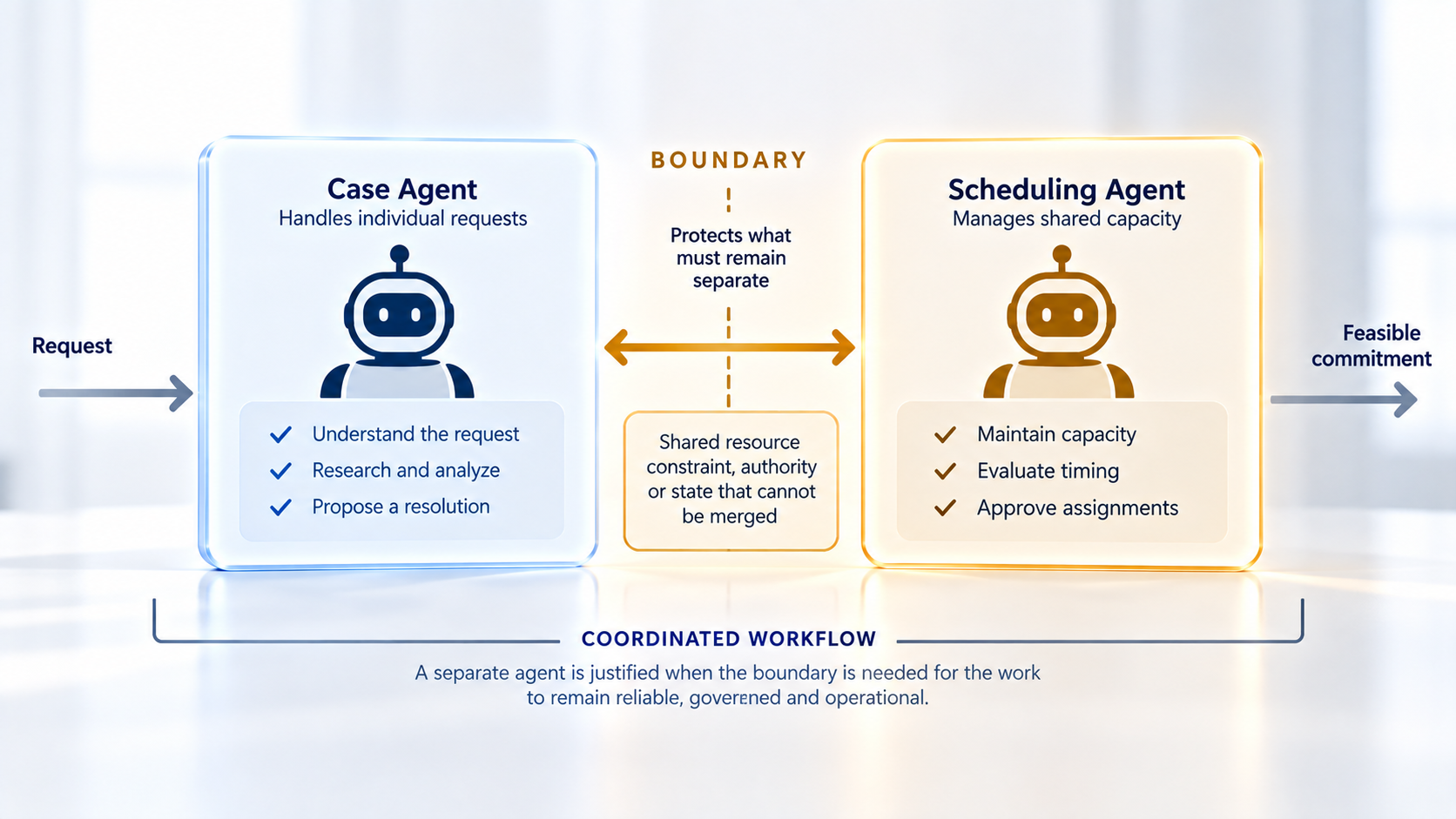
Dividing work into roles leaves an architectural choice open. A separate agent earns its place when it preserves a needed boundary that a simpler arrangement cannot adequately protect.
A new role leaves the architecture undecided
An AI workflow might include planning, research, review, and communication. These roles help explain how the work should progress. They also make it easier to assign responsibilities and identify missing steps.
A role can exist as a stage in a shared workflow, with instructions and checks appropriate to that stage. Giving it a separate agent introduces a further question about what must remain separate throughout execution.
Naming the role leaves the design choice open.
The case for another agent should identify the need for a separately protected boundary, then explain how that boundary affects the work. It might concern who can authorize an action or which state must remain consistent across assignments. The role describes an activity; the boundary explains why its separation matters.
A boundary must make a difference to the work
Consider an AI system helping resolve individual customer requests. A case-handling role concentrates on each request, while a scheduling role protects capacity shared across the service. Their responsibilities operate at different scopes, and successful case resolution depends on respecting the shared constraint.
That constraint might be adequately protected by an ordinary scheduling service. A separate scheduling agent becomes an option if the work also requires continuing interpretation and delegated judgment within its own defined responsibility. The design needs to establish what that additional separation preserves.
A role earns separation when merging it would lose something the mission needs.
This reasoning gives the architecture a practical test. Explain the consequence of removing the separation: which responsibility becomes ambiguous, which state loses its required protection, or which decision can no longer be governed adequately? A concrete answer provides a stronger justification than the existence of another useful task.
Coordination becomes part of the job
Once roles operate as separately managed agents, their relationships require attention. The workflow needs to establish how they exchange work and resolve conflicts, including what happens when one participant stalls. Someone must also be able to determine whether the combined task has finished successfully.
Those obligations belong in the assessment of the design. A second agent may improve its assigned task while creating enough handoff and recovery work to weaken the overall result. Its contribution should therefore be examined through the completed workflow, with coordination included in the effort required.
Start with the least separation that works
The starting point can be the smallest arrangement that preserves the required responsibilities and constraints. The simplest adequate architecture is a legitimate outcome. A staged workflow may provide enough separation for one mission, while another requires a participant with its own continuing authority and state.
When an additional agent is justified, its purpose should be visible to the people operating the system. They should know which boundary it protects and what would be lost if its work were absorbed elsewhere. That explanation gives them a basis for maintaining the architecture.
The decision can be revisited as the work changes. A boundary may become more consequential, or a simpler component may become sufficient to preserve it. Recording the original reason for separation makes either adjustment easier to assess.
Every additional agent should have a boundary worth preserving.
— © 2026 Rogério Figurelli. This article is licensed under the Creative Commons Attribution 4.0 International (CC BY 4.0). You are free to share and adapt this material for any purpose, even commercially, provided that appropriate credit is given to the author and the source. This work was human-directed and AI-assisted, produced with Trajecta Wisdom Machine.