
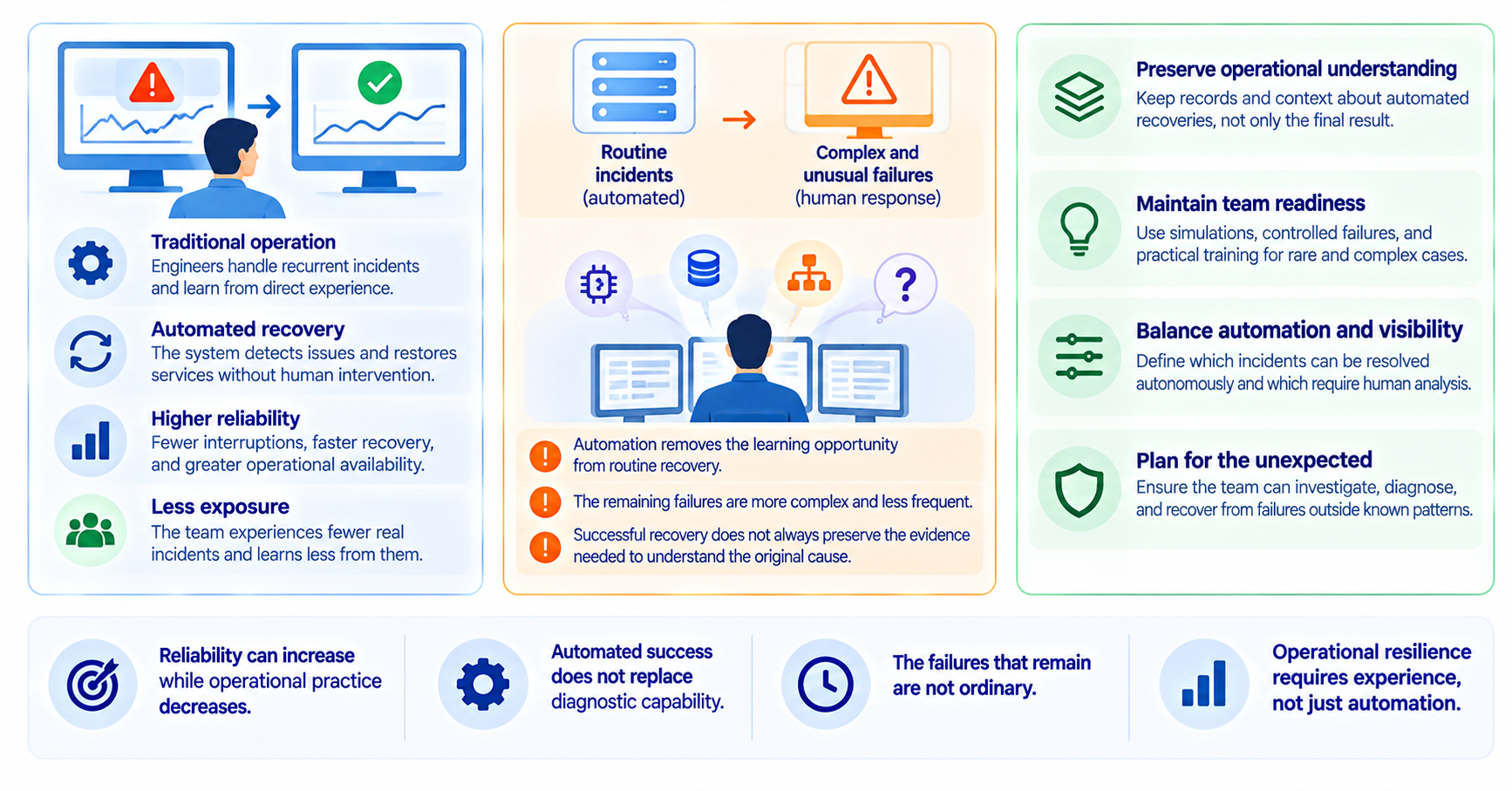
Automated recovery can improve service reliability while reducing the human experience required to handle exceptional failures. The challenge is not to preserve routine incidents, but to preserve the operational understanding that automation may gradually make less visible.
A More Reliable System Can Have a Less Practiced Team
Consider an enterprise infrastructure team responsible for a complex application environment.
Historically, engineers respond to recurring incidents involving resource exhaustion, failed services, configuration inconsistencies, and temporary dependency failures. These interruptions are inconvenient, but they also expose engineers to the actual behavior of the environment.
During an incident, someone examines the symptoms, compares recent changes, identifies dependencies, tests possible explanations, and determines whether a corrective action is appropriate.
Over time, this work contributes to operational familiarity. Engineers learn which signals are misleading, which components fail together, and which recovery actions can produce consequences elsewhere.
The organization then introduces increasingly capable automated remediation.
Monitoring systems detect known conditions. Automated procedures restart failed components, redistribute workloads, adjust resources, and restore services without requiring immediate human intervention.
Availability improves. Repetitive interruptions decline. Engineers spend less time performing predictable recovery tasks.
These are legitimate benefits.
But another change occurs more quietly: the team participates in fewer of the events through which it previously learned how the environment behaves.
The organization may become more successful at recovering from familiar failures while becoming less practiced at diagnosing unfamiliar ones.
This does not mean automation necessarily weakens engineering capability. Reducing repetitive work can free engineers for deeper architectural analysis, preventive engineering, and deliberate training.
The risk arises when the organization assumes those benefits will occur automatically.
Without an explicit replacement for the operational experience that automation removes, the team may gradually lose familiarity with the systems it remains responsible for recovering.
What Disappears Between Detection and Recovery
A conventional incident often leaves a sequence of human observations.
An engineer notices an abnormal pattern, investigates several possible causes, rejects an incorrect hypothesis, and eventually identifies a useful intervention. The process may reveal undocumented dependencies, confusing alerts, inaccurate runbooks, or architectural assumptions that no longer hold.
Automated remediation compresses much of that sequence.
A monitoring rule detects a known pattern. A predefined procedure executes. The health indicator returns to normal. The event may be recorded as successfully resolved.
From the service’s perspective, that is often exactly what should happen.
Yet the recorded result may not preserve everything an engineer would need to understand the event later. A successful restart establishes that the intervention restored service, but it does not necessarily establish the underlying cause. A resource adjustment may relieve pressure while leaving the workload behavior that created it unexplained.
Automation can therefore reduce operational interruption without reducing the underlying uncertainty in the same proportion.
The distinction becomes more significant when AI-based operations systems select remediation actions dynamically rather than executing only deterministic procedures.
An AI system may correlate signals, select among established recovery actions, and adapt its response to observed conditions. Such capabilities can be useful, provided their scope and safeguards are appropriate.
However, as intervention becomes faster and more autonomous, the interval during which the original failure state can be observed may become shorter.
Logs may rotate. Temporary states disappear. Components restart. Dependencies recover in a different order. The environment that engineers later inspect is no longer the environment in which the problem first emerged.
The service is healthy again, but the evidence needed to understand its failure may be incomplete.
Recovery success and diagnostic understanding are different outcomes.
This matters because understanding is not required only for historical explanation. It also supports decisions about whether an incident is likely to recur, whether a remediation technique remains safe, and whether a seemingly familiar symptom is actually caused by a different problem.
A system that records only that automation succeeded may preserve evidence of performance while losing evidence that could challenge the assumptions behind the recovery policy.
The Failures Left to Humans Are Not Ordinary Failures
There is a second consequence.
As automation becomes effective at resolving recognizable incidents, the failures that reach human engineers are increasingly likely to involve conditions outside established recovery patterns.
They may combine multiple component failures, inconsistent observations, unexpected configuration changes, external dependencies, or interactions that were not anticipated when the automation was designed.
These situations often require a different kind of reasoning from the work that automation has removed.
Routine recovery depends heavily on recognizing known symptoms and applying well-understood interventions. Exceptional recovery may require reconstructing the system’s behavior under uncertainty, questioning the reliability of monitoring information, and determining whether ordinary corrective actions could make the situation worse.
The organization needs people capable of reasoning beyond the automated procedure.
Yet those people may have had fewer opportunities to engage with the infrastructure directly.
This creates a potential mismatch between the experience engineers accumulate and the difficulty of the incidents they are ultimately expected to resolve.
The remaining incidents may demand greater judgment precisely because simpler incidents are no longer reaching people.
This is not merely a staffing problem. Hiring experienced engineers does not guarantee that they understand the particular dependencies, operational history, and hidden behavior of a specific enterprise environment.
Nor is expertise maintained simply by requiring employees to approve automated actions. A human approval step can become ceremonial if the reviewer lacks the information or practical understanding needed to challenge the proposed intervention.
Meaningful human oversight depends on the capacity to recognize when the automated system’s assumptions no longer apply.
There is also a risk of organizational overconfidence.
A long period with few visible incidents may be interpreted as evidence that recovery capability is mature. But if most failures have been resolved within a narrow set of known conditions, the organization has not necessarily demonstrated its ability to manage unfamiliar or compound failures.
The absence of incidents requiring human intervention does not establish readiness for the incidents automation cannot handle.
The distinction is particularly important in environments where recovery actions affect data integrity, financial transactions, security controls, or other consequential business states. An intervention that restores availability may still require independent examination of its broader effects.
Automation maturity should therefore not be inferred solely from the percentage of incidents resolved automatically.
Preserving Operational Understanding Without Preserving Manual Work
The solution is not to keep engineers busy with incidents that machines can resolve reliably.
Reintroducing unnecessary manual intervention would weaken the value of automation and could increase the likelihood of human error.
Instead, organizations can treat operational competence as a capability that needs deliberate maintenance even when routine failures become less frequent.
One part of that responsibility concerns evidence preservation.
Automated remediation should, where feasible and proportionate to the risk, retain the relevant pre-intervention signals, the conditions that triggered action, the recovery procedure selected, the changes performed, and the observations supporting the conclusion that recovery succeeded.
This does not require recording everything indefinitely. It requires enough context to distinguish a successful corrective action from a sufficiently understood failure.
Another part concerns learning.
Engineers can review representative automated incidents, examine unexpected patterns, and investigate cases where remediation repeatedly restores service without eliminating the cause. These reviews can turn automatically resolved events into opportunities for architectural improvement rather than allowing them to disappear into aggregate success metrics.
A third part concerns practice under conditions that routine automation does not cover.
Controlled failure exercises, realistic simulations, dependency isolation tests, and carefully designed recovery rehearsals can expose engineers to unfamiliar conditions without requiring genuine production outages.
Such exercises need to test more than familiarity with a runbook. They should examine whether teams can recognize an incorrect automated diagnosis, understand the consequences of disabling a recovery mechanism, identify when escalation is necessary, and restore operations when their usual automation is unavailable.
There are limits to these methods. Simulated incidents cannot reproduce every pressure, ambiguity, or interdependency of real production failures. Documentation alone cannot replace practical expertise. And not every system justifies the same investment in exceptional recovery preparedness.
The appropriate level of training and evidence retention depends on the system’s criticality, the consequences of failure, and the availability of alternative recovery arrangements.
The central architectural principle is nevertheless straightforward: automation should remove repetitive execution without making the organization’s ability to understand and govern recovery disappear.
This suggests evaluating operational resilience along at least two distinct dimensions.
The first concerns how effectively the environment detects and resolves anticipated failures. The second concerns whether the organization retains the knowledge, evidence, authority, and practiced judgment needed when anticipated recovery mechanisms are insufficient.
These dimensions reinforce each other, but they are not interchangeable.
A highly automated environment can be resilient when its operators remain capable of challenging, adapting, and replacing automated recovery procedures under changing conditions.
It can also become fragile if operational success gradually eliminates the expertise required to respond when those procedures encounter their limits.
As AI makes more infrastructure problems recoverable without human intervention, the human role may become less frequent but more consequential.
That should change how engineering capability is developed and maintained.
The goal is not to ensure that people continue performing work automation can already do well.
It is to ensure that when automation reaches the boundary of what it understands, the organization still has people who understand enough to take responsibility for what happens next.
— © 2026 Rogério Figurelli. This article is licensed under the Creative Commons Attribution 4.0 International (CC BY 4.0). You are free to share and adapt this material for any purpose, even commercially, provided that appropriate credit is given to the author and the source. This work was human-directed and AI-assisted, produced with Trajecta Wisdom Machine.