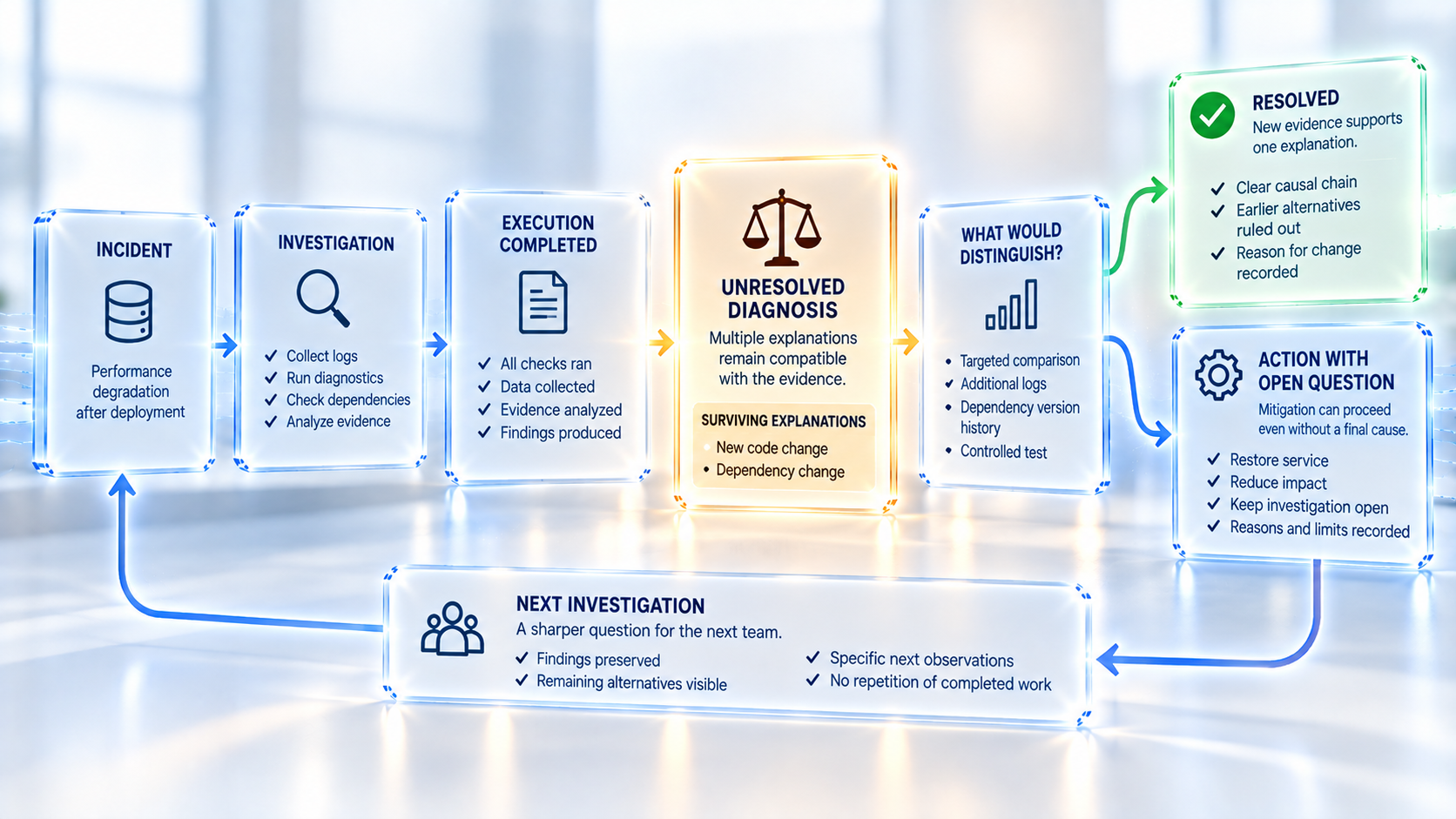
An analysis can execute correctly and still leave several explanations compatible with the evidence. Preserving that uncertainty gives the next investigation a better starting point than a conclusion the record cannot support.
The checks ran; the causes remain
Consider a service that slows down after a deployment. The new code is an obvious suspect, but a dependency changed during the same period. An assistant examines the available logs and completes the requested checks. Suppose the evidence remains compatible with either explanation.
The investigation has produced useful information. It has narrowed the possibilities and established which observations both explanations can account for. Yet choosing one cause would add a distinction that the available record does not justify. A workflow that demands a single cause at this point creates pressure to turn a remaining possibility into a settled diagnosis.
That pressure can disappear into the interface. A completed run receives a green indicator, a cause field receives a value, and the next person encounters a record that looks resolved. The visible certainty came from the format of the return.
Give the open question an explicit status
A useful design separates the execution of an investigation from the status of its conclusion. A query may run successfully while returning evidence that cannot settle the question. The process status tells someone whether the requested work occurred; the conclusion status tells them what that work established.
Execution and resolution need separate states.
An explicit unresolved status can preserve this distinction. Its meaning should be tied to the particular question: the available evidence leaves specified explanations alive, and the investigation has not earned a choice among them. This is more informative than a general low-confidence flag, which may leave the next person guessing what remains uncertain.
An unresolved diagnosis can be the correct result of a completed investigation. The return should make that result visible and explain its scope. A finding about the affected service may be established even while the cause remains open, so preserving uncertainty should also preserve what the analysis did establish.
Leave the next investigator something to use
An unresolved result needs enough substance to support further work. In the service example, that could mean identifying the observations compatible with both causes and the evidence that has already eliminated other explanations. The useful addition is a statement of what would distinguish the surviving explanations. A controlled comparison may help, or the next investigation may need records that the current system does not collect. The question becomes specific enough for someone to decide whether further work is worthwhile.
That record should survive transfer to another person or tool. An unexplained “unknown” forces the investigation to begin again, while a qualified open question preserves the value of the completed work. The handover can carry the unresolved distinction and its supporting evidence without requiring every log entry to travel with it.
Reopening needs an event
An open state should have a reason to change. Running the same analysis again against the same evidence may produce a differently worded explanation while leaving the underlying choice untouched. A longer answer can make the investigation look more developed without making it more discriminating.
More processing may reproduce the same ambiguity.
A useful reopening condition identifies the change that could matter: a new observation, a targeted comparison, or access to a missing record. It can also identify a limit on further investigation. If the next test is impractical or the available work budget is exhausted, the record should retain the reason the question remains open. Administrative completion can coexist with an unresolved diagnosis.
Mitigation can proceed under an unresolved diagnosis.
The team might restore a previous version to reduce disruption while continuing to investigate the dependency. That action may be reasonable under the circumstances, but its operational success would need interpretation: recovery alone may leave the original causal question unanswered. The action record and the diagnostic record should preserve what each event actually established.
Let the final label carry its reason
When new evidence eventually supports one explanation, the transition to a resolved status should be understandable. Someone reviewing the case should be able to identify what changed and why the earlier alternatives no longer have the same standing. That makes closure inspectable rather than merely the last label entered.
Some questions will remain open within the available evidence and resources. Their records can still support useful work by making the limits of the investigation explicit. A future team may obtain the missing observation, or it may decide that the remaining distinction has no practical value for its task.
The benefit of preserving unresolvedness is continuity. Completed work can pass forward with its findings intact, its remaining alternatives visible, and a concrete reason for another inquiry. The next investigator receives a question that has been sharpened by analysis, with room for the evidence to finish the job.
An analysis can execute correctly and still leave several explanations compatible with the evidence. Preserving that uncertainty gives the next investigation a better starting point than a conclusion the record cannot support.
The checks ran; the causes remain
Consider a service that slows down after a deployment. The new code is an obvious suspect, but a dependency changed during the same period. An assistant examines the available logs and completes the requested checks. Suppose the evidence remains compatible with either explanation.
The investigation has produced useful information. It has narrowed the possibilities and established which observations both explanations can account for. Yet choosing one cause would add a distinction that the available record does not justify. A workflow that demands a single cause at this point creates pressure to turn a remaining possibility into a settled diagnosis.
That pressure can disappear into the interface. A completed run receives a green indicator, a cause field receives a value, and the next person encounters a record that looks resolved. The visible certainty came from the format of the return.
Give the open question an explicit status
A useful design separates the execution of an investigation from the status of its conclusion. A query may run successfully while returning evidence that cannot settle the question. The process status tells someone whether the requested work occurred; the conclusion status tells them what that work established.
Execution and resolution need separate states.
An explicit unresolved status can preserve this distinction. Its meaning should be tied to the particular question: the available evidence leaves specified explanations alive, and the investigation has not earned a choice among them. This is more informative than a general low-confidence flag, which may leave the next person guessing what remains uncertain.
An unresolved diagnosis can be the correct result of a completed investigation. The return should make that result visible and explain its scope. A finding about the affected service may be established even while the cause remains open, so preserving uncertainty should also preserve what the analysis did establish.
Leave the next investigator something to use
An unresolved result needs enough substance to support further work. In the service example, that could mean identifying the observations compatible with both causes and the evidence that has already eliminated other explanations. The useful addition is a statement of what would distinguish the surviving explanations. A controlled comparison may help, or the next investigation may need records that the current system does not collect. The question becomes specific enough for someone to decide whether further work is worthwhile.
That record should survive transfer to another person or tool. An unexplained “unknown” forces the investigation to begin again, while a qualified open question preserves the value of the completed work. The handover can carry the unresolved distinction and its supporting evidence without requiring every log entry to travel with it.
Reopening needs an event
An open state should have a reason to change. Running the same analysis again against the same evidence may produce a differently worded explanation while leaving the underlying choice untouched. A longer answer can make the investigation look more developed without making it more discriminating.
More processing may reproduce the same ambiguity.
A useful reopening condition identifies the change that could matter: a new observation, a targeted comparison, or access to a missing record. It can also identify a limit on further investigation. If the next test is impractical or the available work budget is exhausted, the record should retain the reason the question remains open. Administrative completion can coexist with an unresolved diagnosis.
Mitigation can proceed under an unresolved diagnosis.
The team might restore a previous version to reduce disruption while continuing to investigate the dependency. That action may be reasonable under the circumstances, but its operational success would need interpretation: recovery alone may leave the original causal question unanswered. The action record and the diagnostic record should preserve what each event actually established.
Let the final label carry its reason
When new evidence eventually supports one explanation, the transition to a resolved status should be understandable. Someone reviewing the case should be able to identify what changed and why the earlier alternatives no longer have the same standing. That makes closure inspectable rather than merely the last label entered.
Some questions will remain open within the available evidence and resources. Their records can still support useful work by making the limits of the investigation explicit. A future team may obtain the missing observation, or it may decide that the remaining distinction has no practical value for its task.
The benefit of preserving unresolvedness is continuity. Completed work can pass forward with its findings intact, its remaining alternatives visible, and a concrete reason for another inquiry. The next investigator receives a question that has been sharpened by analysis, with room for the evidence to finish the job.
— © 2026 Rogério Figurelli. This article is licensed under the Creative Commons Attribution 4.0 International (CC BY 4.0). You are free to share and adapt this material for any purpose, even commercially, provided that appropriate credit is given to the author and the source. This work was human-directed and AI-assisted, produced with Trajecta Wisdom Machine.