
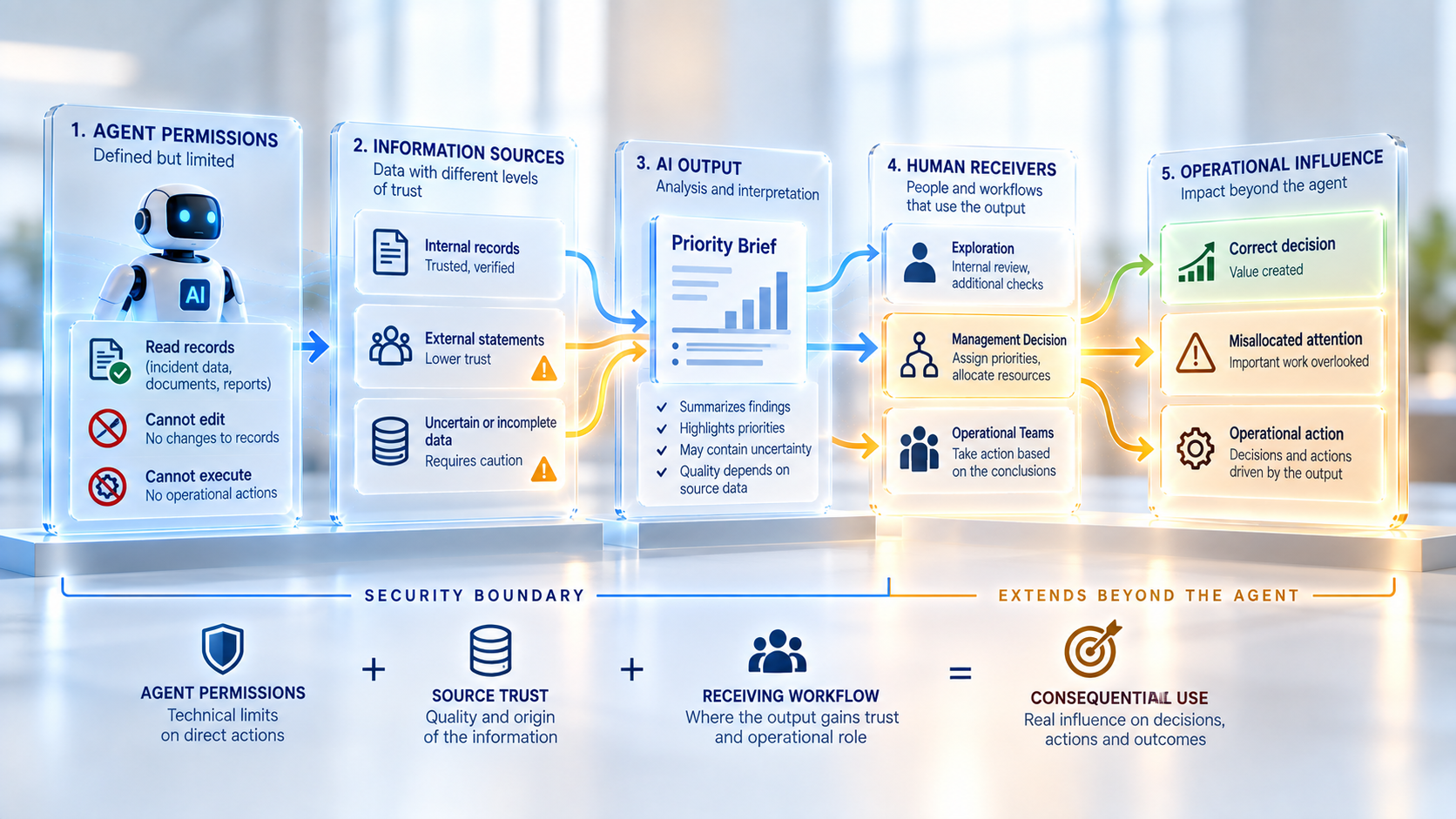
An AI system’s permissions describe part of its reach. Its outputs can gain operational influence through the people and workflows that receive them.
Read access can lead to operational influence
Imagine an AI assistant that reads incident records and prepares a priority brief. It cannot edit the records or execute operational actions. A manager uses its report to allocate the team’s attention.
Now suppose a source record contains a misleading account of an unresolved issue. If the assistant presents that account as a reliable conclusion, its report could steer attention away from work that needs investigation. The assistant has stayed within its access rights, while the information it carries has affected an operational decision.
Its influence travels through the people who use its output.
Read-only access still provides a meaningful restriction. It limits what the assistant can change directly and reduces the exposure created by execution privileges. A security review should also examine where its conclusions go and what those conclusions can cause recipients to do.
Trust at the destination changes the reach
The same report can have different consequences in different settings. In one, it is a working draft checked against the original records. In another, it becomes the accepted basis for assigning priorities. The assistant’s permissions may be identical across both settings, while its practical influence differs substantially.
The consequential transition occurs where an interpretation becomes an operating assumption. At that point, the surrounding process gives the output a role in decisions. Understanding that transition helps locate where source uncertainty should remain visible and where additional review may be needed.
The receiver is part of the security design.
For an assistant assessing supplier documents, this means examining how its conclusions enter the assessment process. A statement supplied by the organization being assessed may deserve a different level of trust from independently established evidence. If the assistant compresses those distinctions away, a polished summary can make an unsupported claim easier to accept.
A trusted output can carry influence that the agent’s account never held.
Make consequential use explicit
A practical security review can trace the routes through which generated content reaches decisions. It should identify where an output acquires trust, what actions it can influence, and which material consequences require further examination. This brings the receiving workflow into the security boundary.
The findings should affect the design. A report used for exploration can retain a different role from one used to direct operational work. Where conclusions carry greater consequences, the process may require access to supporting evidence and explicit approval before action. The organization can then constrain the use of the output alongside the agent’s technical permissions.
People remain responsible for the decisions they make. The architecture should help them recognize uncertainty and inspect the grounds of consequential recommendations. The scope of trusted use should remain visible.
That scope can expand without any change to the agent’s account. Forwarding a report to a wider audience or placing it inside an established decision process may create new routes of influence. Those changes deserve examination because they alter how far an error or manipulated source could travel.
Every consequential use needs an accountable destination.
— © 2026 Rogério Figurelli. This article is licensed under the Creative Commons Attribution 4.0 International (CC BY 4.0). You are free to share and adapt this material for any purpose, even commercially, provided that appropriate credit is given to the author and the source. This work was human-directed and AI-assisted, produced with Trajecta Wisdom Machine.